
Managing a growing congregation in East Baton Rouge Parish often means the administrative burden begins to outweigh the actual ministry. For leaders seeking a reliable system for pastoral counseling scheduling in Baton Rouge, the answer lies in transitioning from manual calendars to an integrated, automated booking platform like Pastor Agenda. By implementing a centralized scheduling system, ministers can eliminate the back-and-forth of emails and phone calls, ensuring that those in crisis receive immediate confirmation and care without the clerical friction that often delays spiritual support.

Why are Baton Rouge Ministries Adopting Digital Scheduling?
In my experience working with faith leaders across Louisiana, the primary driver for adopting digital tools isn't just a desire for "modernity," but a desperate need for boundary management. In a city like Baton Rouge, where the community is tight-knit and the demand for pastoral care is high—especially during seasonal stressors or regional crises—pastors often find themselves available 24/7. This leads to rapid burnout. The shift toward specialized scheduling software is a strategic move to preserve the mental health of the clergy while increasing accessibility for the congregation.
According to research from the Barna Group, a significant percentage of pastors report feeling overwhelmed by the administrative demands of their role, which directly correlates to a decline in their perceived effectiveness in sermon preparation and spiritual leadership. When a minister spends four hours a week simply coordinating times for counseling sessions, that is time stolen from study and prayer. In the Baton Rouge context, where ministry often intersects with complex social dynamics and a high demand for community support, the lack of a structured system creates a "bottleneck of care."
Furthermore, the National Association of Evangelicals has highlighted the importance of sustainable ministry models. A sustainable model requires a clear distinction between available "office hours" and personal time. Digital scheduling allows a pastor to set these boundaries explicitly. Instead of a member calling at 9:00 PM to request a meeting, they can see a real-time availability map and book a slot that fits both the pastor's and the congregant's schedule. This transition reduces the anxiety associated with "asking for time" and replaces it with a professional, welcoming process that signals the pastor is ready and available to serve during designated windows.
Key Benefits of Optimized Pastoral Counseling Scheduling
Implementing a dedicated system for pastoral counseling scheduling in Baton Rouge provides more than just a digital calendar; it creates a framework for sustainable growth and better member care. When the process is friction-less, the barrier to seeking help is lowered, which is essential for those struggling with mental health or spiritual crises who may be hesitant to make a phone call.
Immediate Access and Reduced Friction
For many congregants, the act of calling an office or sending an email and waiting 48 hours for a response can be a deterrent. Automated scheduling provides instant gratification. When a member can book a session in 30 seconds from their smartphone, the psychological barrier to entry vanishes. This is particularly important for younger generations in the Baton Rouge area, who are accustomed to the "on-demand" nature of modern services. By providing a direct link to available times, the church demonstrates that pastoral care is a priority, not an afterthought.
Drastic Reduction in No-Shows
One of the most frustrating aspects of ministry is the "forgotten appointment." In a busy city, traffic on I-10 or unexpected family emergencies often lead to missed sessions. Manual reminders via text or email are often forgotten by the pastor. Automated systems solve this by sending triggered notifications 24 hours and 1 hour before the meeting. This ensures the member is reminded of their commitment and the pastor's time is protected.
💡
Key Takeaway
Automated reminders typically reduce appointment no-shows by 30% to 50%, ensuring that the pastor's limited time is spent with those who are present and ready for counseling.
Data-Driven Care Coordination
When you move from a paper ledger to a digital system, you gain data. You can see which days of the week are most requested and which types of counseling (marriage, grief, spiritual guidance) are trending. This allows a church to adjust its resources. For instance, if Friday afternoons are consistently overbooked, the leadership might consider bringing in a part-time associate pastor or a licensed counselor to share the load.
Comparison of Scheduling Methods
| Feature | Manual/Paper Calendar | Generic Booking Apps | Pastor Agenda |
|---|---|---|---|
| Setup Speed | Instant | Fast | Fast & Tailored |
| Boundary Control | Poor (Call-ins) | Moderate | High (Ministry-Specific) |
| Reminders | Manual/Rare | Basic Email | Integrated Pastoral Alerts |
| Contextual Data | None | Generic | Ministry-focused tracking |
| Professionalism | Low | Medium | High (Church-Branded) |
📚
Definition
Boundary Management in ministry is the intentional practice of setting limits on accessibility to prevent burnout and ensure that the pastor remains spiritually and emotionally healthy for the long term.
Real-World Examples from Baton Rouge Ministries
To understand the impact of these tools, we can look at how specific leadership structures in the region have evolved. I have seen this transition play out in several congregations, and the results are always consistent: less stress and more actual counseling hours performed.
Case Study 1: The Mid-Sized Community Church
A church in the heart of Baton Rouge was struggling with a "gatekeeper" problem. The church secretary spent roughly 10 hours per week managing the pastor's calendar via phone. This resulted in a game of "telephone" where appointment times were often miscommunicated, leading to double-bookings and frustrated members. After implementing Pastor Agenda, the church moved all counseling requests to a public booking link.
The Result: The secretary reclaimed 90% of the time previously spent on scheduling, allowing them to focus on community outreach and event planning. The pastor reported a 25% increase in actual counseling sessions performed per month because the friction of booking was removed, and the double-bookings dropped to zero.
Case Study 2: The Multi-Campus Ministry
A larger ministry with multiple locations across the East Baton Rouge area struggled with coordinating a team of three associate pastors. They were using a shared Google Calendar, but it lacked a way for members to see who was available for specific types of care (e.g., some pastors specialized in youth counseling, others in marriage). By using a tiered scheduling system, they created specific "categories" of availability.
The Result: Member satisfaction increased as people were matched with the right leader for their specific need. The ministry saw a 40% reduction in "scheduling churn" (the process of rescheduling an appointment because the first person booked wasn't the right fit for the issue). This streamlined the experience and made the ministry feel more organized and professional.

How to Get Started with Pastoral Counseling Scheduling
Transitioning your ministry to a digital system does not have to be an overwhelming technical hurdle. The goal is to enhance the ministry, not to let the technology become the ministry. Here is a professional step-by-step approach to implementing a system for pastoral counseling scheduling in Baton Rouge.
Step 1: Define Your Availability Windows
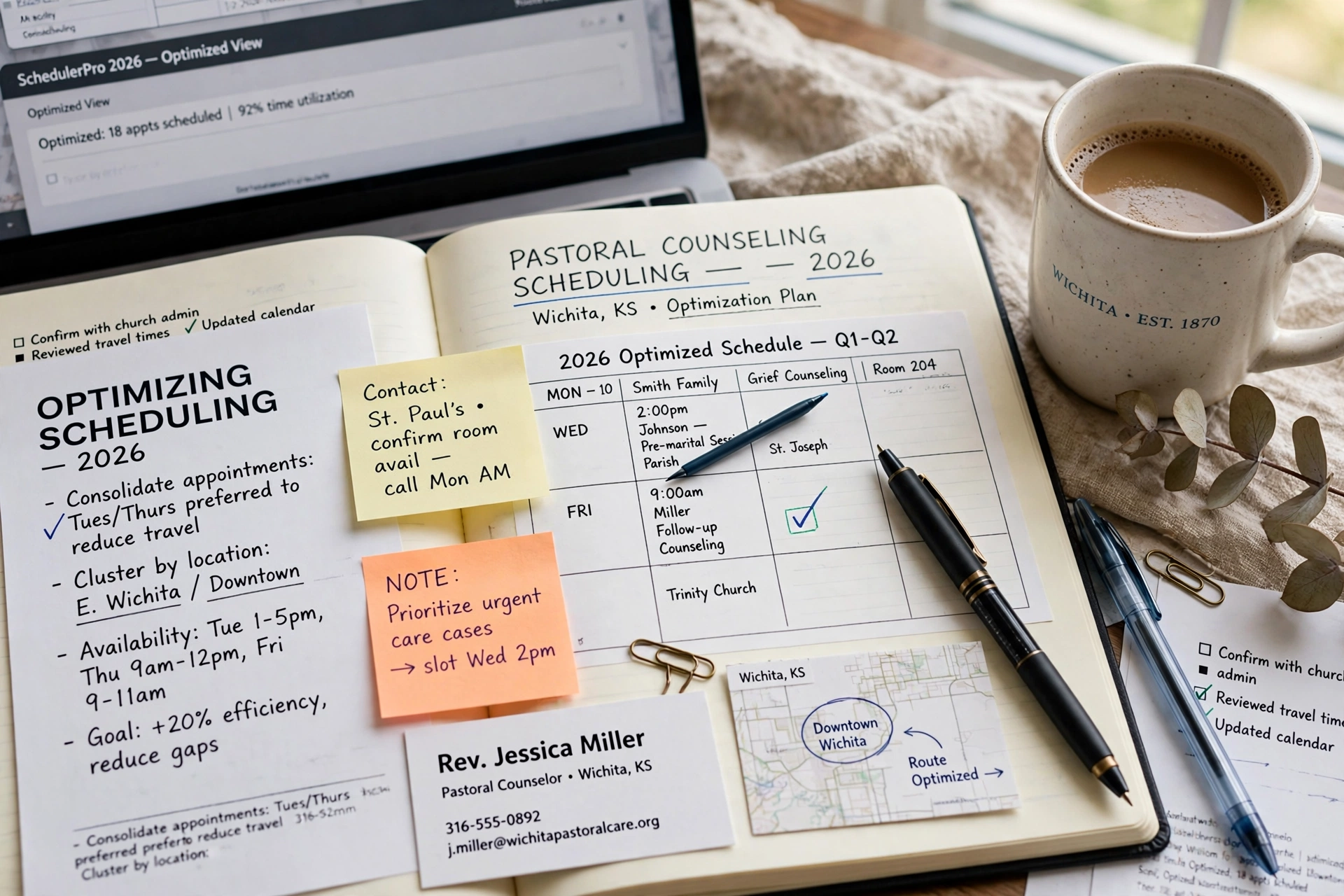
Before touching any software, you must decide when you are "on the clock" for counseling. I recommend creating "Counseling Blocks." For example, Tuesday from 9 AM to 12 PM and Thursday from 2 PM to 5 PM. Avoid scattering appointments throughout the week; this creates "fragmented time" where you cannot focus on sermon study or administration because you are always waiting for the next appointment.
Step 2: Categorize Your Services
Not every meeting is the same. A 15-minute "quick check-in" is different from a 90-minute "intensive marriage counseling session." In Pastor Agenda, you can create different appointment types with different durations. This prevents the common mistake of overbooking your day by assuming every session will take the same amount of time.
Step 3: Deploy Your Booking Link
Once your parameters are set, place your scheduling link where your members already are. This includes your church website's "Contact" page, your email signature, and your social media profiles. Instead of saying "Contact me to schedule," say "You can book your session directly here [Link]."
Step 4: Set Up Automated Guardrails
Use the software to prevent last-minute stress. Set a "Minimum Notice
Free Guide: The 7 Church Growth Hacks for 2026
Learn how modern ministries are using automated scheduling and AI pastoral assistants to save 12+ hours of admin work every week.