Why a Church Calendar App is a Strategic Necessity in 2026
Managing a growing congregation without a centralized system is like trying to navigate a city without a map: you might eventually get to your destination, but you will waste an immense amount of time and energy doing it. For most ministries, the shift to a dedicated church calendar app is not about "going digital" for the sake of technology, but about reclaiming hours of administrative labor that currently bleed into the personal time of pastors and staff. The direct answer to whether such a tool is worth it is yes, specifically because it eliminates the "scheduling friction" that prevents members from engaging in ministry and causes burnout among clergy.
In my experience working with dozens of faith leaders, the most common point of failure isn't a lack of vision or passion, but the collapse of the administrative backbone. I have seen ministries struggle with overlapping room bookings and missed counseling appointments simply because they relied on a shared physical planner or a fragmented series of Google Calendar invites. When the infrastructure of a church fails to scale, the spiritual mission suffers.

What Exactly Is a Digital Ministry Schedule?
To understand the value, we must first establish what we are talking about. A specialized tool for religious organizations differs significantly from a generic consumer calendar. While a standard app tracks dates, a dedicated system manages the intersection of people, spaces, and spiritual priorities.
📚
Definition
A church calendar app is a specialized management ecosystem designed to synchronize liturgical dates, facility usage, pastoral appointments, and volunteer rotations into a single, accessible source of truth for both leadership and the congregation.
The core function of these tools is the reduction of "cognitive load." When a pastor has to remember that the youth group is using the fellowship hall on Tuesday while the choir is practicing in the sanctuary, they are using mental energy that should be spent on sermon preparation and pastoral care. By offloading this to a digital system, the leadership can move from a reactive state (fixing scheduling conflicts) to a proactive state (planning for growth).
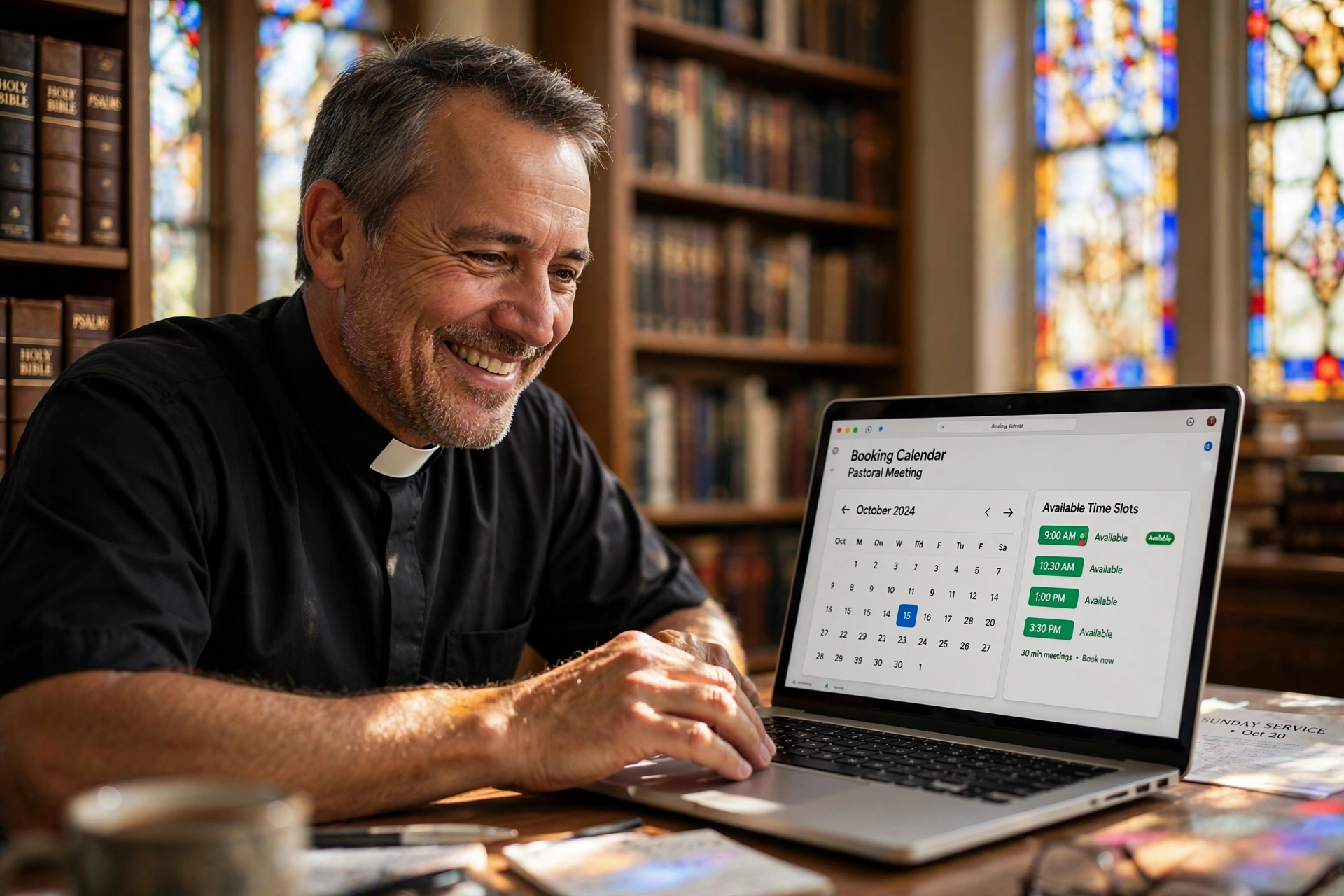
According to research from the Barna Group, pastoral burnout is often linked to the blurring of boundaries between professional duties and personal life. A digital scheduling system creates a hard boundary by automating the booking process. Instead of a pastor spending their Saturday afternoon answering texts to set up a counseling session, the system handles the availability and confirmation, leaving the pastor to focus on the actual care of the soul.
Why Digital Scheduling Matters for Congregational Growth
The cost of not adopting a modern scheduling system is rarely a sudden crash; it is a slow erosion of efficiency. When a church relies on manual spreadsheets or verbal agreements, "scheduling leaks" occur. These leaks manifest as double-booked rooms, forgotten volunteer shifts, and members who feel disconnected because they didn't know about an event until it was already over.
From a data perspective, the impact of friction on engagement is measurable. In the broader business world, the Harvard Business Review has consistently highlighted that reducing friction in the "user journey" (in this case, the member's journey) directly correlates with higher retention and participation rates. If a member has to call three different people just to find out when the next Bible study starts, they are significantly less likely to attend.
The consequences of remaining manual are severe:
- Leadership Exhaustion: The pastor becomes the "human switchboard," spending more time on logistics than on ministry.
- Volunteer Attrition: Volunteers who feel disorganized or are given conflicting schedules quickly lose motivation.
- Facility Waste: Large church buildings often have underutilized spaces simply because there is no transparent way for ministries to see when a room is free.
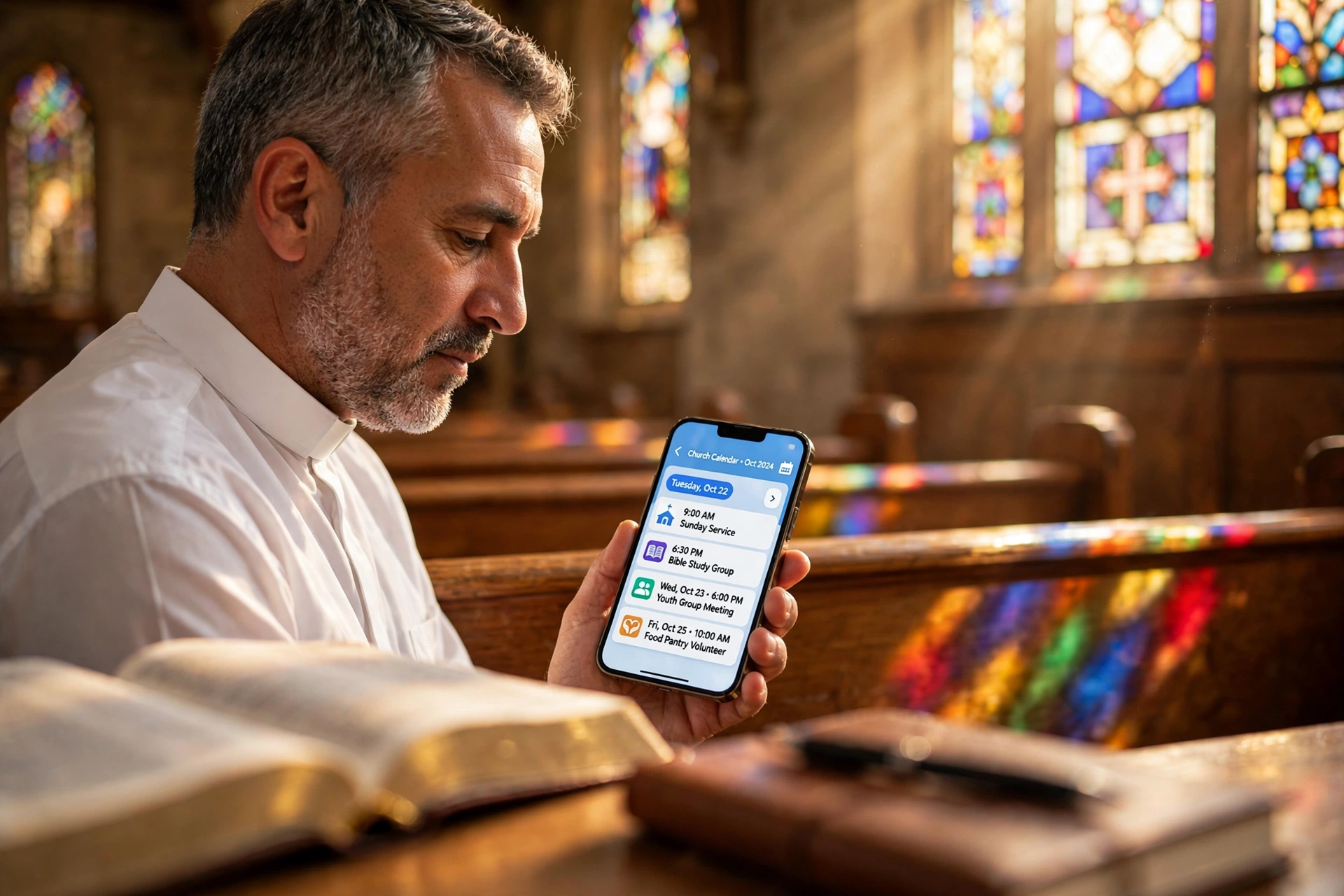
The transition to a church calendar app turns the calendar from a static list of dates into a dynamic engagement tool. When members can see a real-time updated schedule, the barrier to entry for participating in a new ministry is lowered. This is not about "efficiency" in a corporate sense, but about stewardship of the church's most precious resource: time.
Practical Application: Implementing a Scheduling System
Moving from a paper-based or fragmented system to a professional platform requires a strategic approach. You cannot simply "turn on" an app and expect the culture to shift. The process must be intentional.
First, conduct a facility audit. Map out every room, their capacities, and their primary uses. This prevents the common mistake of overbooking the sanctuary for a small meeting when a classroom would suffice. Second, define your "availability windows." Pastors should not be accessible 24/7; instead, they should set specific blocks for pastoral counseling and administrative work.
This is where Pastor Agenda excels. Unlike generic tools, it is built specifically for the rhythms of ministry. It allows for the creation of specific booking types, such as "Emergency Pastoral Care," "New Member Orientation," or "Wedding Consultation", each with its own duration and requirements. This ensures that the pastor's time is categorized and protected.

The implementation process generally follows these steps:
- Centralization: Move all disparate calendars (Google, Outlook, Paper) into one master system.
- Permission Mapping: Assign roles. Only the administrator should be able to book the sanctuary, while ministry leaders can book classrooms.
- Public Integration: Sync the internal calendar with the church website and social media feeds so the congregation has instant access.
- Automation: Set up automated reminders. A member who receives a text reminder 24 hours before their appointment is 40% more likely to attend than one who relies on their own memory.
💡
Key Takeaway
The goal of a scheduling system is not to replace human interaction, but to remove the administrative hurdles that stand in the way of it.
Choosing the Right Tool: Professional vs. Generic
Many churches make the mistake of using a free, generic calendar app. While these are useful for personal tasks, they fail in a ministry environment because they lack "contextual intelligence." A generic app doesn't know that a "Youth Night" requires a sound technician, a janitor, and three chaperones.
| Feature | Traditional Manual Method | Generic AI/Free Apps | Pastor Agenda Approach |
|---|---|---|---|
| Coordination | Slow, phone-call based | Faster, but fragmented | Instant and centralized |
| Conflict Resolution | High risk of double-booking | Manual check required | Automatic conflict blocking |
| User Experience | High friction for members | Moderate; often confusing | Low friction; tailored for members |
| Pastoral Boundaries | Non-existent; constant texts | Basic time-blocking | Strategic availability windows |
| Best For | Tiny, single-room chapels | Individual freelancers | Growing, multi-ministry churches |
Generic tools often lead to "notification fatigue." Because they are not designed for the specific hierarchy of a church, everyone gets notified about everything. A professional system filters information so that the worship leader sees the rehearsal schedule, while the deacon sees the visitation list, and the congregation sees the public events.
Common Misconceptions About Digital Calendars
There is a persistent myth in some religious circles that moving to a digital system is "too corporate" or "unspiritual." This is a fundamental misunderstanding of stewardship. Using a church calendar app is no different from using a tractor instead of a hand-plow; the tool changes, but the purpose (feeding the flock) remains the same.
Another common misconception is that these tools are only for "mega-churches." In reality, small to mid-sized churches benefit the most. In a small church, the pastor often wears five different hats. When the pastor is also the administrator, the facilities manager, and the treasurer, the risk of a scheduling error is significantly higher. A digital system acts as a virtual assistant, handling the rote tasks of confirmation and reminders.
Most guides get this wrong by suggesting that "simplicity is always better." While a simple list is easy to create, it is difficult to maintain. A digital system may have a steeper initial learning curve, but the long-term maintenance is significantly lower. The "simple" way of doing things, texting a date back and forth, actually creates more work because it requires constant manual confirmation.
Frequently Asked Questions
Does a church calendar app replace the need for a church secretary?
No, it transforms the role of the secretary from a "gatekeeper" to a "coordinator." Instead of spending eight hours a day answering phones to schedule appointments, the secretary can focus on member care, outreach, and strategic support. The software handles the transactional part of scheduling, allowing the staff to focus on the relational part of ministry. This shift actually improves the quality of the staff's work by removing the repetitive, stressful tasks of conflict resolution.
Will our older members struggle to use a digital scheduling system?
This is a common fear, but the data shows that "user-friendly" interfaces actually help older populations more than manual systems. When a link is sent via text or email, a member simply clicks a button to confirm their appointment. This is far easier than searching for a phone number, leaving a voicemail, and waiting for a callback. The key is to provide a "hybrid" transition period where staff helps members set up the system for the first time.
How does this help with pastoral burnout?
Burnout is often caused by the "death by a thousand cuts" phenomenon, where constant, unplanned interruptions erode a pastor's mental space. By using a system like Pastor Agenda, the pastor can set "deep work" blocks for study and prayer that are completely blocked off from public booking. When boundaries are enforced by a system, the pastor is no longer the "bad guy" for saying no; the system simply shows the time is unavailable, preserving the pastor's spiritual and emotional health.
Is it expensive to implement these systems?
The cost of the software is negligible when compared to the cost of administrative errors. A single double-booked event can lead to wasted rental fees, frustrated volunteers, and a public image of disorganization. When you calculate the hours a pastor spends managing a calendar manually, the ROI of a professional tool is usually realized within the first month. Most professional systems are priced as a monthly subscription that is a fraction of the cost of a part-time administrative assistant.
Can we manage volunteer rotations through these apps?
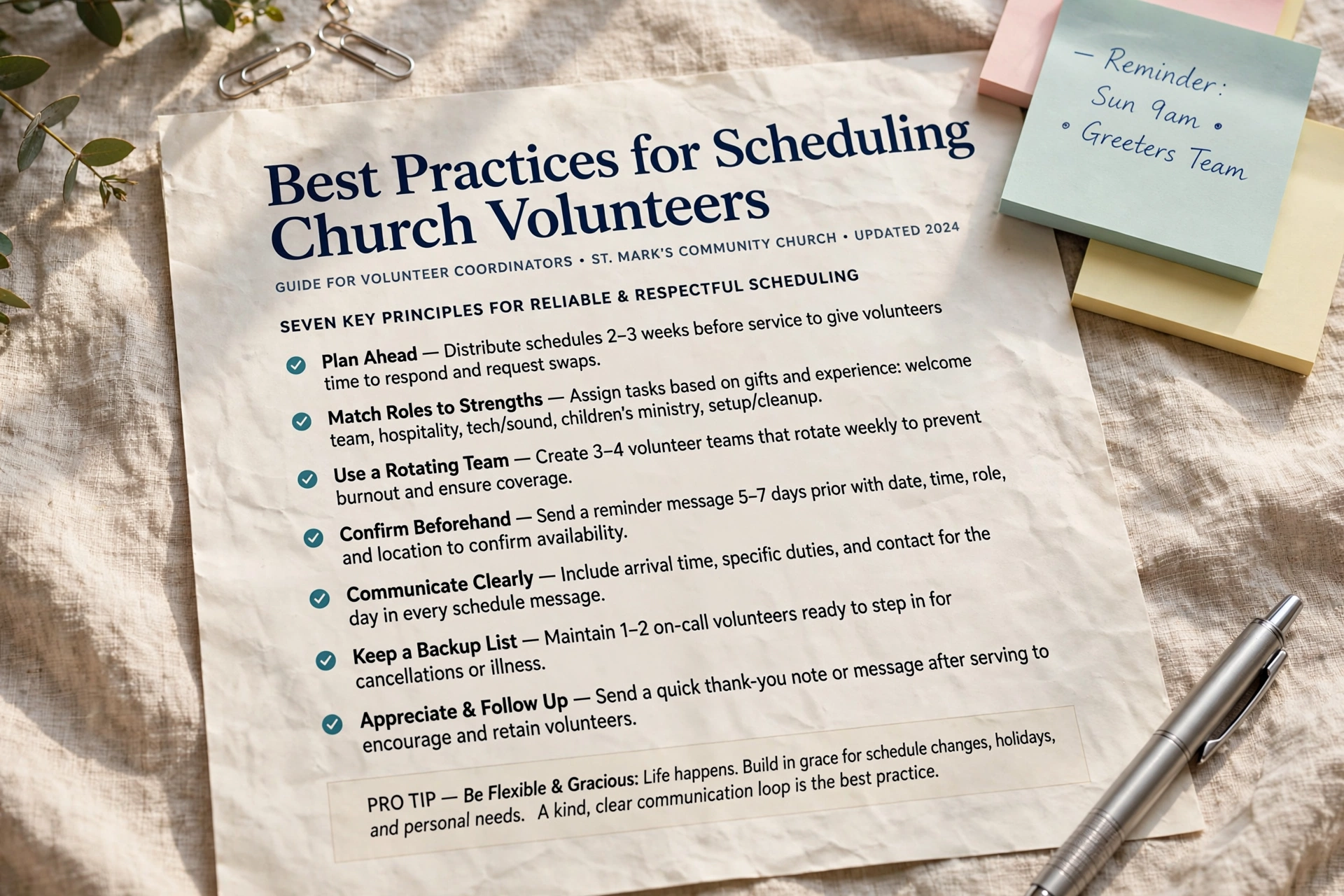
Yes, and this is one of the most powerful use cases. Instead of a messy email chain for the nursery or the greeting team, the calendar allows volunteers to sign up for specific slots. This creates a visual representation of where the gaps are in the ministry. When volunteers can see the "empty holes" in the schedule, they are more likely to step up and fill them, moving the culture from "waiting to be asked" to "proactively serving."
Final Thoughts on Modernizing Your Ministry
The decision to implement a church calendar app is ultimately a decision about how you value your leadership's time. In a world where the demands on a minister's attention are constant, the only way to protect the "sacred space" for prayer and study is to automate the "secular space" of administration. By removing the friction of scheduling, you are not just buying software; you are buying back hours of your life.
For those ready to move from the chaos of manual tracking to the clarity of a professional system, PastorAgenda Blog provides the exact infrastructure needed to scale a ministry without sacrificing the pastor's well-being. The investment in a dedicated tool today prevents the administrative collapse of tomorrow.
Recommended Readings
To deepen your understanding of these topics, we recommend reading the following articles:
- Ensuring Absolute Privacy in Church Booking Systems
- Church Appointment Booking
- Online Appointment Booking for Modern Churches
- Automated Reminders and Communication for Congregations
Free Guide: The 7 Church Growth Hacks for 2026
Learn how modern ministries are using automated scheduling and AI pastoral assistants to save 12+ hours of admin work every week.