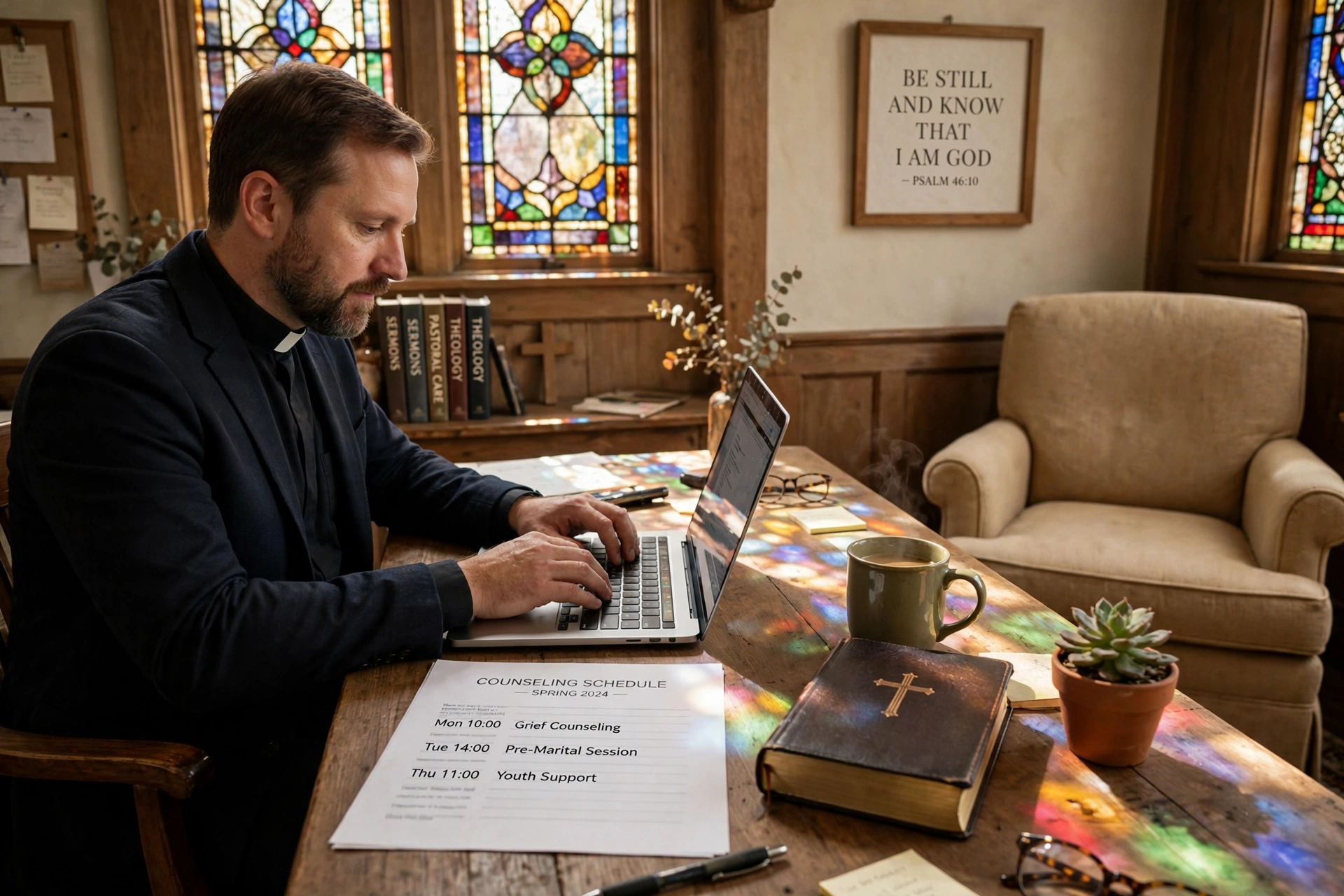
Balancing Spiritual Care with Administrative Security
In my experience working with senior ministers, the most dangerous point of failure in a church's care ministry isn't a lack of compassion, but a lack of structure. When a pastor manages their calendar via text messages, sticky notes, or an open shared Google Calendar, they aren't just risking a double-booked afternoon; they are risking the privacy of a soul in crisis. I've seen firsthand how a misplaced appointment notification on a shared office screen can breach a member's trust instantly, creating a ripple effect of damage that takes years to repair.
For a comprehensive overview of this system, explore our guide on pastoral counseling scheduling. The challenge in 2026 is that the demand for mental health support within the congregation has surged, while the boundaries of the pastor's personal life have shrunk. Without a dedicated system, the pastor becomes the bottleneck, and the quality of care suffers because the administrative friction is too high.

What is Pastoral Counseling Scheduling?
📚
Definition
Pastoral counseling scheduling is the systematic process of coordinating, allocating, and documenting time slots for spiritual guidance and emotional support sessions while maintaining strict boundaries and confidentiality protocols.
Pastoral counseling scheduling is not merely the act of putting a name on a calendar. In a professional ministry context, it is a strategic gatekeeping mechanism. It involves the intersection of availability management, intake screening, and privacy protection. When we talk about "scheduling" in a church context, we are referring to the entire lifecycle of an appointment: from the initial request for help to the final documentation of the meeting.
Effective scheduling ensures that the pastor is not overwhelmed by an unplanned influx of crises. It allows for the implementation of "buffer zones", essential periods of reflection and prayer between sessions so that the minister does not carry the emotional weight of one session into the next. In 2026, this process has moved away from manual ledger books and toward digital ecosystems that can automate reminders while encrypting sensitive data.
Key Takeaway: Professional scheduling transforms pastoral care from a reactive, chaotic struggle into a proactive, sustainable ministry that protects both the shepherd and the sheep.
Why Does Professional Scheduling Matter for Your Ministry?
Pastoral counseling is a high-stakes environment. Unlike a general business appointment, a counseling session often involves deep trauma, marital collapse, or spiritual warfare. If the scheduling process is sloppy, it signals to the congregant that their privacy is not a priority.
According to Barna Group, pastoral burnout is at an all-time high, often driven by the "always-on" expectation of accessibility. When a pastor allows their scheduling to be handled via uncontrolled channels, they are essentially inviting burnout. A structured system creates a professional boundary that actually increases the quality of care. When the congregant knows there is a specific time and place for their session, they feel more secure, and the pastor can be fully present rather than distracted by the next looming request.
Furthermore, the legal and ethical implications are significant. While clergy-penitent privilege is a strong tradition, the administrative handling of that data is where risks emerge. Church Law & Tax emphasizes that governance and administrative compliance are essential to protect the organization from liability. If a scheduling system lacks security, the church is vulnerable to data breaches that could expose the private struggles of its members.
The Impact on Congregation Trust
Trust is the primary currency of the church. If a member discovers that their appointment for "divorce counseling" was visible to the church secretary or a volunteer on a public calendar, the trust is broken. A secure scheduling system ensures that only the necessary parties see the appointment, and even then, the labels are often generic (e.g. "Pastoral Meeting") rather than descriptive.
Operational Efficiency
When using a tool like Pastor Agenda, the administrative load is shifted. Instead of a four-way text thread to find a time that works, the congregant selects a pre-approved slot. This removes the "decision fatigue" for the pastor and ensures that the appointment is locked in without back-and-forth communication that can often lead to missed meetings or scheduling conflicts.
How to Implement a Safe Pastoral Counseling Workflow
Implementing a safe workflow requires a shift from a "come as you are" mentality to a "structured access" model. This does not mean being uncaring; it means being professional so that the care is sustainable.
Step 1: Define Your Availability Windows
Stop treating every hour of your day as a potential counseling slot. Establish specific "Counseling Blocks." For example, Tuesday afternoons from 2:00 PM to 5:00 PM. By restricting the availability, you protect your time for sermon preparation and family, and you create a sense of intentionality for the person booking the appointment.
Step 2: Establish a Secure Intake Process
Never schedule a session without basic context. A safe workflow includes a brief intake form. This allows the pastor to determine if the person is in a crisis that requires a professional psychologist or a hospital rather than pastoral care. This is a critical safety step. If someone mentions self-harm in an intake form, the response must be immediate and different from a standard scheduling confirmation.
For a deeper dive into this, see our guide on how to manage church counseling intake forms and calendars securely.
Step 3: Automate Reminders and Confirmations
No-shows are a waste of a minister's emotional energy. Automated reminders ensure the congregant remembers the appointment, but these reminders must be discreet. Avoid using subject lines like "Reminder: Your Counseling Session." Instead, use "Reminder: Meeting with Pastor [Name]."
Step 4: Implement a Post-Session Documentation Protocol
Scheduling doesn't end when the meeting does. A professional workflow includes a designated time immediately following the session to jot down key points and follow-up actions. If this is integrated into the scheduling software, the record is kept in one secure place rather than in scattered notebooks.
Step 5: Audit Access Permissions
Regularly review who has access to the counseling calendar. In many churches, too many people have "editor" or "viewer" access to the pastor's calendar. Limit this to the pastor and perhaps one highly trusted administrative assistant, ensuring that the detailed notes are restricted even further.
Scheduling Approaches: Comparison Table
Not all systems are created equal. Many churches try to adapt business tools for spiritual work, which often leads to failure.
| Feature | Traditional Manual Approach | Generic AI/Cheap Scheduler | The Pastor Agenda Approach |
|---|---|---|---|
| Privacy | Low (Physical books, open calendars) | Medium (Cloud-based but generic) | High (Designed for clergy confidentiality) |
| Boundary Setting | Non-existent (Text/Call anytime) | Rigid (Standard business hours) | Flexible (Custom ministry blocks) |
| Intake Quality | None (Ad-hoc conversations) | Basic (Generic form fields) | Specialized (Ministry-focused intake) |
| Mental Load | Extreme (Manual coordination) | Moderate (Some automation) | Low (Fully streamlined workflow) |
| Security | Paper-based risks | General cloud security | Encrypted, role-based access |

Common Mistakes in Pastoral Counseling Scheduling
After analyzing dozens of church administrative failures, the patterns are clear. Most mistakes stem from a desire to be "too helpful," which ironically leads to a breakdown in care.
The "Open Door" Fallacy
Many pastors believe that having an open-door policy is the most biblical approach. While being available is a virtue, an unstructured open door leads to interrupted sermon prep and rushed counseling sessions. When a session is squeezed into a 15-minute window because another appointment is starting, the congregant feels unimportant. The solution is to transition from "always available" to "intentionally available."
Over-Reliance on Third-Party Chat Apps
Using WhatsApp or Facebook Messenger for scheduling is a security nightmare. These platforms are not designed for the level of confidentiality required in pastoral care. Information can be easily forwarded, screenshotted, or leaked. By moving the scheduling to a secure platform like Pastor Agenda, you move the conversation into a protected environment.
Neglecting the "Cool-Down" Period
One of the most common errors I see is scheduling appointments back-to-back. A session dealing with grief or trauma requires a mental transition. If you have a 2:00 PM session with a grieving widow and a 3:00 PM session with a complaining deacon, the transition is jarring. Always build in a 15-to-30 minute buffer. This is where you pray, reset your mind, and document the previous meeting.
Failing to Distinguish Between "Meeting" and "Counseling"
Not every meeting with a pastor is a counseling session. Mixing general administrative meetings (e.g. discussing the new roof) with deep soul care on the same calendar without clear labeling can lead to confusion. It also makes it harder to track how much time is actually being spent on pastoral care versus administration.
Lack of Exit Strategy/Referral Path
Pastors are not licensed therapists. A major scheduling mistake is keeping a person on the pastoral calendar for months when they clearly need professional clinical help. A safe scheduling workflow includes a "Referral Trigger." If a person has had X number of sessions without progress, the system should prompt the pastor to provide a referral to a licensed professional.
Advanced Strategies for High-Growth Ministries
As a church grows, the pressure on the lead pastor's calendar increases exponentially. To maintain safety and quality, you must move toward a distributed care model.
Implementing Tiered Scheduling
Not every care need requires the lead pastor. Create a tiered system where initial meetings are scheduled with associate pastors or trained elders. If the situation requires a higher level of authority or specific expertise, the appointment is then escalated to the lead pastor. This prevents the lead pastor from becoming a bottleneck and empowers other leaders in the church.
Utilizing-Siloed Calendars
Avoid having one giant calendar for everything. Create specific silos for different types of care. For example, one calendar for marriage counseling and another for spiritual direction. This allows for better reporting and ensures that if a specific team member is helping with marriage care, they only have access to that specific silo of information.
Integrating Digital Intake with Scheduling
To further reduce friction, integrate your intake forms directly with your booking tool. When a person selects a time, they are immediately prompted to fill out the required fields. This ensures that by the time the pastor opens their calendar for the day, they have a full brief on every person they are seeing, eliminating the need for awkward "remind me why we are meeting" conversations at the start of the session.
For more on this, explore our guide on setting up confident and private pastoral counseling workflows.
The ROI of Structured Scheduling in Ministry
While we don't often talk about "Return on Investment" in a spiritual context, the investment in a tool like Pastor Agenda yields massive dividends in terms of human capital.
Reduction in Ministerial Burnout
When a pastor regains 5-10 hours a week by eliminating manual scheduling and reducing no-shows, that time goes back into study, prayer, and family. A healthy pastor is a more effective pastor. The cost of a scheduling tool is negligible compared to the cost of a pastor taking a six-month sabbatical due to total emotional collapse.
Increased Member Satisfaction
Congregants in 2026 expect a level of professionalism in their interactions. When they can book a session easily and receive a discreet confirmation, they feel valued. It removes the anxiety of "bothering" the pastor and replaces it with a clear, approved path to receiving care.
Legal and Ethical Safeguards
By using a system that prioritizes confidentiality, the church reduces its risk of litigation and membership loss due to privacy breaches. According to National Association of Evangelicals (NAE), maintaining high standards of ministerial ethics is fundamental to the credibility of the evangelical church. A secure digital footprint is part of those ethics.
Frequently Asked Questions
Is it biblical to use a scheduling software for pastoral care?
Yes. Stewardship is a biblical principle, and that includes the stewardship of time. By using a tool to organize appointments, you are not removing the Spirit's lead; you are removing the administrative chaos that hinders the Spirit's work. It allows the pastor to be fully present with the person in front of them, rather than worrying about who else is waiting or if a meeting was missed. Professionalism in administration supports the sanctity of the pastoral encounter.
How do I handle emergency counseling requests in a scheduled system?
A scheduled system is for routine care, not for acute crises. You should maintain a clear "Emergency Protocol" listed on your booking page. For example, "If you are experiencing a life-threatening crisis, please call 988 or go to the nearest emergency room." For urgent pastoral needs, provide a specific phone number or a "Request Urgent Call" button that alerts the pastor via a different channel than the standard booking system.
Will my congregants feel that a digital system is too "corporate"?
On the contrary, most people find a clear system more comforting. The ambiguity of "I'll try to find a time and get back to you" creates anxiety for the person in need. A digital system provides a definitive answer and a guaranteed slot. The key is in the language used. Instead of "Book an Appointment," use "Schedule a Time for Care." The tool is the engine, but the pastoral heart is the driver.
How do I ensure that the secretary doesn't see private notes?
This is achieved through role-based access control (RBAC). In a professional system like Pastor Agenda, you can grant a secretary access to the time and date of the appointment (to manage the office calendar) without giving them access to the intake notes or session summaries. This separation of data is the only way to ensure true confidentiality in a church office environment.
What should I include in a pastoral counseling intake form?
Your form should be concise but targeted. Include the person's name, contact info, the general nature of the request (e.g. marriage, grief, spiritual doubt), and a question asking if they have previously sought professional clinical help for this issue. Most importantly, include a disclaimer that pastoral counseling is spiritual in nature and not a substitute for licensed psychological or medical treatment.
How often should I review my counseling boundaries?
Every quarter. The needs of a congregation change. You may find that your Tuesday blocks are consistently overbooked while Thursdays are empty. Use your scheduling data to adjust your availability. Additionally, review your boundary settings to ensure you aren't sliding back into the "open door" habit that leads to burnout.
Can I use a free tool like Google Calendar for this?
While possible, it is risky. Free tools are designed for general use, not for the high-confidentiality needs of a ministry. They often lack the specific intake integration and the granular privacy controls needed to hide sensitive labels from other users. For a professional ministry, the risk of a privacy leak far outweighs the cost of a dedicated tool.
How do I handle the transition from a manual system to a digital one?
Start with a "Soft Launch." Announce to the congregation that you are implementing a new system to better serve them and protect their privacy. Give them a two-week window where you accept both methods, then move exclusively to the digital system. People will adapt quickly once they see how much easier it is to find a time that works.
Recommended Readings
To deepen your understanding of these topics, we recommend reading the following articles:
Conclusion
Managing the intersection of spiritual urgency and administrative order is one of the hardest parts of modern ministry. When a pastor treats their schedule as an afterthought, they aren't just risking their own sanity; they are risking the trust of the people they are called to lead. A structured approach to pastoral counseling scheduling allows the minister to move from a state of constant reaction to a state of intentional leadership.
By implementing defined availability, secure intake processes, and strict access controls, you create a sanctuary not just in the physical office, but in the administrative process itself. This professionalism does not detract from the ministry; it protects it. When you remove the friction of "how do I get on the calendar?", you clear the way for the actual work of healing and guidance to take place.
If you are ready to stop the chaos and start protecting your time and your people, it's time to move toward a system built for the church. For a comprehensive guide on the best practices and tools to secure your ministry, return to our main resource on Managing Pastoral Counseling Appointments Safely.
To streamline your ministry today, visit PastorAgenda Blog and discover how the right tools can restore your balance and enhance your care.
Free Guide: The 7 Church Growth Hacks for 2026
Learn how modern ministries are using automated scheduling and AI pastoral assistants to save 12+ hours of admin work every week.