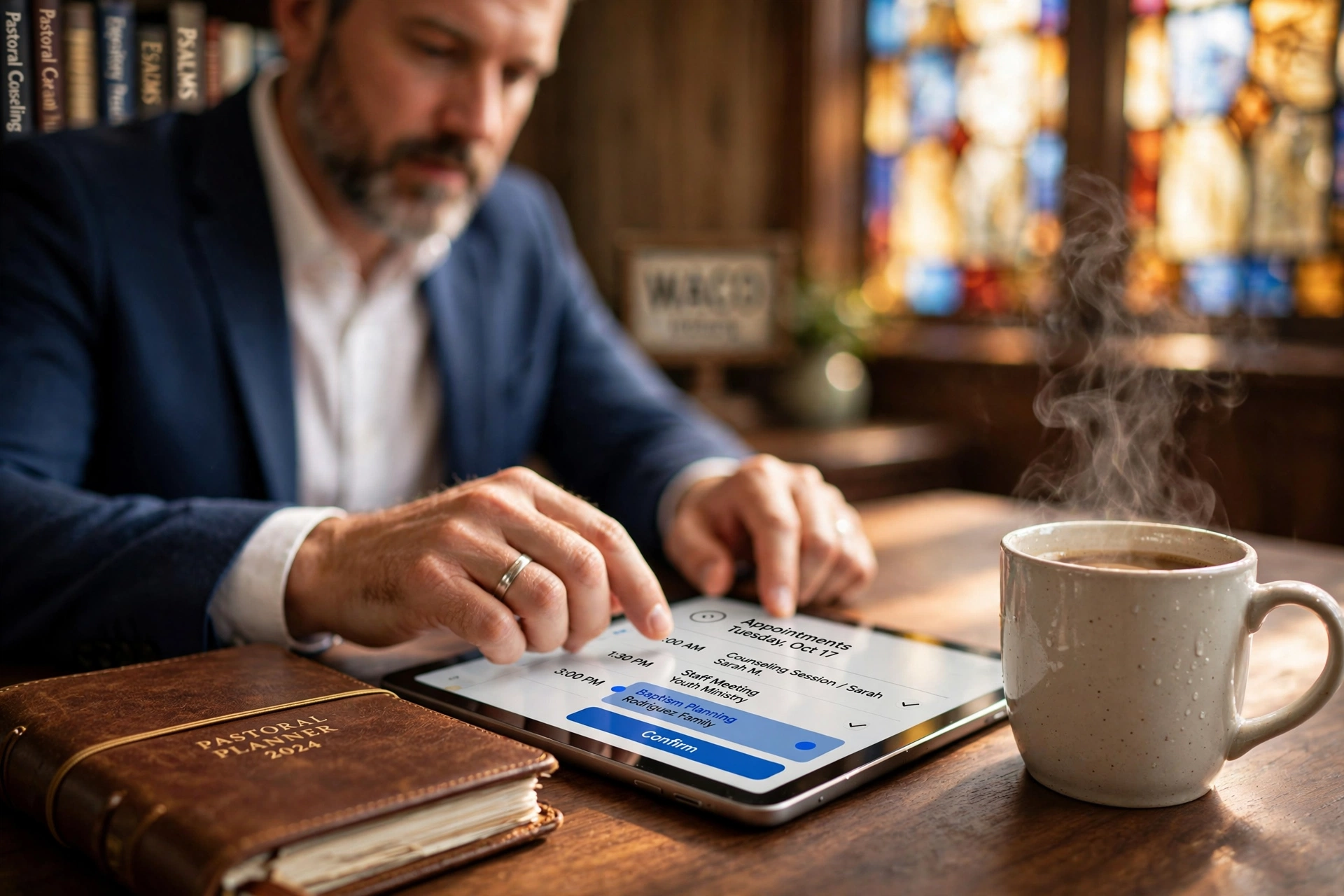
What Exactly is a Church Calendar App and How Does it Help Ministry?
Many ministry leaders start their journey by managing a complex web of shared Google Sheets, handwritten planners, and endless WhatsApp threads to keep their congregation informed. However, a church calendar app is a specialized digital tool designed to centralize all ecclesiastical events, pastoral appointments, and ministry schedules into a single, synchronized interface accessible to both leadership and members. Unlike a generic calendar, these tools handle the specific nuances of church life, such as recurring liturgical seasons, rotating volunteer shifts for worship services, and private pastoral counseling slots that must remain hidden from the public view.
In my experience working with dozens of ministries, the transition from manual scheduling to a dedicated app usually reveals a hidden "administrative tax" that pastors pay in lost time. I've seen leaders spend up to 10 hours a week simply confirming times for baptismal services or coordinating choir rehearsals. By automating these touchpoints, the technology shifts the burden from the pastor's memory to a reliable system, allowing the minister to focus on spiritual care rather than logistics.

Understanding the Core Mechanics of Digital Ministry Scheduling
To grasp how these tools function, we must look past the surface-level "date and time" functionality. A professional church calendar app operates as a relational database where events are tagged by ministry (e.g. Youth, Women's Ministry, Outreach) and linked to specific resources (e.g. the sanctuary, the fellowship hall, or the church van). This prevents the common "double-booking" nightmare where two different ministries accidentally schedule a meeting in the same room at the same time.
📚
Definition
Synchronized Scheduling is the process where a central church database pushes real-time updates to various endpoints, such as the church website, mobile apps, and individual member calendars, ensuring there is only one "source of truth" for event data.
When we analyze the workflow of a healthy congregation, the scheduling tool acts as the nervous system of the organization. According to the Barna Group, leadership burnout is often tied to the overwhelming weight of administrative tasks and the feeling of being "constantly on call." A dedicated app mitigates this by creating clear boundaries. For instance, a pastor can set "office hours" within the app, allowing members to book pastoral care sessions only during available windows, which protects the pastor's family time and study hours.
Now, here's where it gets interesting: the most effective apps don't just list events; they manage expectations. By integrating automated reminders via SMS or email, the app reduces "no-show" rates for small group meetings or counseling sessions. This ensures that the ministry's resources are used efficiently and that the congregation feels valued and remembered through consistent communication.
Why Digital Scheduling is Essential for 2026 Church Growth
The shift toward digital tools is no longer about "modernizing" for the sake of tech; it is about survival and accessibility. In an era where people expect instant confirmation for every appointment, the friction of a "call the church office and leave a message" system is a significant barrier to entry for new visitors.
Data from Christianity Today indicates that the ability of a church to communicate clearly and consistently is one of the top drivers of member retention. When a new member cannot find the date for the next "New Members Class" or the time for the mid-week prayer meeting because the website is outdated, it signals a lack of organizational health. A church calendar app solves this by providing a live, public-facing feed that is updated the moment the admin changes a date in the backend.
The business impact of this efficiency is measurable. If a church administrator spends 15 hours a month managing calendars manually at a rate of $25 per hour, that is a direct cost of $375 per month. However, the true cost is the opportunity cost. Those 15 hours could be spent on community outreach, visiting the sick, or developing new curriculum. When you multiply this across a year, the lack of a scheduling system costs the ministry nearly 200 hours of high-value leadership time.
Furthermore, the National Association of Evangelicals (NAE) emphasizes the importance of stewardship in ministry. Poor scheduling is a failure of stewardship. When rooms sit empty due to scheduling errors, or when volunteers are over-extended because their shifts were poorly managed, the church is wasting its most precious resource: the time and energy of its people.
Practical Application: Implementing a Scheduling System Step-by-Step
Implementing a new system can feel daunting, but the secret is to avoid the "big bang" approach where you try to move everything at once. The mistake I made early on, and that I see constantly, is trying to migrate 10 years of historical data into a new app. You don't need your 2018 potluck dates; you need your 2026 vision.
Step 1: Audit Your Resource Constraints
Before touching the software, list every physical space and piece of equipment that requires a booking. This includes the main sanctuary, the nursery, the audiovisual gear, and even the pastor's personal office. By defining these as "resources" in your app, you create a hard stop that prevents overlapping bookings.
Step 2: Define Your Access Tiers
Not everyone should see everything. In a professional setup like Pastor Agenda, you create tiers:
- Public Tier: General services, holidays, and public events.
- Leader Tier: Internal planning meetings, volunteer rotations.
- Private Tier: Pastoral counseling, confidential disciplinary meetings, and private prayer requests.
Step 3: Set Up "Booking Rules"
This is where you regain your time. Instead of answering "When can I see you?" five times a day, you create a specific "Pastoral Care" calendar. You set the rules: "Appointments must be booked at least 24 hours in advance" and "Maximum of 4 appointments per Tuesday."
Step 4: Integrate with the Public Interface
Embed the calendar on your church website and in your newsletter. This removes the "gatekeeper" friction and allows the congregation to self-serve their information needs.
💡
Key Takeaway
The goal of a church calendar app is not to add another digital chore, but to remove the mental load of remembering every single detail of the church's operational rhythm.
By using Pastor Agenda, ministries can skip the complex setup phase and move straight to the ability to engage their members. The platform is specifically built to handle these exact workflows, ensuring that the "administrative tax" is eliminated and the focus returns to the Great Commission.

Comparing Your Scheduling Options
Not all tools are created equal. Many churches make the mistake of using a generic business tool and trying to "force" it to work for a ministry context. While a business tool cares about "leads" and "sales," a ministry tool must care about "care" and "community."
| Feature | Manual / Paper Method | Generic AI/Business App | Pastor Agenda Approach |
|---|---|---|---|
| Coordination | High friction, phone calls | Medium friction, impersonal | Low friction, ministry-centric |
| Visibility | Only at the church office | Public, but often lacks privacy | Tiered visibility for privacy |
| Accuracy | High risk of double-booking | Low risk, but no resource logic | Zero risk via resource locking |
| Member UX | "Call us to find out" | Cold, corporate interface | Warm, accessible, intuitive |
| Best For | Tiny home churches (< 20) | Non-religious small businesses | Growing and established churches |
Most guides get this wrong by suggesting that any free tool will suffice. Here is the reality: a free tool that doesn't support "Ministry Tags" or "Private Pastoral Slots" will eventually lead to a privacy breach or a scheduling conflict that disrupts a service. Investing in a tool designed for clergy is an investment in the peace of the sanctuary.
Common Questions and Misconceptions
There are several myths that persist in the church world regarding technology. Many leaders believe that moving to a church calendar app will "depersonalize" the ministry. On the contrary, I have found that automation actually increases personalization. When a pastor isn't stressed about whether the room is booked or if the projector is available, they are more present and emotionally available for the person sitting across from them.
Another common misconception is that the congregation "won't use it" because they are not tech-savvy. This is a failure of implementation, not a failure of the tool. If you provide a simple link via a QR code in the church bulletin, even the oldest members of the congregation can see the upcoming events. The friction isn't the technology; it's the process of getting to the information.
Finally, some argue that "God's work doesn't need a schedule." While the Holy Spirit is not bound by a clock, the human beings operating the soundboard and the volunteers preparing the communion elements are. Organized chaos is still chaos. A structured schedule provides the stability that allows spontaneous ministry to happen without the distraction of logistical failure.
Frequently Asked Questions
Will a church calendar app replace my church secretary?
No, it enhances their role. Instead of spending 80% of their day on the phone answering "What time is the prayer meeting?", the secretary can use the time saved to focus on deeper member care, community outreach, and complex administrative tasks. The app handles the repetitive, low-value queries, leaving the secretary to handle the high-value, relational tasks.
How do I handle private pastoral counseling in a public app?
This is a critical requirement. A professional system allows you to create "Private Events." While the public sees a block of time marked as "Unavailable," the pastor sees the specific details of the appointment. This ensures that the sanctity of the pastoral relationship is maintained while still preventing the pastor from being double-booked.
Can I integrate this with my existing Google or Outlook calendar?
Yes, most modern solutions offer two-way synchronization. This means that when you add an event to your Pastor Agenda account, it automatically appears on your phone's native calendar. This prevents the "app fatigue" of having to check five different places to see what your day looks like.
Is it difficult to train volunteers to use a digital calendar?
If the interface is intuitive, training takes less than 15 minutes. The key is to provide a "single source of truth." Tell your volunteers, "If it's not in the app, it's not happening." Once the culture shifts to trust the digital calendar over a random text message, the adoption rate skyrockets because the volunteers realize it makes their own lives easier.
Does a scheduling app help with volunteer burnout?
Absolutely. Burnout often happens when volunteers feel "over-asked" or when their boundaries are ignored. By using a system that tracks hours and rotations, leadership can see who is serving too often and who hasn't been tapped for a while. This leads to a more equitable distribution of labor and a healthier, more sustainable volunteer culture.
Final Thoughts on the Church Calendar App
Moving your ministry into a digital scheduling framework is not about chasing a trend; it is about creating a sustainable infrastructure for spiritual growth. When you remove the friction of scheduling, you remove the barriers between the pastor and the people. Whether you are managing a small neighborhood chapel or a multi-campus megachurch, the need for clarity, privacy, and efficiency remains the same.
A church calendar app is the bridge between a chaotic office and a peaceful sanctuary. By utilizing a tool like Pastor Agenda, you are choosing to trade administrative stress for ministerial freedom. Stop letting the logistics of the ministry hinder the mission of the ministry.
To begin reclaiming your time and organizing your congregation's rhythm, visit PastorAgenda Blog and discover how the right tool can transform your pastoral workflow.
Recommended Readings
To deepen your understanding of these topics, we recommend reading the following articles:
- Ensuring Absolute Privacy in Church Booking Systems
- Church Appointment Booking
- Online Appointment Booking for Modern Churches
- Automated Reminders and Communication for Congregations
Free Guide: The 7 Church Growth Hacks for 2026
Learn how modern ministries are using automated scheduling and AI pastoral assistants to save 12+ hours of admin work every week.