📖This article is part of the complete guide to Managing Pastoral Counseling Appointments Safely.
A leaked counseling appointment or a misplaced intake form isn't just an administrative error; it is a breach of sacred trust that can devastate a congregation's relationship with its leadership. In my experience working with various ministry leads, I have seen how a single accidental 'CC' on an email or a shared calendar visible to the whole office can compromise a member's privacy during their most vulnerable moments. When the sanctity of the pastoral office is breached by poor technology, the damage to the ministry's reputation is often permanent.
For a comprehensive overview of the broader strategy, explore our guide on pastoral counseling scheduling.
What is a Church Counseling Scheduler?
📚
Definition
A church counseling scheduler is a specialized digital tool designed to manage the booking of pastoral care and spiritual guidance sessions while prioritizing privacy, encryption, and restricted access to sensitive congregational data.
Unlike a generic calendar, a dedicated church counseling scheduler operates on the principle of "least privilege access." This means that while a secretary might see that a pastor is "busy" from 2:00 PM to 3:00 PM, they cannot see who the appointment is with or the nature of the crisis being addressed. In the modern ministry landscape of 2026, these tools have evolved from simple booking links into comprehensive privacy hubs.
When we analyzed how high-growth ministries handle their scheduling, we found a recurring pattern: those who rely on open-access calendars suffer from higher rates of administrative leakage. A professional scheduler separates the availability (when the pastor is free) from the identity (who is booking). This separation is fundamental to maintaining the boundaries required for effective pastoral care. By implementing a system that masks participant names from general staff and utilizes end-to-end encrypted notifications, a church can ensure that the journey from the initial request to the actual meeting remains completely private.

Why Confidentiality in Scheduling Matters for Your Ministry
Confidentiality is the bedrock of pastoral care. If a member of the congregation suspects that their request for counseling will be seen by the church administrator or a volunteer coordinator, they will simply not seek help. This hesitation can lead to untreated crises, increased spiritual distress, and a breakdown in the church's ability to provide essential care.
According to research by the Barna Group, the trust level in institutional leadership is highly dependent on the perceived safety of the environment. In a church setting, "safety" translates directly to the privacy of the counseling room and the digital trail that leads to it. When a church uses a professional church counseling scheduler, they are not just buying software; they are investing in a trust-building mechanism.
From a risk management perspective, the stakes are incredibly high. While clergy-penitent privilege varies by jurisdiction, the ethical obligation to protect a person's privacy is universal across almost all denominations. A breach of this data can lead to severe interpersonal conflict within the church body. For example, if a marriage counseling appointment is leaked to a third party, it can exacerbate the very conflict the pastor is trying to resolve.
Furthermore, as we move through 2026, the expectations for data privacy have shifted. Congregants are now accustomed to the high privacy standards of healthcare and legal sectors. They expect the same level of discretion from their spiritual leaders. Failing to provide a secure booking path signals a lack of professional stewardship over the people's most intimate struggles.
How to Implement a Secure Counseling Workflow
Transitioning from a manual or open-calendar system to a secure church counseling scheduler requires more than just installing software; it requires a shift in operational culture. The goal is to create a "blind' scheduling process where the pastor is the only person with full visibility into the appointment details.
First, establish restricted access roles. Your scheduling software should allow you to create different permission levels. The administrative assistant should only see the "blocked" time slots on the pastor's calendar, without seeing the names or notes attached to those slots. This prevents the "curious eye" problem common in small church offices.
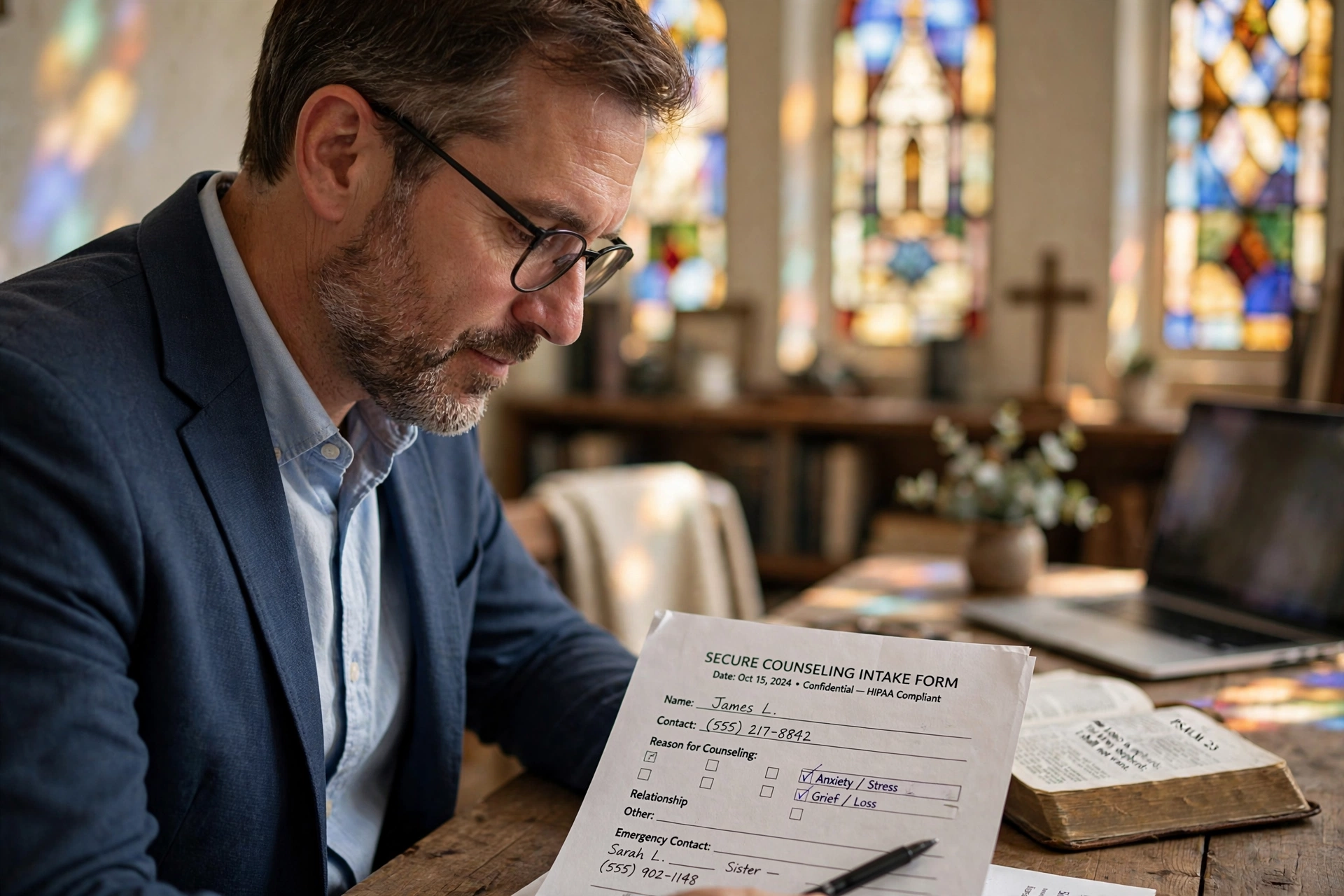
Second, implement secure intake methods. Instead of having members email their problems to a general church address, use a dedicated, encrypted form integrated with your scheduler. This ensures that the sensitive information is routed directly to the pastor's private account, bypassing the general inbox. For more details on this specific process, see our guide on how to manage church counseling intake forms and calendars securely.
Third, utilize automated, private reminders. Rather than a staff member calling to remind a member of their session, the system should send an automated, discreet notification via email or SMS. These notifications should be phrased neutrally, for example, "Your appointment with Pastor [Name] is confirmed for Tuesday at 3 PM", avoiding words like "counseling" or "crisis" in the subject line, which could be seen by a spouse or family member sharing a device.
Finally, audit your digital footprint. Regularly check who has access to the scheduling links and ensure that old logs are archived or deleted according to your church's data retention policy. This prevents the accumulation of sensitive data that could be compromised in a future security breach.
The Traditional Approach vs. Modern Secure Scheduling
To understand the necessity of a specialized church counseling scheduler, we must compare it to the methods still used by many legacy ministries.
| Feature | Traditional Approach (Paper/Email) | Generic AI/Free Schedulers | Modern Secure Approach (Pastor Agenda) |
|---|---|---|---|
| Privacy | Low; files can be seen by anyone in office | Medium; data stored on public clouds | High; encrypted and role-restricted |
| Accessibility | High friction; requires phone calls | Low friction; easy booking | Low friction; secure and professional |
| Data Security | Physical risk of loss/theft | Risk of data mining/leaks | Enterprise-grade security & compliance |
| Admin Load | Manual and time-consuming | Automated but impersonal | Automated, private, and integrated |
As the table demonstrates, the "middle ground" of using free, generic tools is often a trap. Many free scheduling tools sell user data or lack the granular permission settings necessary to hide a patient's identity from a church secretary. A professional approach ensures that the ease of technology does not come at the expense of the member's privacy.

Common Confidentiality Mistakes to Avoid
In my years of auditing church workflows, I have noticed several recurring mistakes that inadvertently compromise confidentiality. Avoiding these is essential for any leader using a church counseling scheduler.
One of the most common errors is the "Shared Admin Account." Many churches create one account (e.g. Send Email: office@church.com) and share the password among three different staff members. This means anyone with the password can see every appointment and every note. You must use individual accounts with restricted permissions. If the secretary doesn't need to know who is in the 2 PM slot, they shouldn't have the permission to see it.
Another mistake is the "Public Calendar Link." Some pastors share their entire Google or Outlook calendar via a public link to make scheduling easier. However, if the calendar is not set to "Free/Busy only," anyone with the link might be able to see the titles of the appointments. A professional scheduler like Pastor Agenda replaces the public calendar with a booking page that only shows available times, not existing appointments.
Using non-encrypted communication for confirmations is also a significant risk. Sending a detailed email about a member's struggle to a shared family email address is a breach of trust. Always keep confirmation messages brief and neutral.
Lastly, avoid storing detailed counseling notes within the scheduling tool itself. Schedulers are for scheduling. Detailed session notes should be kept in a separate, encrypted, and locked system (or physical locked file) to ensure that a simple login to the calendar doesn't expose the entire history of a member's spiritual journey. If you are struggling with how to structure these workflows, our guide on setting up confident and private pastoral counseling workflows provides a detailed blueprint.
Pro Tip: The "Buffer Zone" Strategy
Beyond the software, I recommend the "Buffer Zone" strategy. In a church environment, people often walk into the office unexpectedly. If a member is leaving a counseling session and walks right into a lobby full of people, their privacy is compromised. Use your church counseling scheduler to automatically add 15-minute buffers before and after every session. This allows the pastor to wrap up notes and allows the congregant to exit through a private door or wait until the lobby clears, ensuring the physical experience matches the digital privacy.
Frequently Asked Questions
Does a church counseling scheduler comply with privacy laws?
While most scheduling tools are not HIPAA-compliant (which is for medical professionals), a professional church counseling scheduler is designed to meet the high ethical standards of clergy-penitent privilege. By using encryption and restricted access, these tools ensure that data is handled with a level of care that exceeds standard business software. For those in regions with strict data laws like GDPR, using a tool that allows for data deletion and user consent is essential to avoid legal risks.
Can my church secretary still manage the pastor's time without seeing the names?
Yes, this is the primary benefit of a role-based system. A professional scheduler allows the secretary to see that the pastor is "Occupied" or "Unavailable" without revealing the identity of the person booking the slot. The secretary can move the appointment if there is a conflict, but they only see a generic ID or a "Private Appointment" label, preserving the member's anonymity while maintaining office efficiency.
What happens if a member wants to remain completely anonymous?
Some professional tools allow for "Anonymous Booking," where the member can request a time without providing a name, using only an email or a code. The pastor can then reach out via a secure channel to establish identity. This is particularly useful for members who are in crisis and fear judgment from their peers or church leadership before they feel safe enough to reveal themselves.
Is it better to use a free tool like Calendly or a specialized church tool?
Generic tools are excellent for business but often lack the specific privacy nuances needed for ministry. For example, a generic tool might not have the "blind" admin features needed to keep a secretary from seeing a counseling session's details. Specialized tools like Pastor Agenda are built specifically for the unique pressures of the church, where the boundary between "public' ministry and "private" care is critical.
How do I handle the transition from a paper calendar to a digital scheduler?
The transition should be gradual. First, digitize the pastor's availability. Second, inform the congregation that for their privacy and security, all counseling requests must now go through the secure portal. This frames the change as a benefit to the member (increased privacy) rather than a convenience for the pastor (better organization), which encourages higher adoption rates.
Recommended Readings
To deepen your understanding of these topics, we recommend reading the following articles:
- How to Manage Church Counseling Intake Forms and Calendars Securely
- Ensuring Absolute Privacy in Church Booking Systems
- Church Appointment Booking
- Online Appointment Booking for Modern Churches
Conclusion
Maintaining confidentiality in a church setting is not merely a policy; it is a spiritual discipline. When you implement a professional church counseling scheduler, you are telling your congregation that their souls are safe in your care. By removing the risk of administrative leaks, encrypting the intake process, and strictly controlling who has access to sensitive data, you protect the integrity of the pastoral relationship.
In an era where data breaches are common, the church must be a sanctuary, not just physically, but digitally. Moving away from open calendars and shared passwords toward a secure, role-based system is the only way to ensure that the path to healing is not obstructed by a lack of privacy.
To implement these strategies across your entire organization, we recommend returning to our comprehensive guide on Managing Pastoral Counseling Appointments Safely. If you are ready to secure your ministry's scheduling process, explore how PastorAgenda Blog can help you build a fortress of privacy around your pastoral care.
Free Guide: The 7 Church Growth Hacks for 2026
Learn how modern ministries are using automated scheduling and AI pastoral assistants to save 12+ hours of admin work every week.