
Why Does Your Ministry Need Church Management Software?
Administrative friction is the silent killer of spiritual growth. When a pastor spends four hours a week manually updating membership spreadsheets or chasing down scheduling conflicts for the worship team, that is time stripped away from pastoral care and sermon preparation. The primary reason to implement church management software is to decouple administrative labor from spiritual leadership, ensuring that the operational side of the church supports—rather than hinders—the mission of the ministry.
In my experience working with growing congregations, the most common tipping point occurs when the "memory-based system" fails. A pastor remembers a new visitor's name, but forgets to follow up; a secretary knows the building is booked, but the youth leader doesn't. Once a church exceeds a certain size, human memory is no longer a scalable database. Shifting to a digital ecosystem isn't about "modernizing" for the sake of technology; it is about creating a sustainable infrastructure that prevents burnout and member attrition.

What Exactly Is Church Management Software and How Does It Function?
To understand the "why," we must first define the "what." Many leaders mistake a simple database or a shared Google Calendar for a management system, but these are merely tools, not systems.
📚
Definition
Church Management Software (ChMS) is an integrated suite of tools designed to automate the administrative, financial, and relational aspects of a faith community, consolidating member directories, contribution tracking, and event scheduling into a single source of truth.
A robust ChMS functions as the central nervous system of the church. It integrates disparate data points—such as attendance trends, giving history, and small group participation—into a cohesive dashboard. For example, instead of checking three different lists to see who hasn't attended a service in a month, a pastor can run a single report to identify "at-risk" members who may need a pastoral visit.
According to research by the Barna Group, there is a direct correlation between the health of a church's administrative systems and the emotional health of its leadership. When systems are chaotic, leadership stress increases, which often leads to a decline in the quality of pastoral care. A professional software solution removes the "cognitive load" of remembering mundane details, allowing the minister to focus on the spiritual needs of the congregation.
The functionality generally splits into three core pillars: Relational Management (member profiles, family linking, and communication), Financial Stewardship (tithe tracking, tax receipts, and fund accounting), and Operational Logistics (room booking, volunteer scheduling, and event registration). When these three pillars are integrated, the church moves from a reactive posture—fixing problems as they arise—to a proactive posture, where growth is planned and tracked.
Why Does the Absence of Professional Systems Create Risk for Your Ministry?
The danger of relying on manual processes isn't just inefficiency; it is the risk of institutional blindness. When data is scattered across notebooks, emails, and various spreadsheets, the leadership cannot see the patterns of their own growth or decline.
The most immediate consequence of not acting is "member leakage." This happens when new visitors fall through the cracks because there was no formal system to track their integration into the church. In a manual system, a visitor fills out a card, the card sits on a desk for three days, and by the time the pastor calls, the visitor has already decided the church isn't interested in them. In a digital environment, that visitor's information is entered into the church management software instantly, triggering an automated welcome sequence and alerting a deacon to reach out within 24 hours.
Furthermore, financial transparency is a significant risk area. Manual tracking of tithes and offerings is prone to human error and lacks the audit trails required for professional governance. According to Church Law & Tax, proper financial record-keeping is not just a best practice but a necessity for maintaining tax-exempt status and avoiding legal complications. Using a dedicated system ensures that every contribution is logged accurately and that year-end statements are generated without the stress of manual calculation.
Then there is the issue of volunteer burnout. Many churches rely on a "core few" who do everything. Without a scheduling system, the same three people are asked to serve every Sunday because they are the ones the pastor remembers. This leads to rapid burnout. A management system allows for a fair distribution of labor, tracking who is serving and who is resting, which preserves the long-term health of the volunteer base.
How to Implement a Digital Strategy Using Pastor Agenda
Moving from a manual system to a digital one can feel overwhelming, but the secret is to start with the "pain point" rather than the "feature list." If your biggest struggle is scheduling, start there.
The first step is the Data Audit. You must gather every list, spreadsheet, and paper directory currently in use. The mistake I see constantly is that churches try to import "dirty data"—incomplete or outdated lists—into a new system. This only migrates the chaos. You must clean your data first, removing duplicates and verifying contact information.
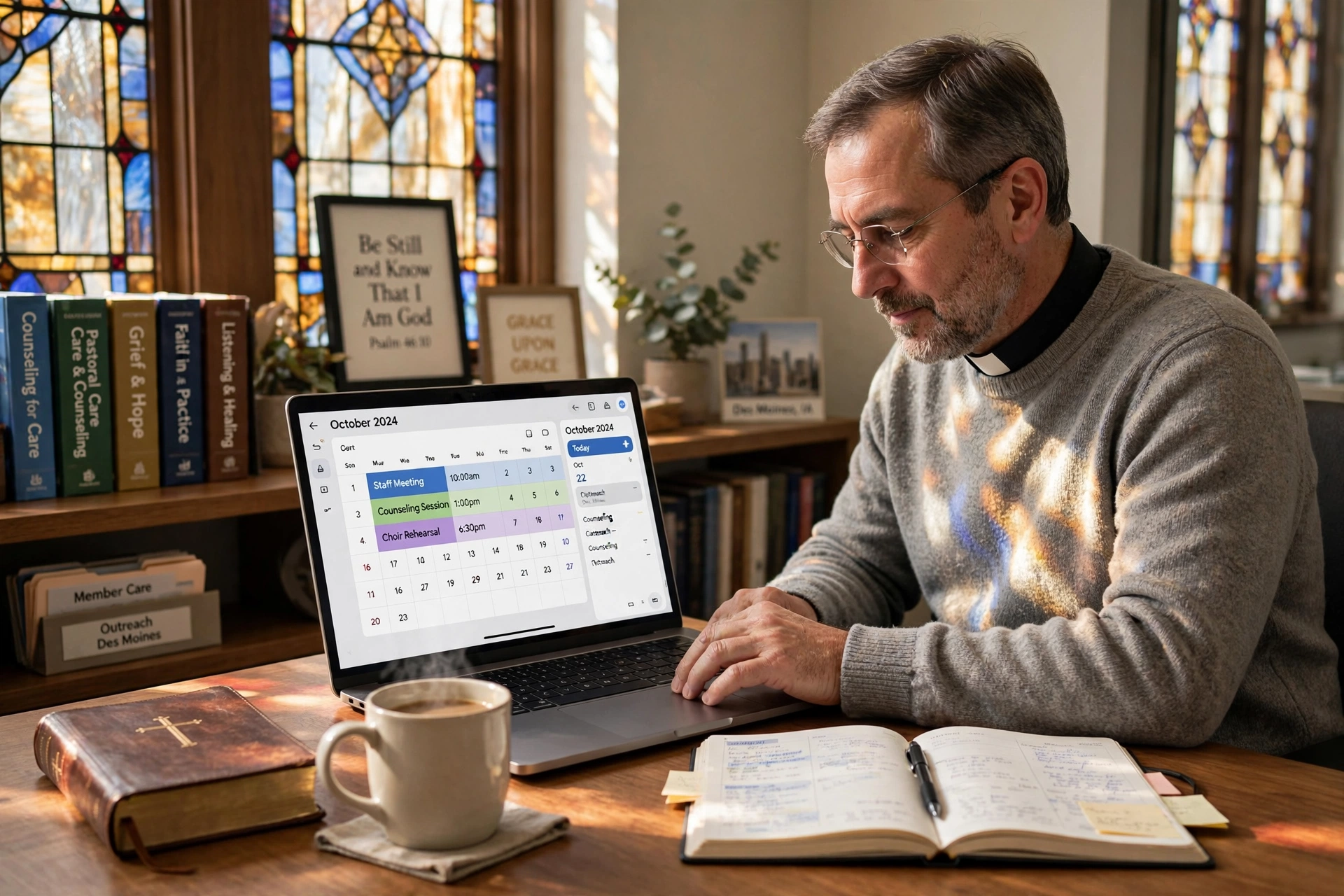
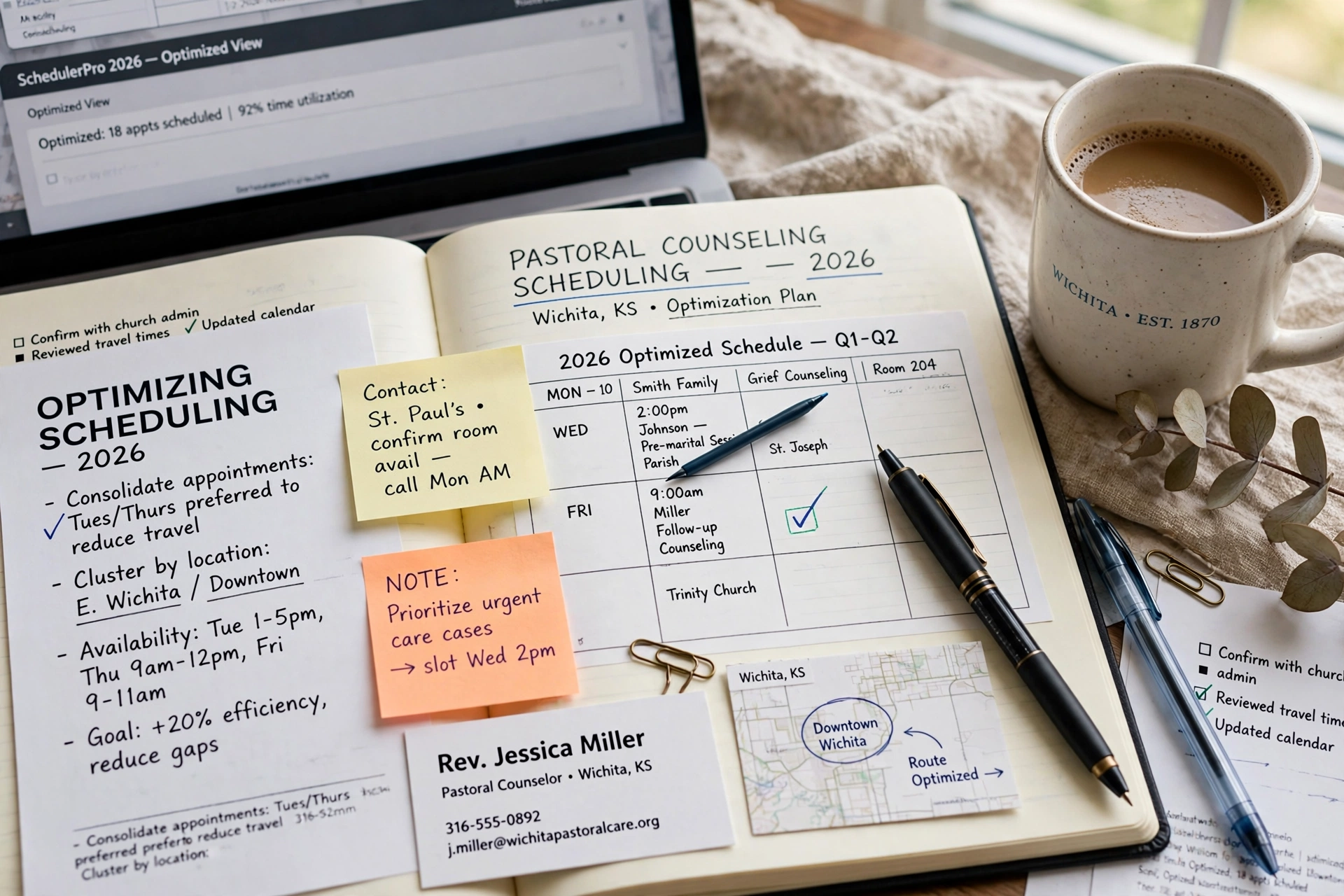
Once your data is clean, you should implement a Scheduling First approach. This is where Pastor Agenda excels. By automating the appointment booking process, you remove the back-and-forth emails and phone calls that clog a pastor's day. Instead of playing "calendar tag," you provide a link where members can see your availability and book their own pastoral counseling or meeting. This immediately restores hours of time to your weekly schedule.
Implementation Steps:
- Identify the Friction: Determine if your primary leak is in membership tracking, financial reporting, or scheduling.
- Centralize Access: Move all administrative permissions to a single platform to avoid "data silos" where only one person knows how the system works.
- Automate the Welcome: Set up a workflow for new visitors that triggers a sequence of touches (email, text, call) within the first 72 hours.
- Train the Core Team: Ensure your secretaries and deacons understand the software; otherwise, they will revert to their old, manual habits.
💡
Key Takeaway
The goal of church management software is not to replace the personal touch of ministry, but to automate the logistics so that the personal touch has more room to breathe.

Comparing the Approaches to Church Administration
Not all methods of management are created equal. Some churches attempt to "hack" a solution using generic business tools, while others stick to the old ways. Here is how those approaches compare in a real-world ministry environment.
| Approach | Pros | Cons | Best For |
|---|---|---|---|
| Manual / Paper-Based | No technology cost, familiar to elderly staff | Extremely slow, high error rate, zero data insights, high risk of loss | Very small house churches (<30 members) |
| Generic AI / Spreadsheet Hacks | Low initial cost, flexible for basic lists | No integrated workflow, data silos, manual entry, no specific ministry tools | Temporary projects or micro-ministries |
| Professional ChMS (Pastor Agenda) | Automated scheduling, centralized data, scalable, audit-ready | Requires initial setup time, modest subscription fee | Growing churches seeking sustainable leadership |
Most guides get this wrong by suggesting that a free spreadsheet is "good enough." It is only "good enough" if you are comfortable with the risk of losing member data or spending 10 hours a month on manual entry. When you calculate the hourly value of a pastor's time, the cost of a professional system is negligible compared to the cost of wasted leadership hours.
Common Misconceptions About Digital Ministry
There is a persistent myth that using software "de-spiritualizes" the church or makes the ministry feel corporate. This is a fundamental misunderstanding of what technology does. Technology is a tool, not a destination. A hammer doesn't make a carpenter "corporate"; it just allows them to build a house faster. Similarly, church management software doesn't make a church corporate; it makes it organized.
Another common misconception is that the congregation will feel "managed" rather than "pastored." In reality, the opposite is true. Members feel more cared for when the church remembers their birthday, tracks their children's milestones, and follows up promptly after a prayer request. These "small wins" are only possible when there is a system in place to remind the leadership to act.
Finally, some leaders believe they are "too small" for a system. I have seen churches of 50 people struggle with scheduling and 500-person churches struggle with the same issues. The struggle isn't about the number of people; it is about the complexity of the relationships. Once you have more than ten people to care for, you are no longer managing a group; you are managing a community. Communities require systems to thrive.
Frequently Asked Questions
Does using church management software replace the need for a church secretary?
No, it transforms the role of the secretary. Instead of spending their entire day on data entry and manual scheduling, the secretary becomes a "Ministry Coordinator." They move from being a typist to being a strategist who uses the data from the software to identify who needs a call, which volunteers are overextended, and how to optimize the church's resources. The software handles the "what" and "when," allowing the secretary to focus on the "who" and "how."
Is my member data safe in a cloud-based system?
Modern, professional platforms use encryption and security protocols that far exceed what is possible in a physical filing cabinet or a local spreadsheet. In fact, paper records are much more vulnerable to theft, fire, or simple loss. By using a reputable service, your data is backed up across multiple servers, ensuring that a single hardware failure doesn't wipe out decades of church history. Always ensure your software provider complies with standard data protection regulations.
How long does it take to see a return on investment (ROI) from these tools?
The ROI in a ministry context is measured in "recovered time" and "retention rates." Most churches see an immediate impact within the first 30 days through the reduction of administrative emails and phone calls. If a pastor recovers just five hours a week by using Pastor Agenda for scheduling, that is 260 hours a year returned to the ministry. When you multiply that by the hourly value of leadership, the system pays for itself almost instantly.
Can a software system really help with spiritual growth?
Software cannot pray, preach, or counsel, but it removes the barriers to those activities. Spiritual growth is often stunted by "administrative noise"—the stress of missed appointments, forgotten visitors, and chaotic events. When the noise is removed, the leadership has the mental clarity and the time required to engage in deep, spiritual work. By organizing the "earthly" details, you create a sanctuary of order that supports spiritual flourishing.
What happens if our staff is not tech-savvy?
This is the most common fear among senior pastors. The key is to choose a system designed specifically for ministry, even for those who struggle with technology. Tools like Pastor Agenda are built for intuition, not for IT experts. The goal is to make the software invisible; the user shouldn't feel like they are "using a program," but rather that they are simply managing their calendar. Proper onboarding and a simplified interface are essential for adoption.
Final Thoughts on Modernizing Your Ministry
The decision to implement church management software is ultimately a decision about how you value your time and your people. Every single hour spent fighting with a spreadsheet is an hour not spent in prayer, in a hospital room, or studying the Word. The "why" is simple: you cannot lead a growing congregation using the tools of a stagnant one.
By centralizing your data, automating your scheduling, and professionalizing your financial tracking, you build a foundation that can support a hundred members or a thousand. The risk of not acting is not just a lack of efficiency; it is the potential for burnout and the tragedy of missed opportunities to care for the flock.
If you are ready to stop the administrative leak and reclaim your time for ministry, explore how Pastor Agenda can streamline your leadership. It is time to move from the chaos of manual management to the clarity of professional organization.
Recommended Readings
To deepen your understanding of these topics, we recommend reading the following articles:
- Church appointment booking
- Online Appointment Booking for Modern Churches
- Pastor scheduling
- Pastoral counseling scheduling
Free Guide: The 7 Church Growth Hacks for 2026
Learn how modern ministries are using automated scheduling and AI pastoral assistants to save 12+ hours of admin work every week.