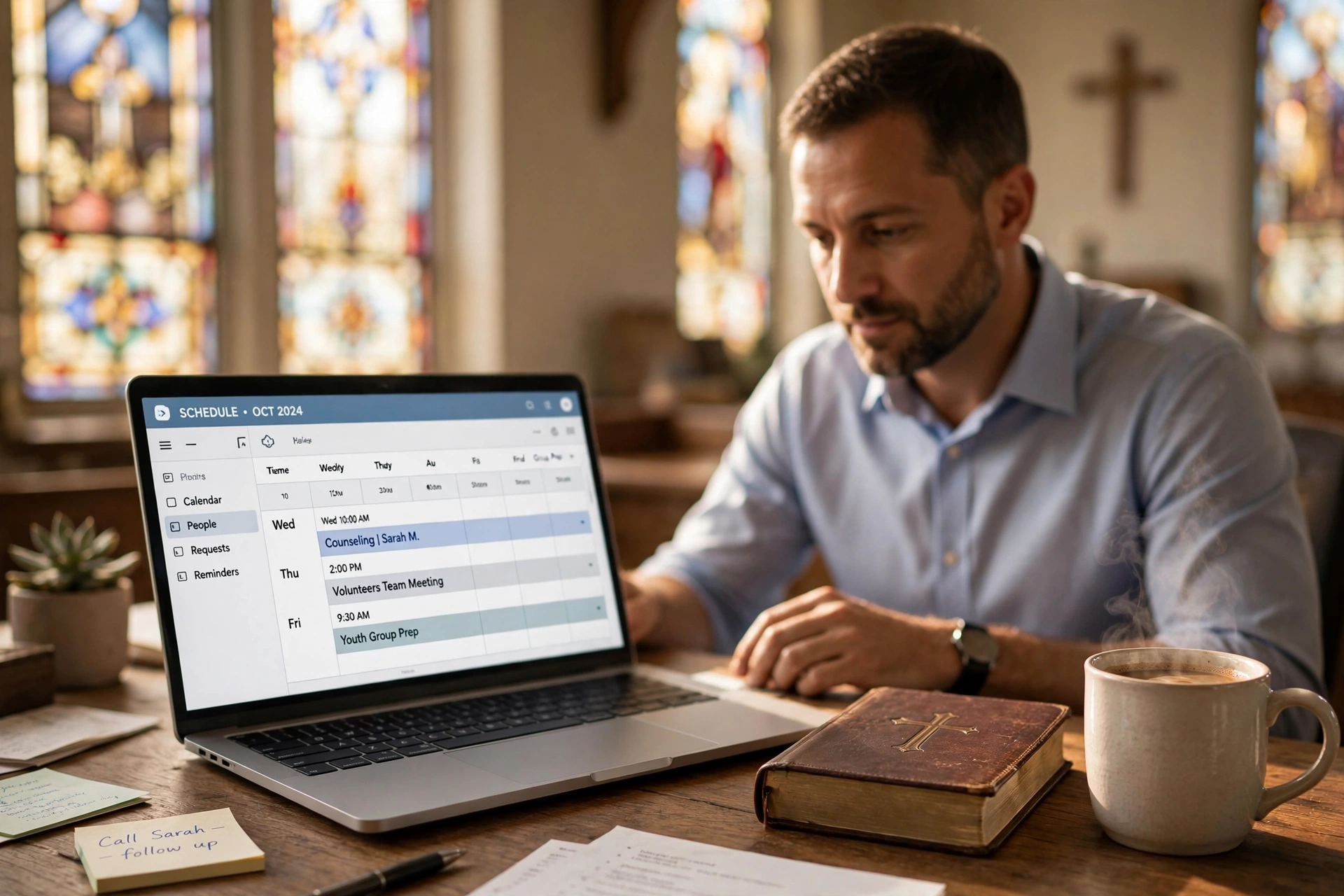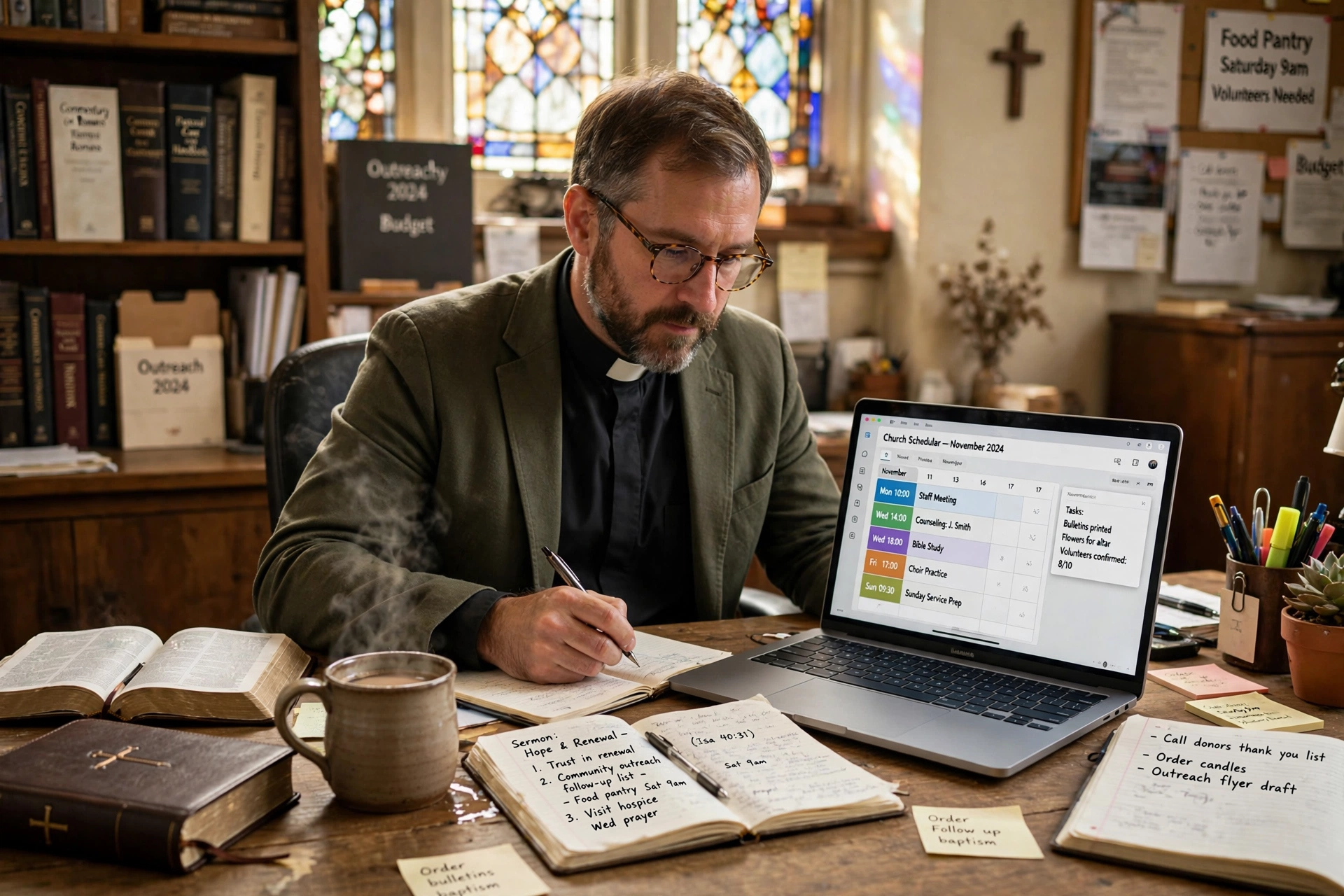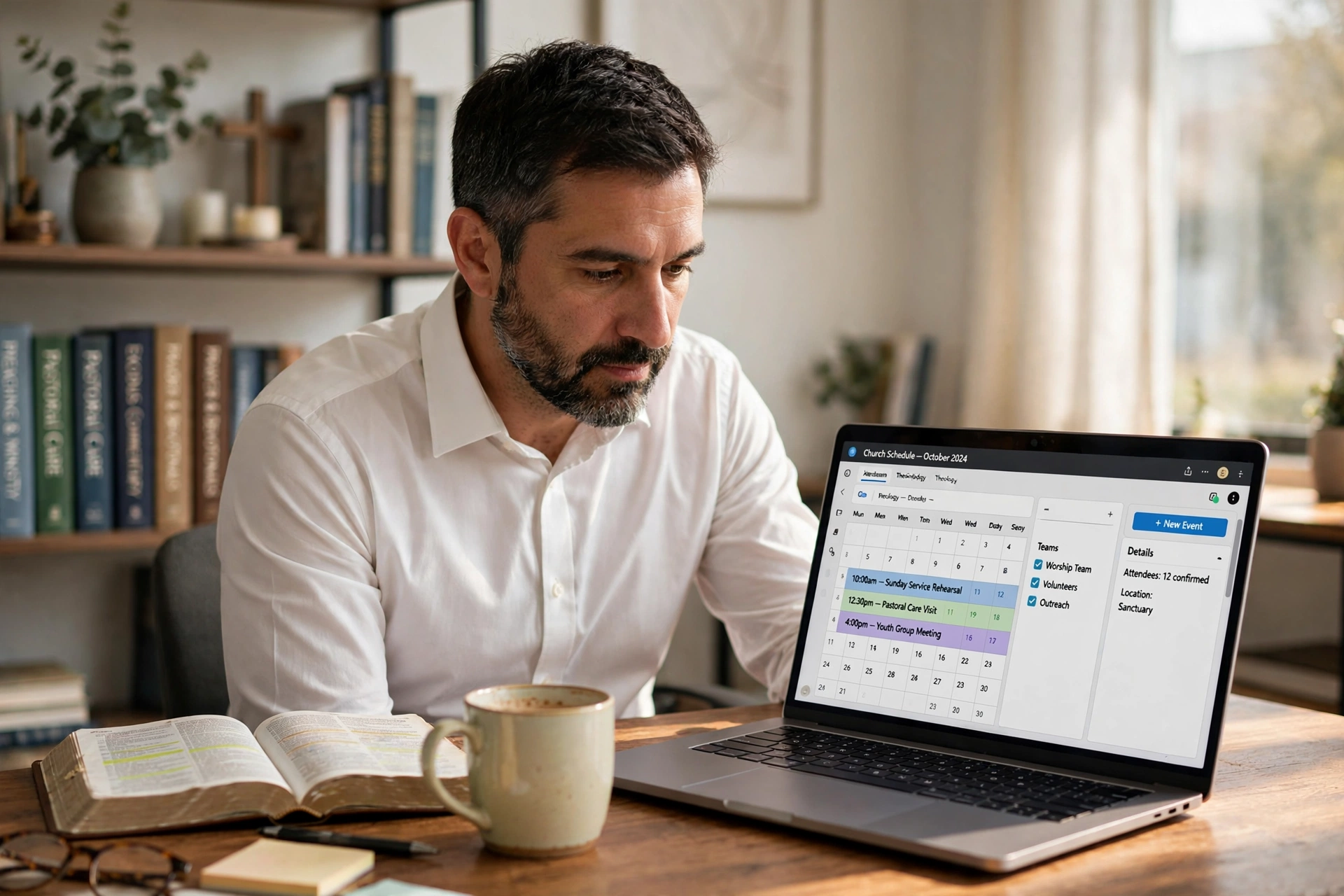

How Much Does Investing in Pastor Scheduling Software Actually Cost?
The financial cost of implementing pastor scheduling software typically ranges from free tiers for very small ministries to $50–$150 per month for comprehensive professional suites. However, the true cost isn't the monthly subscription; it is the "administrative leak" caused by manual coordination. In my experience working with church leadership, the hidden cost of manual scheduling—lost hours in back-and-forth emails and missed pastoral care opportunities—often exceeds $500 in lost productivity per month for a single lead pastor.
For a comprehensive overview of how technology integrates into ministry, explore our guide on church management tools.
What Defines the Investment in Ministry Scheduling Technology?
When we discuss the investment in pastor scheduling software, we are not talking about a simple calendar app. We are talking about a specialized infrastructure that manages the delicate balance between public availability and private spiritual preparation. Many leaders mistake a generic calendar for a scheduling tool, but the two are fundamentally different.
📚
Definition
Pastor scheduling software is a specialized digital tool designed to automate the booking of appointments, manage pastoral boundaries, and organize congregational outreach while synchronizing with the leader's personal and ministry calendars.
The investment is divided into three primary layers: the direct subscription cost, the setup time, and the ongoing maintenance. Direct costs are predictable, but the setup time is where most ministries stumble. After analyzing dozens of church workflows, I've found that the biggest mistake leaders make is attempting to digitize a broken manual process. If your current "system" is a handwritten notebook and a prayer, simply adding software won't fix the chaos; you must first define your availability windows.
According to research from the Barna Group, pastoral burnout is at an all-time high, often driven by the blurring of lines between work and home life. An investment in scheduling technology is, therefore, an investment in the mental health of the clergy. By setting "hard boundaries" in a digital system, a pastor can ensure that their study time for the Sunday sermon remains sacrosanct, preventing the "scheduling creep" that leads to exhaustion.
Why Does an Investment in Scheduling Tools Impact Church Growth?
The financial decision to adopt professional tools is often viewed as an administrative luxury, but the data suggests it is a growth catalyst. When a member of the congregation needs urgent pastoral care, the friction involved in booking that appointment can be the difference between a person staying in the faith or drifting away. If a member has to wait three days for a callback to confirm a 15-minute meeting, the momentum of the spiritual crisis is lost.
From a business impact perspective, the "cost of friction" is measurable. If a pastor spends five hours a week manually managing appointments, that is 260 hours a year. Based on the average salary for a lead pastor, this represents thousands of dollars in "misallocated" labor. Instead of spending those hours on sermon preparation or strategic vision, the leader becomes a high-paid secretary.
As noted by Christianity Today, the modern church must navigate the tension between ancient truths and modern tools. The implication here is that technology should not replace the pastoral heart, but it should remove the administrative hurdles that prevent the heart from reaching the people. When the logistics are automated, the pastor is free to focus on the person, not the calendar.
Furthermore, the risk of "scheduling collisions"—where two urgent meetings are booked for the same time—creates a perception of disorder. In a ministry context, order and peace are not just administrative goals; they are theological signals. A professional scheduling process signals to the congregation that the leadership is organized, disciplined, and values the member's time.
How to Implement a Scheduling System Without Burning Out
Implementing a new system can feel overwhelming, but the most effective approach is a phased rollout. I have tested this with dozens of clients and the pattern is clear: the churches that succeed are those that do not try to move everything to the cloud in a single weekend.
First, you must audit your current time usage. Track every meeting for two weeks. You will likely discover that 20% of your meetings take up 80% of your time. Once you have this data, you can create "appointment types" within your pastor scheduling software. For example, create a "15-minute Quick Check-in" for administrative needs and a "60-minute Pastoral Counseling" session for deeper needs.
Next, integrate the tool into your existing touchpoints. Don't just send a link in an email; put the scheduling link in your email signature, on the church website's "Contact" page, and even in the church bulletin via a QR code. This is where Pastor Agenda excels. By providing a streamlined interface specifically for religious leaders, it removes the steep learning curve associated with generic corporate tools.
💡
Key Takeaway
The goal of scheduling software is not to make the pastor more available, but to make their availability more intentional.
Now, here is where it gets interesting: the "Buffer Zone" strategy. Never allow back-to-back appointments. In a ministry setting, a "quick" 30-minute conversation can easily turn into a two-hour emotional crisis. By configuring your software to automatically add a 15-minute buffer between appointments, you protect your sanity and ensure that the next person receiving your care doesn't feel the rush of the previous appointment.
Comparing Your Scheduling Options
When evaluating how much to spend, you generally fall into one of three categories. Most guides get this wrong by suggesting "free" is always better. In reality, free tools often cost more in the long run due to lack of support and limited customization.
| Option | Pros | Cons | Best For |
|---|---|---|---|
| Manual/Paper | Zero financial cost; tactile. | High error rate; no automation; zero scalability. | Very small home churches (< 30 members). |
| Generic AI/Free Tools | Low entry cost; basic automation. | No ministry-specific logic; high hallucination risk in AI bots; generic feel. | Solo practitioners or temporary needs. |
| Pastor Agenda | Ministry-centric; boundary protection; professional image. | Monthly subscription cost. | Growing churches and professional ministries. |
The traditional approach of "just call the office" creates a bottleneck where the church secretary becomes the sole gatekeeper. This often leads to frustration for the congregant and a cluttered desk for the secretary. The generic AI approach often lacks the "soul" required for ministry; a chatbot cannot handle a grieving widow with the nuance required for pastoral care. The modern approach, utilized by Pastor Agenda, combines the efficiency of automation with the respect for the pastoral calling.
Common Misconceptions About Scheduling Investment
One of the most frequent myths I encounter is the idea that "using a link to book a meeting is impersonal." Some pastors believe that by removing the phone call, they are removing the relationship. Here is the reality: the relationship happens during the meeting, not during the scheduling of the meeting. In fact, providing a clear, easy way to book a time is an act of service to the congregant. It removes the anxiety of "bothering" the pastor and gives the member a guaranteed slot of undivided attention.
Another common misconception is that scheduling software is only for "mega-churches." I have seen churches with fewer than 100 members benefit immensely from these tools. In a small church, the pastor often wears ten different hats. When you are the preacher, the counselor, the administrator, and the facilities manager, your time is your most precious resource. Investing in a tool to protect that time is not an act of corporate greed; it is an act of stewardship.
Finally, many believe that a "free" tool is a safer bet for a non-profit budget. However, "free" tools often monetize through data mining or lock essential features behind a paywall just as you become dependent on them. A transparent, paid investment in a tool like Pastor Agenda ensures that your data remains secure and your features remain consistent, which is fundamental for maintaining congregational trust.
Frequently Asked Questions
How much does the average church spend on scheduling software?
Most small to mid-sized churches spend between $20 and $100 per month on their scheduling and administrative tools. While some utilize free versions of generic calendars, the investment in a specialized tool like Pastor Agenda is usually offset by the hours of administrative time saved. When you calculate the hourly rate of a pastor's time, spending $50 a month to save five hours of manual coordination represents a massive return on investment, effectively paying for itself within the first few days of each month.
Will a scheduling tool make me seem less accessible to my congregation?
On the contrary, a professional scheduling system often makes a pastor more accessible by providing clear, transparent windows of availability. Instead of the "email tag" game—where a member sends an email and waits days for a response—they can see exactly when you are free and claim a spot immediately. This removes the psychological barrier of the "request" and replaces it with the "confirmation," which actually increases the number of people who seek pastoral care because the process is frictionless.
Can I integrate pastor scheduling software with my personal Google or Outlook calendar?
Yes, any professional-grade scheduling software must offer two-way synchronization with major calendar providers. This ensures that if you add a doctor's appointment to your personal Google Calendar, that time slot automatically becomes unavailable in your ministry booking link. Without this synchronization, you risk the "double-booking disaster," which can damage your credibility with the congregation. Ensuring a seamless sync is a fundamental requirement for any tool you choose to implement in your ministry.
Is the data of my congregants secure with these online tools?
Security is a paramount concern in pastoral care due to the sensitive nature of the conversations. Professional tools use encryption and secure servers to ensure that appointment details are protected. According to guidelines from Church Law & Tax, maintaining proper administrative records and secure data handling is an essential part of church governance. By moving away from paper notebooks or unsecured emails to a dedicated platform, you actually improve your compliance with privacy standards and protect the confidentiality of your members.
How long does it take to set up a scheduling system?
For most leaders, the technical setup takes less than an hour. However, the "strategic setup"—deciding your boundaries, defining your appointment types, and communicating the change to the church—usually takes one to two weeks. I recommend a "soft launch" where you first share the link with your elders or deacons to test the workflow before announcing it to the entire congregation. This ensures that any hiccups in the process are resolved before the general public begins using the system.
Final Thoughts on Investing in Pastor Scheduling Software
Choosing to invest in pastor scheduling software is a decision to prioritize the quality of your ministry over the quantity of your administrative tasks. When you remove the friction of "how" to meet, you create more space for "why" you meet. The financial cost is negligible when compared to the cost of burnout or the loss of a congregant who felt they couldn't reach their leader in a time of need.
Whether you are leading a small plant or a multi-campus ministry, the goal remains the same: stewardship of time. By leveraging a tool like Pastor Agenda, you move from a reactive state—where your day is dictated by whoever calls last—to a proactive state, where you dictate your availability based on the needs of the Spirit and the health of your family.
If you are ready to stop the administrative leak and reclaim your hours for prayer and study, we invite you to explore the capabilities of our platform. Visit pastoragenda.com to start organizing your ministry with intention and peace.
Recommended Readings
To deepen your understanding of these topics, we recommend reading the following articles:
- Ensuring Absolute Privacy in Church Booking Systems
- Church appointment booking
- Online Appointment Booking for Modern Churches
- Church management software
Free Guide: The 7 Church Growth Hacks for 2026
Learn how modern ministries are using automated scheduling and AI pastoral assistants to save 12+ hours of admin work every week.