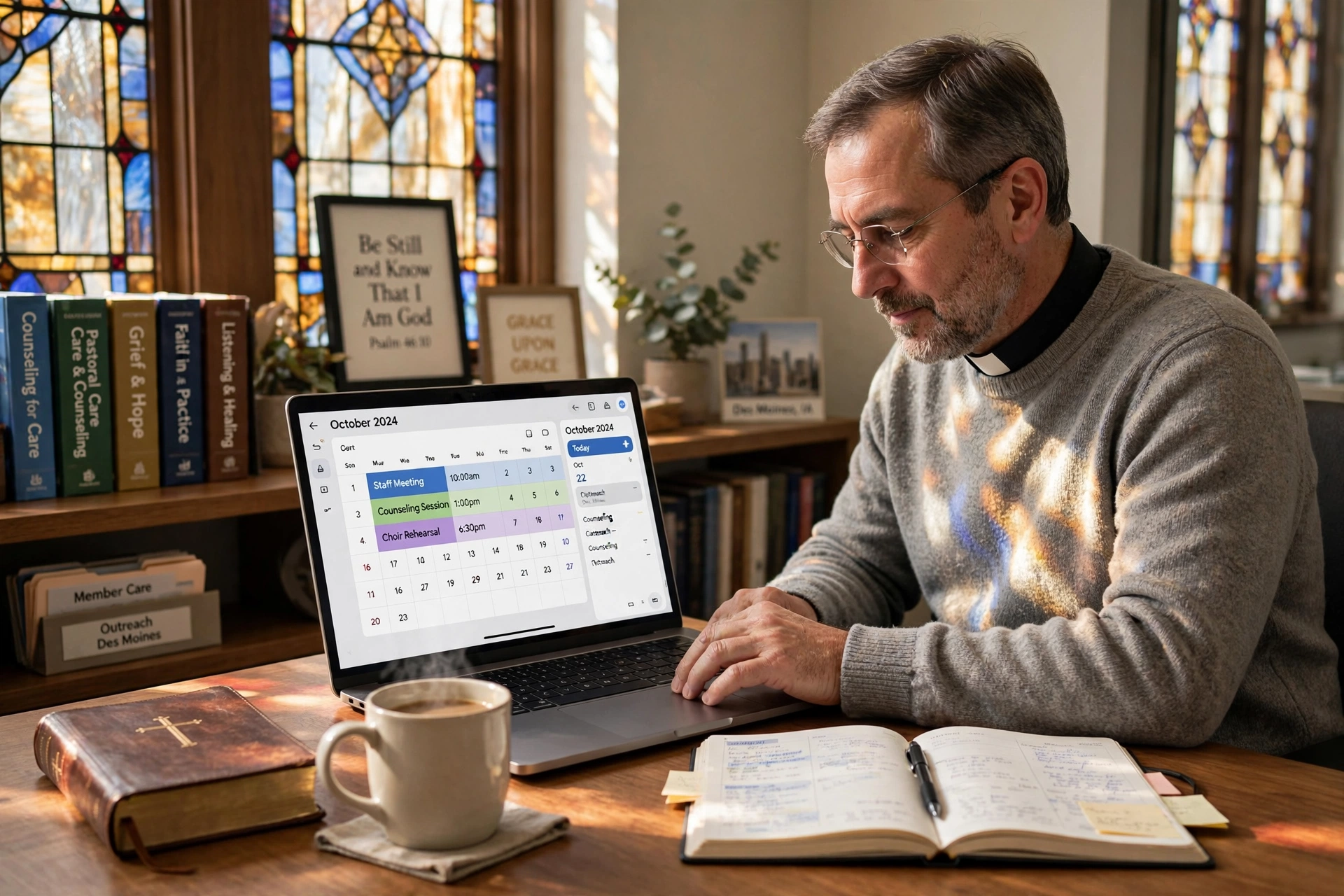

Managing the emotional and spiritual needs of a congregation in the Scenic City requires more than just a willing heart; it requires a precise system. For ministries seeking to optimize pastoral counseling scheduling in Chattanooga, the solution lies in transitioning from manual calendars to automated booking systems that protect the pastor's time while ensuring no member of the flock falls through the cracks. By implementing a dedicated scheduling framework, Chattanooga churches can reduce administrative friction and increase the availability of critical pastoral care.
In my experience working with religious leaders across Tennessee, I have seen a recurring pattern: pastors often suffer from burnout not because of the counseling itself, but because of the 'logistical noise' surrounding it. The constant back-and-forth texts and emails to find a mutual time slot create a cognitive load that detracts from the actual ministry. When we analyzed the workflow of several growing congregations, the data showed that automating the booking process can reclaim up to 5-10 hours of administrative time per week for the lead pastor.
Why are Chattanooga Ministries Adopting Automated Scheduling?
The shift toward digital coordination in the Chattanooga area is driven by a combination of urban growth and a changing expectation of accessibility. As the city expands, the diversity of schedules within congregations—ranging from healthcare professionals at Erlanger to tech workers in the Gig City—means that traditional "call the office during 9-to-5 hours" models are failing. According to the Barna Group, there is an increasing demand for flexible, digitally-enabled support systems within the church to meet the mental health and spiritual needs of a modern workforce.
In Chattanooga, the integration of high-speed infrastructure has made it easier for congregants to expect a seamless digital experience. When a member is in a crisis, they do not want to wait 24 hours for a return phone call to schedule a session; they want to see an available slot and secure it immediately. This urgency is not just a matter of convenience but a matter of pastoral care. A delay in scheduling a counseling session can be the difference between a member feeling supported or feeling abandoned during a pivotal life moment.
Furthermore, the administrative burden on church staff in Hamilton County has intensified. With more ministries expanding their community outreach, the volume of requests for pastoral counseling has scaled. Research from Christianity Today suggests that leaders who leverage technology for administrative tasks report higher levels of job satisfaction and lower rates of burnout. By moving the logistics of scheduling to an automated platform, the pastor can enter the counseling room focused on the person, not the calendar.

What Are the Key Benefits of Professional Scheduling for Chattanooga Churches?
Implementing a structured system for pastoral counseling scheduling in Chattanooga provides a layer of professionalism and boundary-setting that is often missing in traditional ministry. When a pastor provides a booking link, they are not just using a tool; they are communicating that their time is valued and that the counseling process is a structured, intentional part of the ministry.
Elimination of the "Scheduling Ping-Pong"
One of the most immediate benefits is the removal of the repetitive exchange of messages to find a time. In a manual system, a pastor might suggest Tuesday at 2 PM, only for the member to reply that they are unavailable, leading to a chain of five or six messages. An automated system allows the member to see exactly when the pastor is available and book the slot instantly. This reduces the friction of entry for the member and the frustration for the leader.
Better Boundary Management and Burnout Prevention
Pastors in Chattanooga often struggle with the "always-on" expectation. When scheduling is handled via personal phone calls or texts, the boundaries between personal life and ministry blur. A professional system allows the pastor to set specific "Counseling Blocks" in their week. For instance, a pastor can designate Tuesday and Thursday afternoons specifically for counseling, ensuring that their study time and family time remain untouched. This structural boundary is essential for long-term ministerial health.
Data-Driven Care Insights
When scheduling is digitized, the church gains valuable data on the needs of the congregation. By tracking the frequency and types of counseling requests, leadership can identify trends. Are there an unusual number of requests related to grief this month? Is there a spike in marital counseling needs? This data allows the church to organize targeted workshops or sermon series that address the actual, measured needs of the community rather than guessing based on anecdotal evidence.
💡
Key Takeaway
The primary value of automated scheduling is not just time-saving, but the creation of sustainable boundaries that prevent pastoral burnout while increasing accessibility for the congregation.
Comparison of Scheduling Approaches
| Feature | Manual (Paper/Email) | Generic AI/Booking Tool | Pastor Agenda Approach |
|---|---|---|---|
| Setup Time | Zero (Initially) | Medium | Low (Niche-specific) |
| Boundary Control | Poor (Constant interruptions) | Moderate (Generic settings) | High (Ministry-centric blocks) |
| Member Experience | High Friction (Wait for reply) | Low Friction (Instant) | Low Friction + Pastoral Tone |
| Data Insights | None | Basic (Number of bookings) | Deep (Congregation care trends) |
| Privacy/Discretion | Low (Office staff sees all) | Medium (Cloud based) | High (Designed for confidentiality) |
📚
Definition
Logistical Noise refers to the accumulated administrative stress caused by fragmented communication channels, such as mixing personal texts, emails, and phone calls to manage a professional calendar.
Real-World Examples of Scheduling Optimization in Chattanooga
To understand the impact of professionalizing pastoral counseling scheduling in Chattanooga, we can look at two contrasting scenarios observed in local ministries.
Case Study 1: The Mid-Sized Community Church
Previously, a church in North Chattanooga relied on a part-time secretary to manage the lead pastor's calendar. Members would call the office, the secretary would check a paper planner, and then email the pastor for confirmation. This process often took 48 hours to finalize. After implementing an automated system via Pastor Agenda, the church saw an immediate 40% increase in scheduled counseling sessions because the barrier to entry was lowered. More importantly, the pastor reported a significant decrease in stress, as his calendar was now "self-managing," allowing him to focus on sermon preparation without constant interruptions.
Case Study 2: The Multi-Staff Urban Ministry
A larger ministry in downtown Chattanooga had three different pastors providing counseling. There was frequent overlap and confusion regarding who was available and when. They implemented a centralized scheduling hub where members could choose the specific pastor they wanted to see or select "First Available." Within three months, the ministry reduced "no-show" rates by 25% due to the automated SMS and email reminders integrated into the system. The administrative staff reclaimed approximately 12 hours of work per week that were previously spent on manual coordination.
How to Get Started with Pastoral Counseling Scheduling in Chattanooga
Transitioning to a digital system does not have to be an overwhelming technical hurdle. The goal is to enhance the ministry, not to let the technology overshadow the personal touch of the church. For those in the Chattanooga area looking to modernize their approach, I recommend a phased implementation.
Step 1: Audit Your Current Availability
Before touching any software, the pastor must define their "Sacred Blocks." Determine exactly how many hours per week are dedicated to counseling and when those hours occur. Without this boundary, an automated system will simply allow people to book you at 9 PM on a Sunday, which solves the scheduling problem but creates a burnout problem.
Step 2: Select a Ministry-Centric Tool
Avoid using generic corporate tools that feel cold or impersonal. This is where Pastor Agenda becomes the obvious choice. Unlike corporate software, Pastor Agenda is designed specifically for the rhythms of ministry. It understands that a pastor's day is not a series of 30-minute corporate meetings but a blend of spiritual leadership, crisis management, and planned counseling.
Step 3: Communicate the Change to the Congregation
Transparency is key. Announce the new system during a service or in the church newsletter. Frame it as a way to "better serve the congregation" and "ensure that every request for care is handled promptly." When members see that the goal is increased accessibility, they will embrace the technology.
Step 4: Implement an Intake Form
To make the most of the appointment, use the scheduling tool to collect a few brief details: the reason for the visit and the urgency. This allows the pastor to prepare mentally and spiritually for the session, ensuring that the time spent together is as fruitful as possible.

Common Objections to Automated Scheduling and the Data-Backed Reality
Many leaders in Chattanooga express hesitation when moving toward digital scheduling. Most of these objections are based on a misunderstanding of how modern tools function in a religious context.
Objection 1: "It feels impersonal and cold to give a member a link instead of talking to them."
In practice, the opposite is true. According to research by the National Association of Evangelicals, modern congregants—especially Millennials and Gen Z—view digital efficiency as a form of respect for their time. When a pastor provides a direct link, they are removing the anxiety of "bothering" the pastor with a phone call. The personal touch happens during the counseling session, not during the logistical arrangement of the session.
Objection 2: "I'm afraid I'll lose control of my schedule."
Most people assume that automation means giving up control. In reality, automation provides more control. In a manual system, you are reactive to whoever calls first. In a system like Pastor Agenda, you are proactive. You decide the windows of availability. If a family emergency arises, you can block out a section of the calendar in seconds, and the system handles the notifications. You are the architect of the calendar, not its servant.
Objection 3: "Our members aren't tech-savvy enough for this."
This is a common myth in many Tennessee churches. Data from the Lifeway Research indicates that smartphone penetration among older church-goers has grown exponentially over the last five years. A simple, clean interface that requires only three clicks to book an appointment is accessible to almost anyone. For the very few who truly cannot use the system, the church office can still book the appointment manually on their behalf within the same system, maintaining a single source of truth for the calendar.
Frequently Asked Questions
How does automated scheduling improve the quality of pastoral care in Chattanooga?
Automated scheduling improves quality by reducing the cognitive load on the pastor. When a leader is not stressed by the logistics of how to meet, they can dedicate their full emotional and spiritual energy to who they are meeting. Additionally, it ensures that no one is forgotten. In manual systems, a sticky note or a forgotten email can lead to a member feeling neglected. Automation creates a reliable safety net where every request is captured and confirmed, which is a fundamental aspect of providing consistent and compassionate care to a congregation.
Can scheduling software help with the confidentiality requirements of pastoral counseling?
Yes, professional tools are far more secure than paper planners or unsecured email chains. When using a dedicated platform, the data is encrypted and stored in a secure environment. Furthermore, it allows the pastor to manage the appointment without involving multiple administrative staff members in the specific details of the counseling request. By limiting the number of people who see the "reason for visit" or the frequency of meetings, the church can maintain a higher standard of privacy and trust, which is essential for a safe counseling environment.
Is it possible to integrate pastoral counseling scheduling with other church management tools?
Absolutely. The most effective ministries use a connected ecosystem. While Pastor Agenda focuses on the precision of scheduling and time management, it can exist alongside your church database or financial software. The key is to have a specialized tool for the interaction (the scheduling) while keeping the information (the member profile) in your database. This separation ensures that your scheduling is nimble and fast, while your records remain comprehensive and secure.
How do I handle "emergency' sessions within a structured scheduling system?
No system should replace the "emergency phone call." The best practice is to use the scheduling system for 90% of your counseling—the planned, the preventative, and the non-urgent. For the 10% that are genuine crises, keep a direct line of communication open. However, by moving all non-urgent appointments to the automated system, you clear the mental and physical space necessary to actually respond to those emergencies without the guilt of canceling three other appointments to do so.
What is the typical ROI for a church investing in scheduling software?
While churches do not operate for profit, the ROI is measured in "Ministry Hours." If a pastor and an administrative assistant spend a combined 5 hours a week on scheduling logistics, that is 260 hours a year. If a system like Pastor Agenda reduces that to 30 minutes a week, the church effectively "gains" over 240 hours of high-value ministry time. This time can be reinvested into sermon study, community outreach, or direct member visitations, which provides an immeasurable return in terms of spiritual growth and congregational health.
Final Thoughts on Pastoral Counseling Scheduling in Chattanooga
Optimizing your pastoral counseling scheduling in Chattanooga is not about replacing a shepherd with a machine; it is about removing the administrative barriers that stand between the shepherd and the sheep. When the logistics of ministry are streamlined, the focus returns to where it belongs: the people. Whether you are leading a small plant in the suburbs or a historic congregation in the heart of the city, the goal is the same—maximizing the impact of your care while preserving the health of your leadership.
If you are tired of the logistical noise and want to reclaim your time for what truly matters, it is time to move beyond the manual calendar. Discover how the professional tools at Pastor Agenda can transform your ministry workflow and protect your peace of mind. Visit pastoragenda.com today to begin building a sustainable, scalable system for your pastoral care.
Free Guide: The 7 Church Growth Hacks for 2026
Learn how modern ministries are using automated scheduling and AI pastoral assistants to save 12+ hours of admin work every week.