📖This article is part of the complete guide to Organizing Church Events and Services Efficiently.
The logistical pressure of a holiday season can break even the most organized ministry. In my experience working with medium-to-large congregations, the most common point of failure isn't a lack of passion, but a lack of a structured scheduling system. When Christmas Eve or Easter Sunday arrives, a simple overlap in room bookings or a forgotten volunteer slot can turn a spiritual milestone into a chaotic administrative nightmare. For a comprehensive overview of these operational challenges, explore our guide on church event management.
What Does it Mean to Schedule Holiday Church Services Professionally?
📚
Definition
Scheduling holiday church services is the strategic process of coordinating liturgical times, staffing, facility usage, and volunteer rotations for high-attendance events such as Christmas, Easter, and Thanksgiving.
To schedule holiday church services effectively means moving beyond a simple calendar entry. It requires a multi-layered approach where the timing of the service is balanced against the availability of the clergy, the capacity of the sanctuary, and the mental health of the volunteer teams. In 2026, professional scheduling involves integrating digital tools that provide real-time visibility into who is doing what, where, and when.
Most churches treat holiday scheduling as a reactive task, simply adding dates to a calendar as they come. However, a professional framework treats these dates as "anchor events." By establishing these anchors months in advance, the pastor can protect their personal time and ensure that the ministry does not suffer from burnout. When we analyzed the workflows of high-growth churches, we found that those using centralized scheduling software reduced their administrative email volume by nearly 40% during the December rush.

Why Proper Holiday Scheduling Matters for Your Ministry
High-attendance holidays are often the primary entry point for new visitors to join a congregation. If a visitor experiences a disjointed service or a disorganized parking lot, the spiritual message is often overshadowed by the logistical friction. According to research by the Barna Group, the quality of the guest experience during major holiday services significantly correlates with the likelihood of a visitor returning for a regular Sunday service.
Beyond the guest experience, there is the critical issue of pastoral burnout. The emotional and physical toll on a minister during the "holiday gauntlet" is immense. Without a rigid, transparent schedule, the pastor becomes the sole point of failure for every minor detail, from the lighting cues to the communion bread. Implementing a structured system allows the leadership to delegate tasks with confidence.
Furthermore, compliance and safety are paramount. In 2026, churches must be mindful of crowd control and fire marshal regulations during peak attendance. A schedule that accounts for "buffer time" between services prevents the dangerous overcrowding of lobbies and ensures that the transition between the 10:00 AM and 11:30 AM services is seamless. Using an automated tool like Pastor Agenda ensures that these time blocks are respected and not accidentally double-booked.
How to Schedule Holiday Church Services Step-by-Step
Effective scheduling is a phased operation. You cannot simply decide on Christmas Eve services in November. The following framework provides a professional path to a frictionless holiday season.
Phase 1: The Anchor Date Establishment
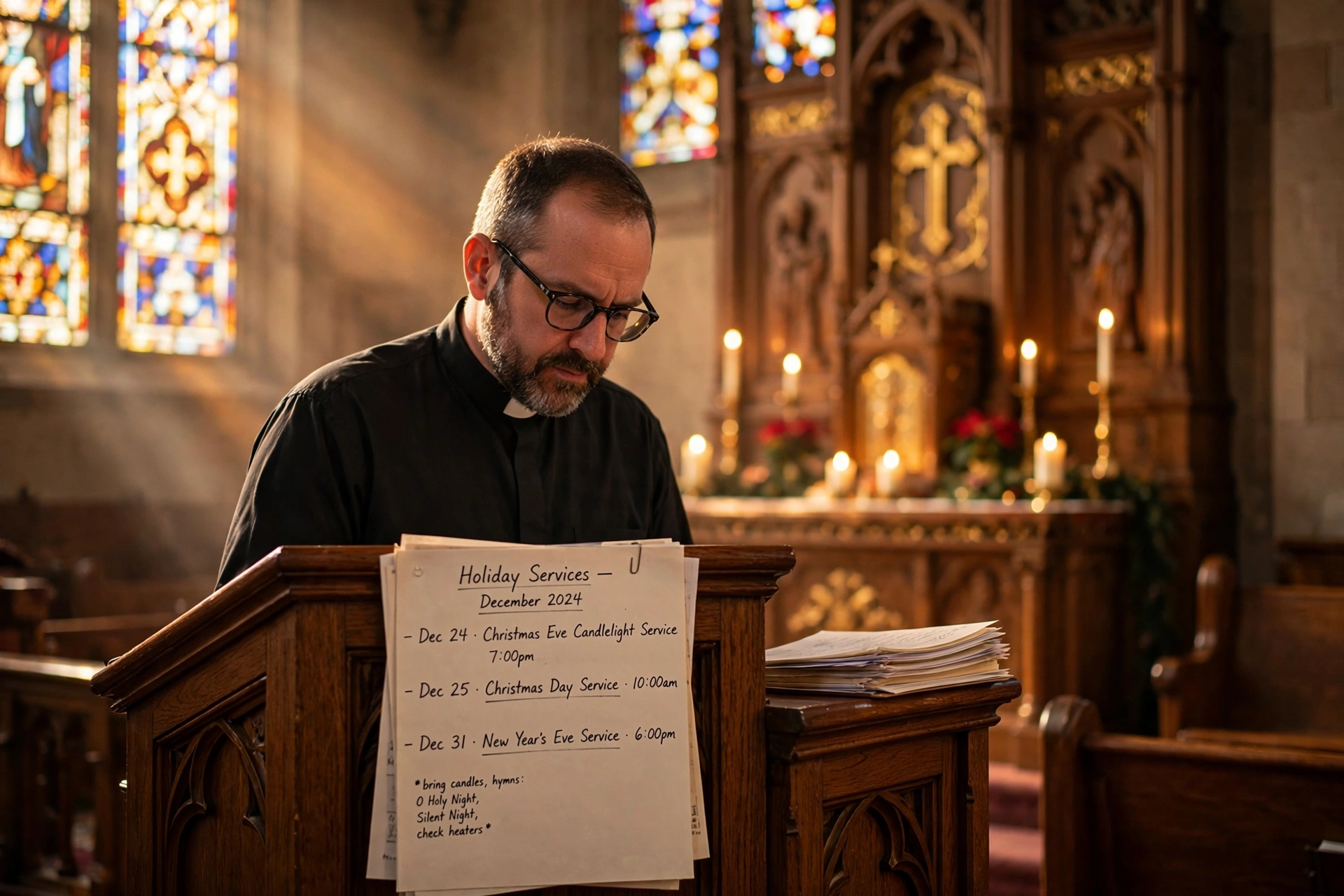
Begin by marking all non-negotiable dates on the master calendar. This includes the actual holiday, rehearsal dates, and clergy "blackout dates" for family time. By establishing these early, you prevent the common mistake of scheduling a mandatory choir rehearsal on a day the lead pastor is unavailable.
Phase 2: Capacity and Resource Mapping
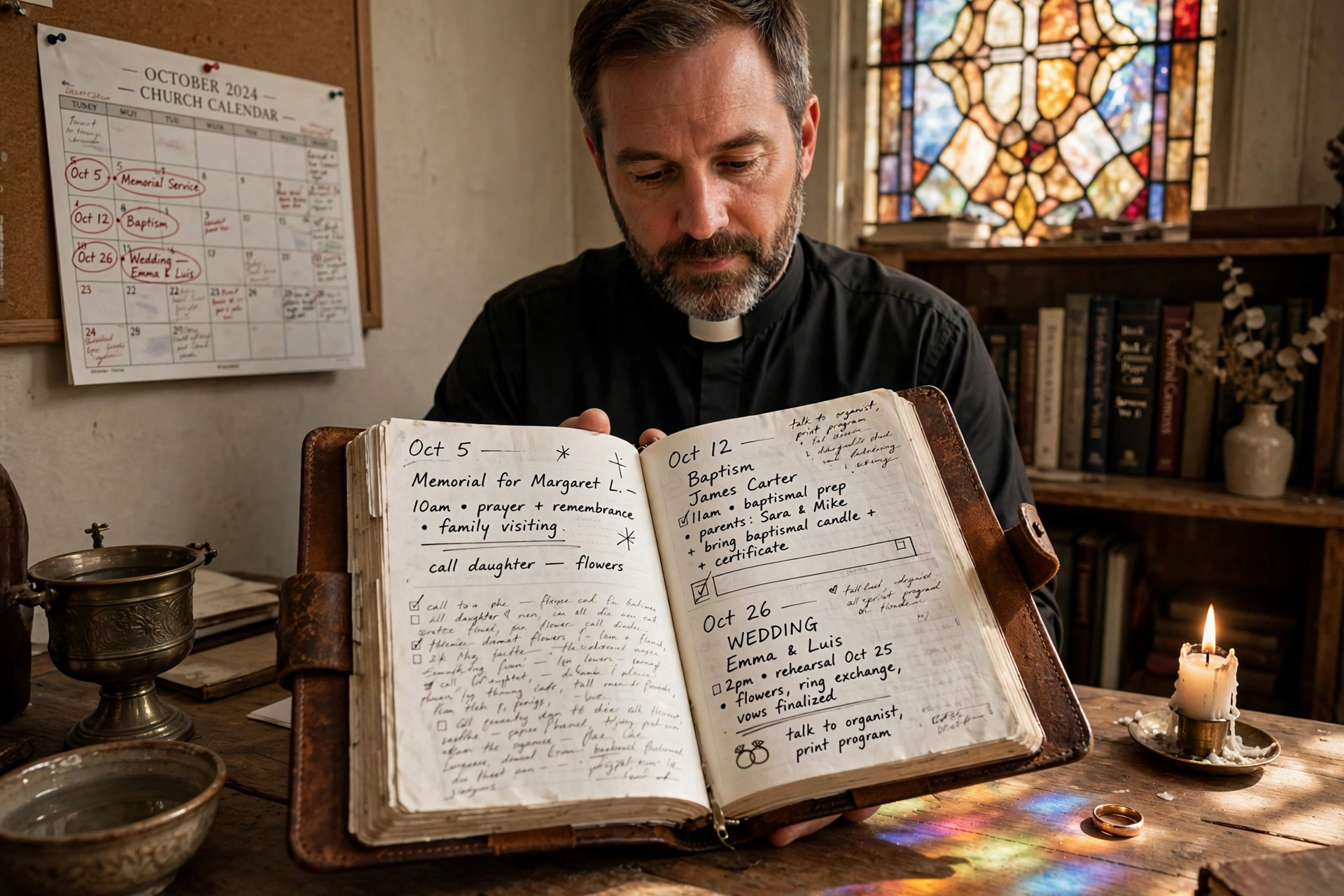
Before announcing service times, map your resources. Do you have enough volunteers for three services, or only two? Does the sanctuary require a specific setup for a candlelight service that will take two hours to implement? This is where you should reference your guide on manage calendars for baptisms, weddings, and funerals to ensure no overlapping private events are scheduled during the holiday window.
Phase 3: The Volunteer Rotation Matrix
Avoid the "favorite volunteer" trap. Instead of asking the same five people to work every holiday, create a rotation matrix. Use digital scheduling to allow volunteers to sign up for specific slots. This transparency reduces resentment and ensures that the burden of service is shared across the congregation.
Phase 4: Digital Integration and Communication
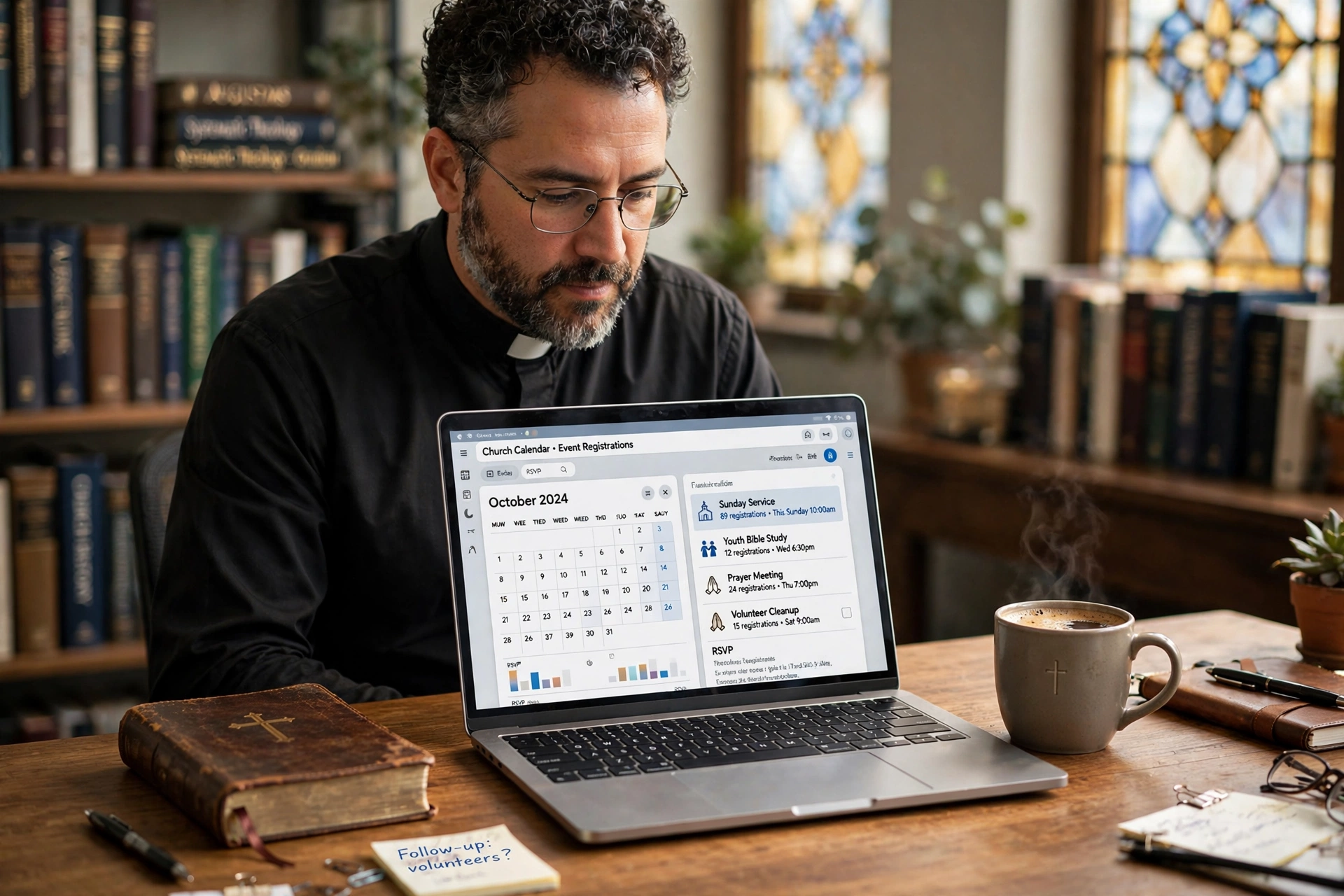
Once the schedule is set, it must be communicated instantly. Integration is key. If your registrations for special events are not synced with your calendar, you will inevitably overbook. We highly recommend integrating event registrations directly with pastor calendars to automate the flow of information and reduce manual entry errors.
Comparing Scheduling Approaches for 2026
Depending on the size and tech-savviness of your church, you likely fall into one of these three categories. The difference in efficiency is stark.
| Feature | Traditional Manual Approach | Generic/Cheap AI Tools | Pastor Agenda Modern Approach |
|---|---|---|---|
| Coordination | Paper calendars & emails | Fragmented chatbots | Centralized ministry hub |
| Error Rate | High (Double-bookings) | Moderate (Hallucinations) | Very Low (Real-time Sync) |
| Volunteer UX | Manual texting/calling | Confusing generic forms | Direct portal booking |
| Pastoral Stress | Maximum (Constant pings) | Moderate (Technical glitches) | Minimum (Automated flow) |

Common Mistakes to Avoid When Scheduling Holidays
In my years of observing church administration, I have seen the same three errors repeat across different denominations. Avoiding these will put you in the top 10% of organized ministries.
1. The "Buffer Time" Fallacy
Many pastors schedule services back-to-back (e.g. 9:00 AM and 10:00 AM) without accounting for the "human element." People move slowly, bathrooms need cleaning, and the worship team needs a moment to breathe. Always include a 20-to-30 minute buffer between high-capacity services. If you don't, the second service will always start late, regardless of how professional your team is.
2. Over-Reliance on Memory
"I think the choir is available at 4:00 PM" is a dangerous sentence. In a high-stress holiday environment, memory fails. Everything must be documented in a shared digital space. When we built the scheduling logic at Pastor Agenda, we focused on a "single source of truth" philosophy. If it isn't on the digital calendar, it doesn't exist.
3. Neglecting Post-Service Logistics
Scheduling often ends when the service starts. However, the most chaos usually happens after the service. Who is responsible for shutting down the AV system? Who ensures the sanctuary is locked? Who manages the parking lot exit? Include these "wrap-up" tasks as specific line items in your schedule to avoid leaving the burden on the pastor.
Best Practices for Maximum Efficiency
To truly excel in 2026, your ministry should adopt these advanced habits:
- Implement a "Freeze Date": Set a date (e.g. December 1st) after which no more changes can be made to the holiday schedule. This prevents the "last-minute shuffle" that stresses out volunteers.
- Sermon Prep Blocks: Do not just schedule the service; schedule the preparation. Block out 4-hour chunks of "deep work" on the pastor's calendar for sermon writing and rehearsal. This protects the spiritual quality of the message from being eroded by administrative noise.
- Digital Self-Service: Allow members to see available slots for things like pastoral counseling or holiday prayer requests through an online portal. This removes the pastor as the "human switchboard."
💡
Key Takeaway
Professional holiday scheduling is about protecting the people, both the leaders and the volunteers, so that the spiritual focus of the service remains undisturbed by administrative friction.
Frequently Asked Questions
How far in advance should I schedule holiday services?
For major holidays like Christmas and Easter, the framework should be finalized at least 8 to 12 weeks in advance. This allows the music team to prepare complex arrangements and gives volunteers sufficient notice to arrange their personal lives. According to guidelines on leadership from Christianity Today, early planning reduces clergy stress and allows for more intentional spiritual preparation.
How do I handle overlapping volunteer needs for multiple services?
The best approach is a "tiered" volunteer system. Divide your team into primary and secondary groups. Use a digital scheduling tool to assign primary roles for the main service and secondary roles for early/late services. This prevents any single individual from working a 12-hour shift, which leads to exhaustion and mistakes during the service.
What is the best way to communicate schedule changes to the congregation?
Avoid relying solely on pulpit announcements. Use a multi-channel approach: an email blast, a dedicated page on your church website, and a push notification via your church app. Ensure that the link to the schedule is static and updated in real-time so that users aren't looking at outdated PDFs or image files from previous years.
How can I prevent double-booking the sanctuary for rehearsals and services?
Implement a centralized booking system where every rehearsal, sound check, and service is treated as a "hard event." Generic calendars often fail here because they don't account for set-up and tear-down time. Use a system like Pastor Agenda that allows for specific time-blocking and visibility across different ministry departments to ensure the sanctuary is clear before the next group arrives.
How do I balance the need for a strict schedule with the spontaneity of ministry?
Build "flexible windows" into your calendar. For example, instead of scheduling a rigid 15-minute window for a pre-service prayer, schedule a 30-minute block but aim for 15. This provides a safety net for the unexpected needs of the congregation without throwing the entire service timeline into disarray.
Recommended Readings
To deepen your understanding of these topics, we recommend reading the following articles:
- How to Integrate Event Registrations Directly with Pastor Calendars
- Ensuring Absolute Privacy in Church Booking Systems
- Church Appointment Booking
- Online Appointment Booking for Modern Churches
Conclusion
Scheduling holiday church services is not merely an administrative chore; it is a form of stewardship. By organizing your time, people, and resources with precision, you create a space where the congregation can encounter the divine without the distraction of logistical failure. Whether you are managing a small chapel or a mega-church, the shift from manual tracking to a professional scheduling system is the only way to scale your impact without sacrificing your mental health.
If you want to move beyond the chaos of spreadsheets and endless email threads, it is time to implement a system designed specifically for the needs of clergy. For a deeper dive into optimizing your entire operational flow, return to our comprehensive guide on organizing church events and services efficiently. Stop letting the logistics dictate your ministry and start leading with a clear, automated agenda.
Visit pastoragenda.com to discover how to reclaim your time this holiday season.
Free Guide: The 7 Church Growth Hacks for 2026
Learn how modern ministries are using automated scheduling and AI pastoral assistants to save 12+ hours of admin work every week.