📖This article is part of the complete guide to Ensuring Absolute Privacy in Church Booking Systems.
Managing sensitive spiritual records isn't just a matter of ethics; in 2026, it is a matter of rigorous legal compliance. When a congregant shares a deep struggle during a session, the data generated, from the appointment time to the session notes, becomes a liability if not stored correctly. I have seen too many ministries rely on simple spreadsheets or unsecured email threads, mistakenly believing that the 'sacred' nature of the work exempts them from secular data laws. The reality is that once data enters a digital system, it is subject to the laws of the land.
For a comprehensive overview of the broader landscape, explore our guide on church booking system privacy.
What is Pastoral Counseling Data Compliance?
📚
Definition
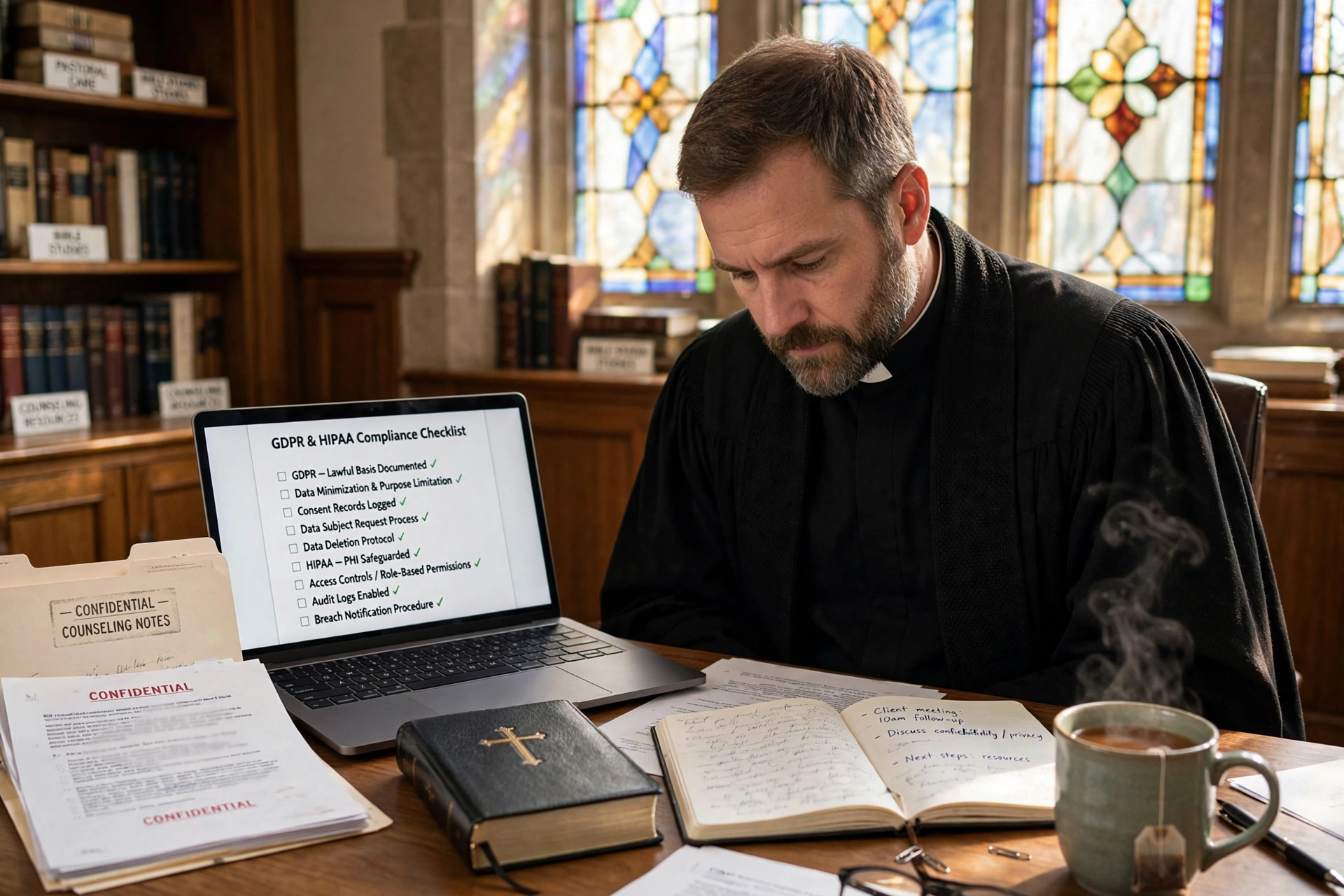
Pastoral counseling data compliance refers to the alignment of a ministry's data handling processes with legal frameworks, such as GDPR in Europe and HIPAA in the United States, that protect Personal Identifiable Information (PII) and Protected Health Information (PHI).
Pastoral counseling data compliance is the practice of ensuring that all digital and physical records related to spiritual care are stored, transmitted, and deleted according to strict legal standards. While many pastors view their role primarily as spiritual, the moment they use a digital tool to schedule an appointment or store a note about a member's mental health, they are interacting with data that laws seek to protect. In the United States, while clergy often have a 'privileged communication' status, this does not automatically grant immunity from data privacy laws if the church operates as a business entity or provides services that overlap with healthcare.
In my experience working with diverse congregations, the biggest gap is the 'trust gap.' Pastors trust their staff, and members trust their pastors, but trust is not a security protocol. Compliance requires technical safeguards, like end-to-end encryption, and administrative safeguards, such as strict access controls. When we developed the architecture for Pastor Agenda, we realized that a simple calendar wasn't enough; ministries needed a system that isolates sensitive data from general administrative views to prevent accidental leaks.

Why Does Compliance Matter for Your Ministry?
Compliance is not about bureaucracy; it is about protecting the flock from the consequences of a data breach. In an era where artificial intelligence is used to scrape data and cyberattacks on non-profits are rising, the risk of exposing a congregant's most private struggles is a catastrophic threat to the church's reputation and the individual's well-being.
First, the legal ramifications are severe. Under the General Data Protection Regulation (GDPR), fines for non-compliance can reach millions of euros or a percentage of global turnover. While most local churches aren't global corporations, the principle of 'data minimization', only collecting what is absolutely necessary, is a global standard. According to Barna Group, the trust relationship between a pastor and a member is the foundation of church growth; a single data leak can shatter that trust instantly, leading to a mass exodus of members who no longer feel safe.
Second, the overlap between pastoral care and mental health is significant. When a pastor provides counseling for depression, addiction, or trauma, they are handling information that mimics Protected Health Information (PHI). Although the Health Insurance Portability and Accountability Act (HIPAA) primarily targets "covered entities" (healthcare providers and insurers), many ministries find that adopting HIPAA-level standards is the only way to ensure a level of care that prevents legal challenges. Research from Church Law & Tax suggests that maintaining clear boundaries between spiritual guidance and clinical therapy is essential to avoid being legally classified as a healthcare provider, which would trigger full HIPAA mandates.
Third, the operational efficiency gained from compliance is immense. When you have a clear system for pastoral counseling data compliance, you no longer wonder where the files are or who has seen them. You move from a reactive state, hoping nothing goes wrong, to a proactive state of stewardship. By integrating tools like PastorAgenda Blog, ministries can automate the scheduling process while ensuring that the identity of the seeker remains shielded from general church staff.
How to Implement Data Compliance in Your Counseling Ministry
Implementing a compliance-first strategy requires a shift in how you view your digital tools. You cannot simply 'add' compliance to a broken process; you must build the process around the data's security.
Step 1: Conduct a Data Audit
Identify every touchpoint where a congregant's private information is captured. Does it happen in a Google Form? An email? A physical notebook? A generic calendar? Once you map the flow, you can identify the 'leaks.' For example, if a secretary schedules counseling appointments in a public church calendar, that is a major compliance failure.
Step 2: Implement Access Control
Not everyone in the church office needs to know who is seeing the pastor for counseling. Implement the 'Principle of Least Privilege' (PoLP). This means only the pastor and a designated confidential assistant should have access to counseling records. Using specialized scheduling software allows you to keep the booking process separate from the general church directory.
Step 3: Encrypt Data at Rest and in Transit
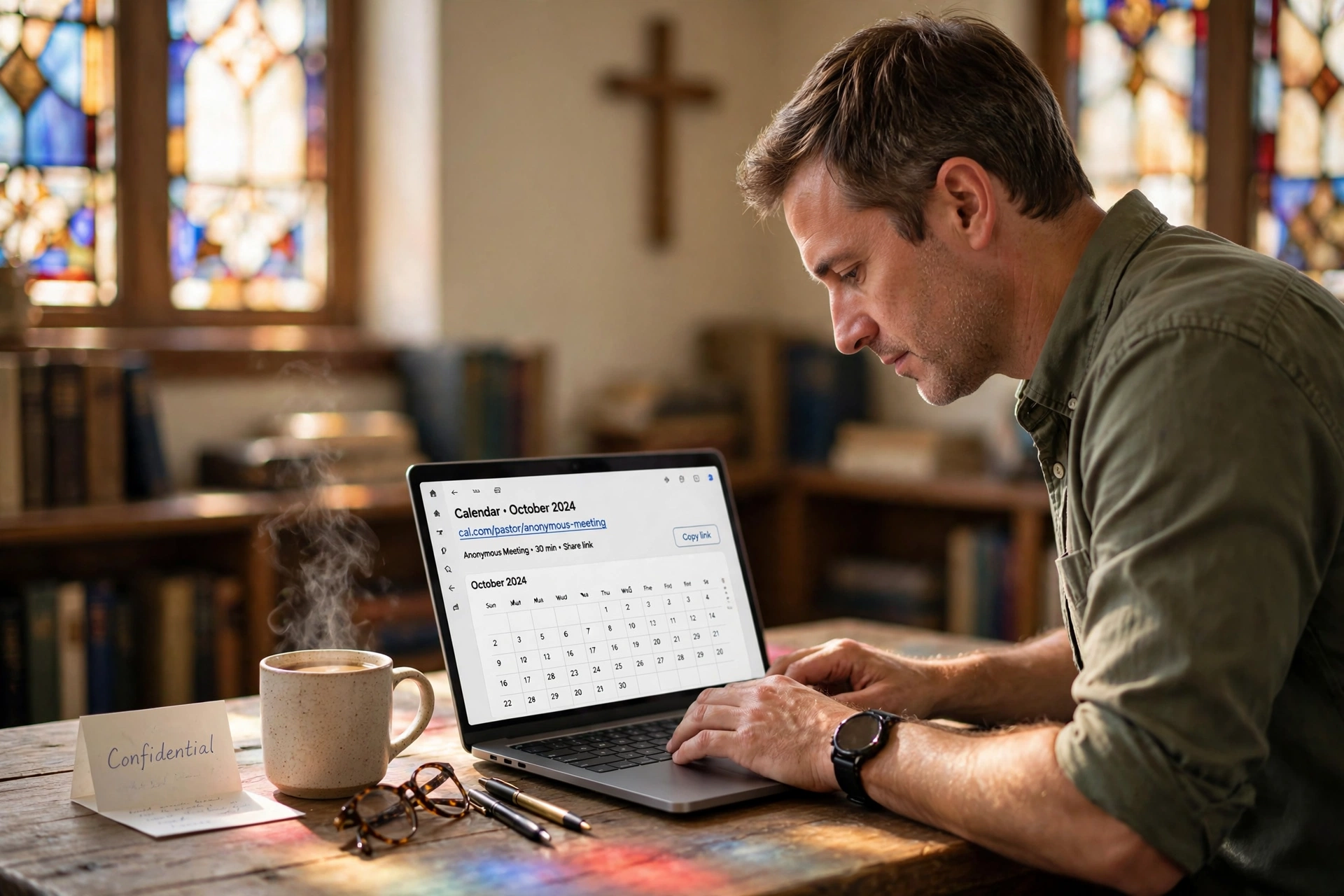
Ensure that any tool you use employs AES-256 encryption. If you are sending a confirmation email, it should not contain the reason for the visit. Instead, use a secure link. This is why we recommend looking into how to offer anonymous scheduling links for confidential meetings, as it removes the need to store sensitive 'reason for visit' text in an insecure email subject line.
Step 4: Establish a Data Retention and Deletion Policy
Data should not be kept forever. Establish a policy where session notes are archived or deleted after a specific period (e.g. 7 years), provided there is no legal requirement to keep them. This reduces the 'blast radius' in the event of a hack.
Step 5: Train Your Team
Technical tools are useless if a staff member shares a password or leaves a laptop unlocked. Regular training on protecting congregant privacy in digital booking platforms ensures that the human element of the security chain remains strong.
| Aspect | Traditional Approach | Generic AI/Free Tool Approach | Modern Compliant Approach |
|---|---|---|---|
| Storage | Physical notebooks/Paper | Unsecured Cloud/Google Sheets | Encrypted Dedicated Database |
| Access | Shared office folders | Open shared logins | Multi-factor Authentication (MFA) |
| Privacy | 'Trust-based' verbal agreements | Basic password protection | Zero-knowledge encryption & PoLP |
| Audit Trail | None (Manual) | Limited history | Full immutable audit logs |
Common Mistakes in Pastoral Data Management
One of the most frequent errors I encounter is the 'Assumption of Exemption.' Many leaders believe that because they are a non-profit religious organization, GDPR or HIPAA simply does not apply to them. This is a dangerous misconception. If you have members from the EU, GDPR applies regardless of where your church is located. If you collaborate with licensed clinical therapists, you may be entering a 'Business Associate' territory under HIPAA.
Another common mistake is using 'all-in-one' church management software for counseling. While these systems are great for tracking tithes and attendance, they are often not designed for the extreme privacy required for pastoral care. Mixing a member's financial record with their confession of a struggle is a recipe for a privacy disaster. You need a dedicated silo for counseling data.
Furthermore, many ministries ignore the 'Right to be Forgotten.' Under GDPR, individuals have the right to request the deletion of their personal data. If your data is scattered across five different spreadsheets and three email accounts, fulfilling this request becomes an administrative nightmare. A centralized, compliant system makes this a one-click process.
Finally, relying on 'hidden' calendars is a fallacy. Moving a calendar from 'Public' to 'Private' in a generic tool doesn't make it compliant; it just makes it less visible. True compliance requires that the data is encrypted so that even the service provider cannot read the content of the appointment.

Deep Dive: The Intersection of AI and Data Privacy in 2026
As we move further into 2026, many ministries are tempted to use artificial intelligence to summarize session notes or analyze trends in congregational needs. While the efficiency is tempting, the risk to pastoral counseling data compliance is immense. Most public AI models use input data to train their future iterations. If a pastor pastes a sensitive session summary into a public AI tool, that data is no longer private; it has been ingested into a corporate model.
To maintain compliance, ministries must only use 'Private AI' instances, where the data is siloed and not used for training. The gold standard is to use tools that provide a BAA (Business Associate Agreement) if they are acting as a data processor. If your tool doesn't offer a BAA or a clear GDPR data processing agreement, you should not use it for counseling data.
Frequently Asked Questions
Is a pastor legally required to follow HIPAA laws?
In most cases, pastors are not 'covered entities' under HIPAA because they do not bill insurance companies for their services. However, if a pastor works in a clinical capacity or partners with a medical facility, they may fall under HIPAA. Regardless of the legal mandate, following HIPAA standards for data storage is the best practice for any ministry handling sensitive mental health information to avoid liability and ensure the highest level of congregant care.
How does GDPR apply to a local church in the US?
GDPR applies to any organization that processes the personal data of individuals located in the European Union, regardless of the organization's physical location. If your church has members who are EU citizens or residents, you must adhere to GDPR principles, including the right to access data and the right to erasure. Failure to do so can lead to legal complications for the organization's digital presence and potential fines if the data is processed via EU-based servers.
Can I use a standard Google Calendar for counseling appointments?
Using a standard Google Calendar for counseling is generally not recommended for high-privacy needs. While Google has security measures, a standard calendar lacks the granular access controls and the 'anonymous' layer required for sensitive pastoral care. For true compliance, you need a system where the appointment exists but the sensitive details are encrypted and separated from the primary administrative account, such as those provided by Pastor Agenda.
What is a BAA and why do I need one?
A Business Associate Agreement (BAA) is a legal contract between a service provider (like a software company) and a covered entity. It ensures that the provider will protect PHI according to HIPAA standards. While a church may not always be a covered entity, insisting on a BAA from your software provider is a sign that the tool is built for professional-grade privacy and is a critical component of a robust pastoral counseling data compliance strategy.
How should I handle physical session notes?
Physical notes should be treated with the same rigor as digital data. They should be stored in locked filing cabinets with restricted key access. When notes are no longer needed, they should be destroyed using a cross-cut shredder, not simply thrown in the trash. A digital transition to a secure, encrypted platform often reduces the risks associated with physical records, which can be easily lost or stolen during a move or office transition.
Recommended Readings
To deepen your understanding of these topics, we recommend reading the following articles:
- How to Offer Anonymous Scheduling Links for Confidential Meetings
- How to Protect Congregant Privacy in Digital Booking Platforms
- Church Appointment Booking
- Online Appointment Booking for Modern Churches
Conclusion
Pastoral counseling data compliance is not about limiting the ministry's reach; it is about creating a sanctuary of safety. When a member knows that their most vulnerable moments are protected by the highest standards of digital security, be it GDPR, HIPAA, or internal church ethics, they are more likely to seek the help they need. Relying on outdated methods or generic tools is a risk that no modern ministry should take in 2026.
By auditing your data flow, implementing strict access controls, and using dedicated tools, you transition from a state of vulnerability to a state of stewardship. Your primary focus should be the spiritual health of your people, not the fear of a data breach. To ensure your systems are fully aligned with these standards, we invite you to review our comprehensive guide on Ensuring Absolute Privacy in Church Booking Systems.
For a professional, secure, and compliant way to manage your ministry's schedule, visit PastorAgenda Blog and start protecting your congregation today.
Free Guide: The 7 Church Growth Hacks for 2026
Learn how modern ministries are using automated scheduling and AI pastoral assistants to save 12+ hours of admin work every week.