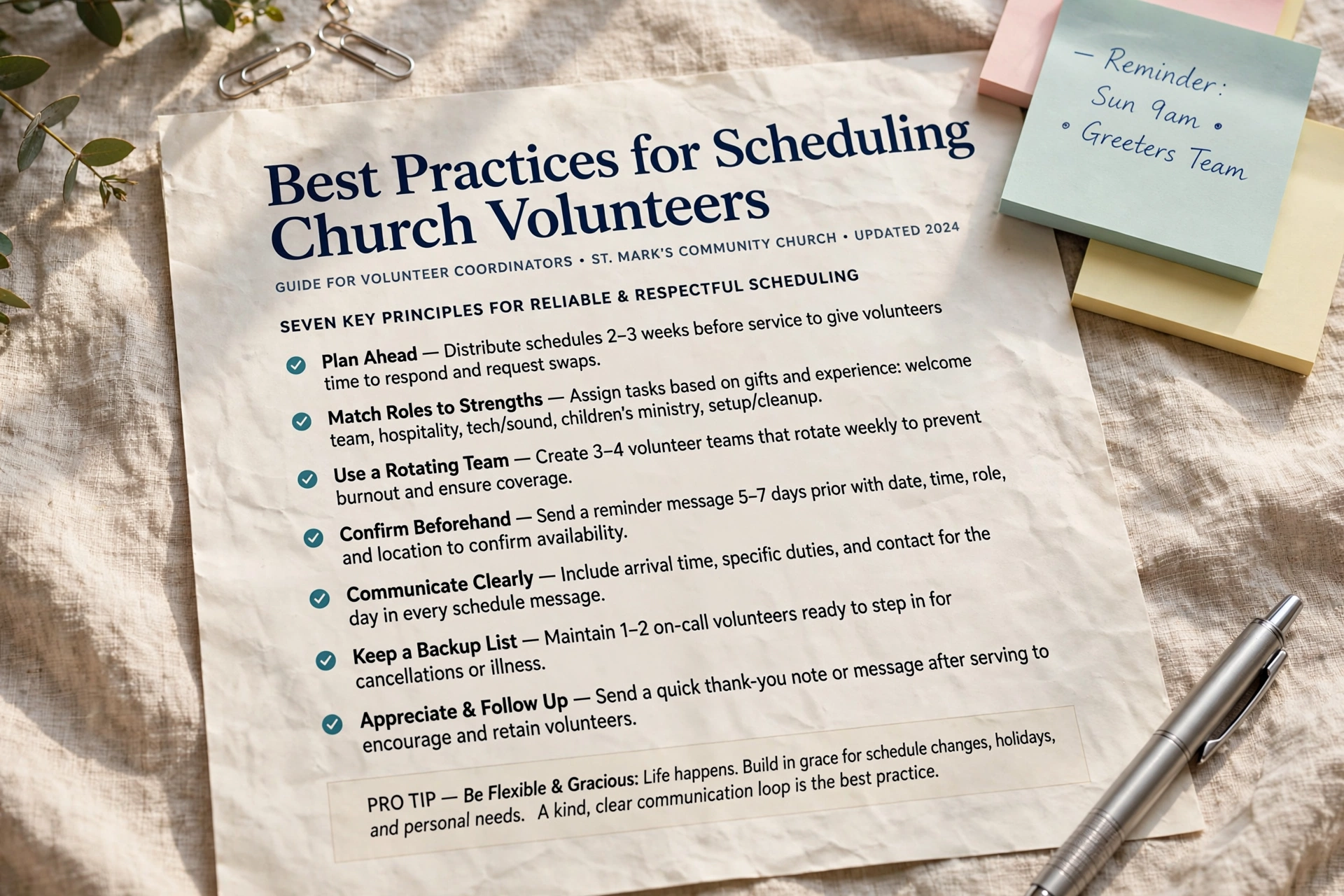
📖This article is part of the complete guide to Best Practices for Scheduling Church Volunteers.
Managing a rotating team of ushers, worship leaders, and nursery workers via a giant group text thread is a recipe for administrative collapse. In my experience working with medium-sized congregations, the moment a church hits the 150-member mark, the "manual method" of scheduling typically breaks. I've seen pastors spend four hours a week just confirming if the sound technician is actually showing up on Sunday morning. This friction doesn't just cause stress; it creates a barrier to entry for new volunteers who find the onboarding process confusing and disorganized.
For a comprehensive overview of the strategic side of this process, explore our guide on church volunteer scheduling.
What is a Volunteer App for Churches?
📚
Definition
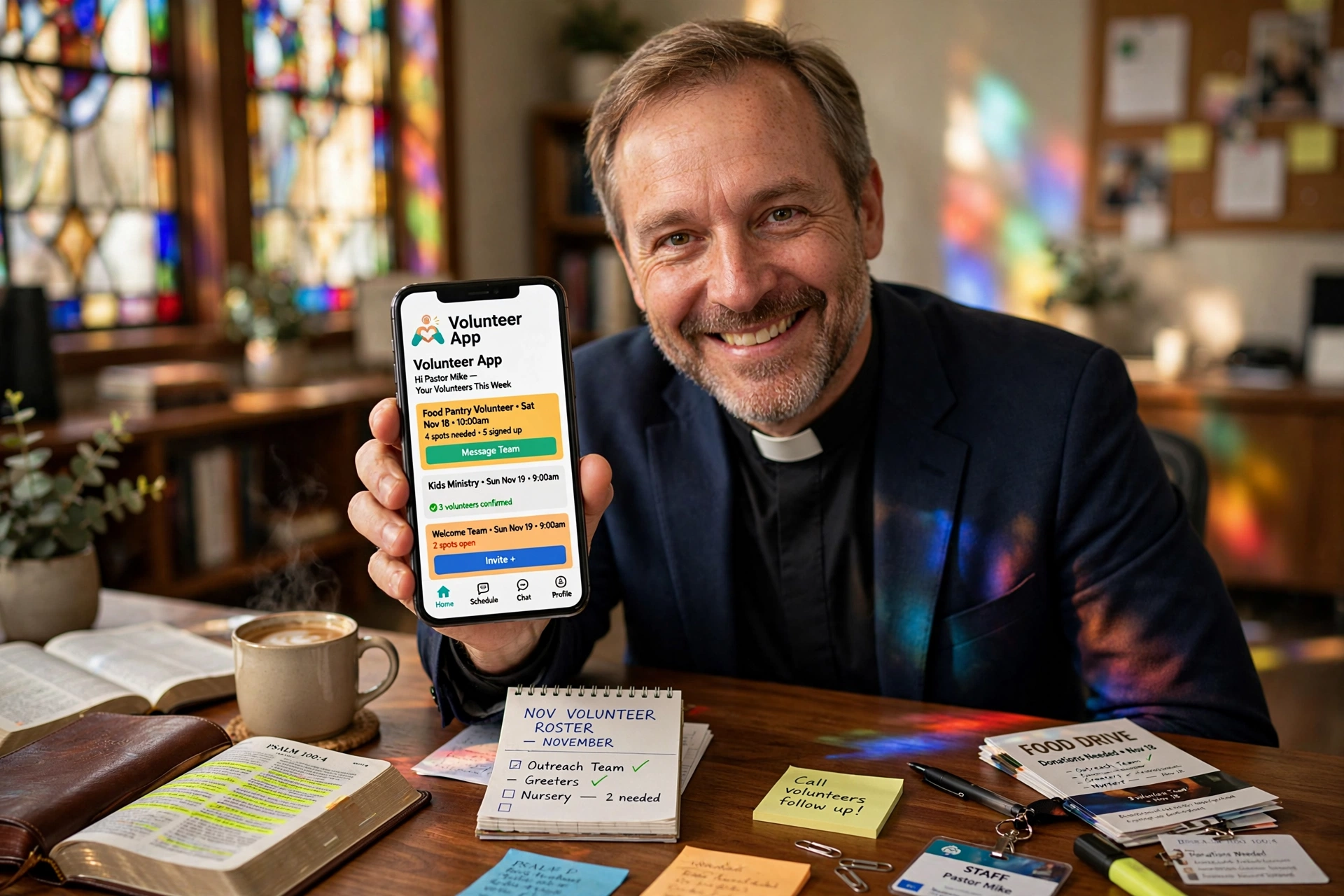
A volunteer app for churches is a specialized software solution designed to coordinate personnel, manage availability, and distribute schedules for ministry teams within a faith-based community.
Unlike a generic project management tool, a dedicated volunteer app for churches focuses on recurring rotations and the relational nature of ministry. It isn't just about filling a slot on a calendar; it is about ensuring that the right person is in the right place at the right time, while maintaining a healthy balance of service to prevent burnout.
When we analyzed how various ministries use these tools at Pastor Agenda, we discovered that the most successful churches don't treat the app as a replacement for pastoral care, but as the administrative foundation that frees the pastor to actually perform that care. Instead of spending a Sunday morning chasing down a missing greeter, the leader can focus on the congregation. These apps typically handle the heavy lifting: automated reminders, self-service availability updates, and centralized communication hubs.
For those looking to specifically optimize their technical teams, our guide on how to automate scale schedules for musicians and ushers provides deeper technical insights into the synchronization of complex rotations.

Why Choosing the Right Volunteer App Matters for Your Ministry
The administrative burden of managing a congregation often falls on a few dedicated individuals. When this process is manual, the "cognitive load" on the leader becomes immense. According to research by the Barna Group, pastoral burnout is a growing concern, often driven by the accumulation of small, administrative stressors rather than a single catastrophic event. A fragmented scheduling process is exactly the kind of "death by a thousand cuts" that leads to leadership fatigue.
Using a professional volunteer app for churches transforms the volunteer experience from a chore into a streamlined act of service. When a volunteer receives a push notification 48 hours before their shift, they feel seen and organized. Conversely, when they have to scroll through 50 messages in a WhatsApp group to find their date, they feel like an afterthought. This psychological shift directly impacts retention rates within the ministry.
Furthermore, the legal and safety implications of disorganized scheduling are significant. In children's ministries, knowing exactly who is on-site and ensuring that background-checked adults are correctly paired is not just a preference; it is a safety mandate. A robust scheduling system provides a digital paper trail of who was serving where and when, which is essential for church governance and liability management. This aligns with the operational standards suggested by Church Law & Tax, emphasizing that clear administrative records reduce institutional risk.
How to Implement a Volunteer App Successfully
Implementing new technology in a church environment requires more than just a login and password; it requires a cultural shift. Many volunteers may be resistant to "another app" on their phone. To overcome this, you must lead with the benefit of time and clarity.
Step 1: Audit Your Current Rotations
Before migrating to a volunteer app for churches, map out every single single recurring role. Don't just list "Worship Team." Break it down: Lead Vocal, Backup Vocal, Acoustic Guitar, Electric Guitar, Drummer, Sound Engineer. If you don't have a granular list, your app will be a mess from day one.
Step 2: Define Availability Constraints
One of the biggest mistakes I see is failing to set boundaries. Use the app to establish "blackout dates" or frequency limits. For example, if a nursery worker should only serve once a month to avoid burnout, the system should enforce that. For more on this, see our analysis on how to reduce volunteer burnout in ministry with smart calendar rules.
Step 3: The Onboarding Phase
Do not simply email a link to the app. Hold a brief 15-minute training session after a service. Show them how to mark their "unavailable" dates. When volunteers realize they can manage their own time without texting the pastor, the adoption rate skyrockets.
Step 4: Integration with Pastoral Care
Ensure the app is integrated into your broader communication strategy. Use the app for the logistics (who, where, when) but keep the relationship (how are you doing?) in personal conversations or phone calls. This prevents the ministry from feeling mechanical.
Comparing Scheduling Approaches
Many churches struggle to decide between a manual process, a cheap generic tool, or a dedicated ministry solution. The following table illustrates the operational difference:
| Feature | Manual (Spreadsheets/Text) | Generic AI/Business Apps | Professional Ministry Approach |
|---|---|---|---|
| Setup Time | Low (initially) | Medium | Medium (high initial value) |
| Error Rate | High (double bookings) | Medium (hallucinations) | Low (validated rotations) |
| Volunteer UX | Frustrating/Confusing | Cold/Corporate | Intuitive/Supportive |
| Communication | Fragmented (many threads) | Generic Emails | Centralized & Targeted |
| Accountability | None (verbal) | Basic Logs | Audit-Ready History |
Common Mistakes When Selecting a Volunteer App for Churches
In my years of consulting with ministry leaders, I have noticed a recurring pattern of failures when introducing new software. The first and most common mistake is over-complicating the feature set. A small church does not need a full-scale ERP (Enterprise Resource Planning) system. They need a reliable way to see who is serving this Sunday. When you choose a tool that is too complex, your volunteers will abandon it, and you will return to the dreaded group text.
Another frequent error is ignoring the mobile experience. Most church volunteers are not sitting at a desk when they check their schedules; they are at work, in their car, or at home. If the volunteer app for churches you select has a clunky mobile interface or requires a desktop for basic changes, it will fail. The friction of the interface must be lower than the friction of a text message.
Thirdly, many leaders fail to set up a clear "substitution protocol." The app is a tool, not a miracle. If a volunteer cannot make it, there must be a clear, app-driven way to find a replacement. If the process is "text the pastor and he'll find someone," the app hasn't actually solved the problem; it has just moved the data to a different screen.
Finally, there is the mistake of underestimating the need for centralization. I often see churches using one app for the worship team, a different spreadsheet for the ushers, and a physical calendar for the nursery. This creates silos of information. A unified approach, using a cohesive church volunteer scheduling software system, allows the leadership to see the total volunteer load across the entire congregation, preventing the same three "reliable people" from being tapped for every single ministry.

Pro Tip: The "Low-Friction" Onboarding Secret
If you are facing resistance from older volunteers who aren't tech-savvy, don't force the app on them immediately. Instead, use the app as your internal source of truth, but continue to send them a simplified text summary for the first month. Once they see how organized the process has become for everyone else, they usually become curious about how to access the information themselves. Transitioning from "manual" to "digital" is a psychological journey, not just a technical installation.
Deep Dive: The Role of Artificial Intelligence in Scheduling
As we move through 2026, the integration of artificial intelligence (AI) into scheduling software is becoming a standard. Modern apps are moving beyond simple calendars toward "predictive scheduling." This means the system can suggest the most likely replacement for a vacant slot based on historical data and stated preferences.
However, a word of caution: AI should never replace the pastoral eye. An algorithm might see that a volunteer is "available" and "qualified," but it doesn't know that the volunteer is currently going through a family crisis and needs a season of rest. The best use of AI in a volunteer app for churches is to handle the mathematics of the schedule so the pastor can handle the ministry of the people. This balance ensures that the efficiency of technology serves the empathy of the church.
Frequently Asked Questions
Which volunteer app for churches is best for very small congregations?
For very small churches, the best app is one that prioritizes simplicity and zero-cost or low-cost entry. You should look for tools that offer a "freemium" tier and focus on mobile accessibility. The goal for a small church is to eliminate the "mental overhead" of remembering who is serving without introducing a learning curve that alienates your small pool of volunteers. Focus on features like automated SMS reminders and a simple digital sign-up sheet.
How do I stop volunteers from ignoring app notifications?
Notification fatigue is real. To combat this, ensure that your app is configured to send a specific sequence: a notification one week prior, a reminder 48 hours before, and a final "day-of" alert. More importantly, establish a culture where the app is the only place where the official schedule lives. If you continue to send manual texts, volunteers will ignore the app. When the app becomes the single source of truth, they will check it habitually.
Can these apps help with background checks for children's ministry?
While most volunteer apps for churches focus on scheduling, high-end systems often integrate with third-party verification services or allow you to upload a "verified" badge to a volunteer's profile. This is essential for compliance. By linking the schedule to the verification status, you can ensure that no single adult is ever scheduled alone with a child, which is a critical safety standard for modern church governance.
What happens if my volunteers aren't tech-savvy?
This is a common challenge in many congregations. The solution is to choose an app with a "guest view" or a simple link-based schedule that doesn't require a full account creation for the most basic tasks. Additionally, designate a "Tech Shepherd", a young, tech-savvy volunteer, to help the elders set up their phones. Often, the resistance isn't to the technology itself, but to the fear of doing it wrong. A little personal guidance removes that barrier.
How does a scheduling app prevent volunteer burnout?
Burnout happens when the same few people are asked to serve every single week because they are the only ones who say "yes." A professional app allows you to visualize the distribution of service. You can set rules that prevent a person from being scheduled more than twice a month, or create "automatic breaks." By diversifying the load and making it easy for new people to sign up, you move from a "hero-based" ministry to a "system-based" ministry.
Recommended Readings
To deepen your understanding of these topics, we recommend reading the following articles:
- Ensuring Absolute Privacy in Church Booking Systems
- Church Appointment Booking
- Online Appointment Booking for Modern Churches
- Automated Reminders and Communication for Congregations
Conclusion
Choosing the right volunteer app for churches is not about finding the most features; it is about finding the lowest friction. When the administrative layer of your ministry becomes invisible, the actual ministry can flourish. By moving away from chaotic text threads and into a structured system, you protect your leaders from burnout and your volunteers from confusion.
Remember that technology is a tool, not the mission. The goal is to spend less time on the screen and more time with the people in your pews. If you are ready to move beyond the basics and build a sustainable culture of service, we highly recommend revisiting our comprehensive guide on church volunteer scheduling to align your tools with your vision.
To start streamlining your leadership and reclaim your time, visit PastorAgenda Blog and discover how specialized scheduling can transform your ministry's efficiency.
Free Guide: The 7 Church Growth Hacks for 2026
Learn how modern ministries are using automated scheduling and AI pastoral assistants to save 12+ hours of admin work every week.