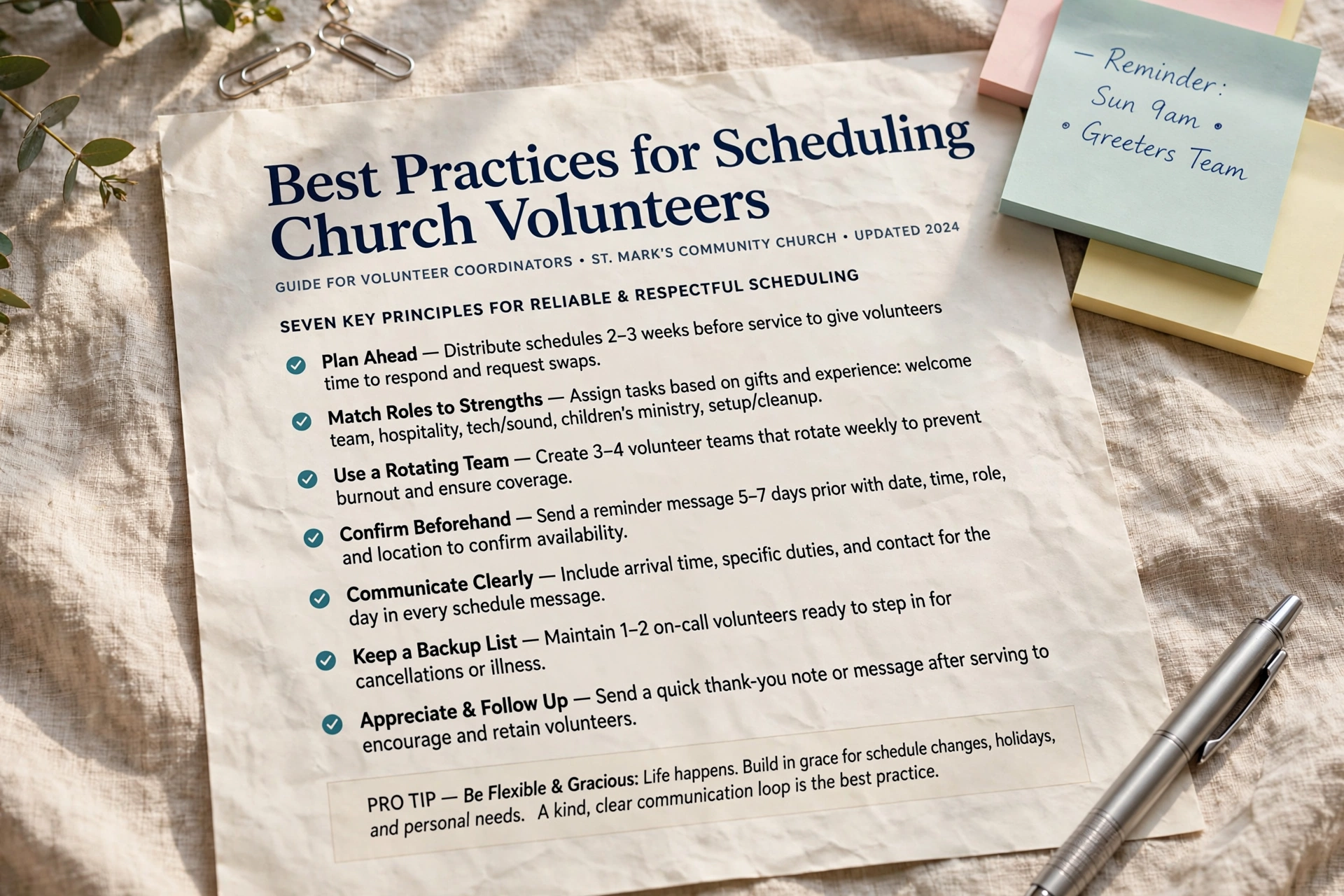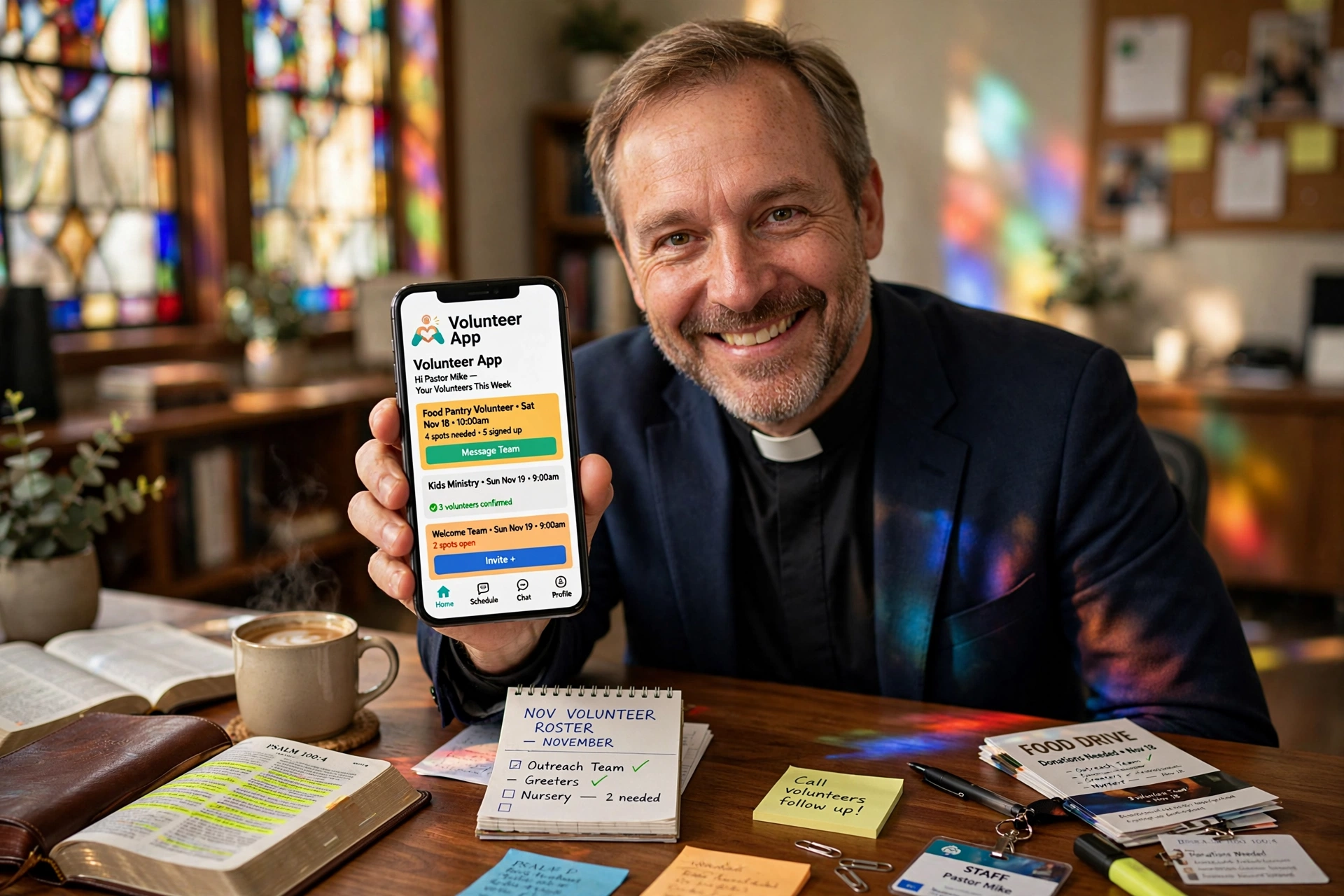
📖This article is part of the complete guide to Best Practices for Scheduling Church Volunteers.
In my experience working with growing congregations, the most dangerous phrase a ministry leader can utter is, "They don't mind helping out more." I have seen dedicated worship leaders and ushers push through months of exhaustion because of a misplaced sense of duty, only to suddenly vanish from the roster entirely. When a volunteer reaches the breaking point, it isn't usually because they lack faith or passion; it is because the administrative system failed to protect their boundaries. In 2026, the mental health of church servants is a strategic priority, and the only way to protect it is through the rigorous application of smart calendar rules.
For a comprehensive overview of how to build a sustainable system, explore our guide on church volunteer scheduling.
What is Volunteer Burnout in Ministry?
📚
Definition
Volunteer burnout in ministry is a state of emotional, physical, and spiritual exhaustion caused by prolonged exposure to high-stress roles or excessive scheduling without adequate recovery periods.
Volunteer burnout in ministry occurs when the demands placed on a servant exceed their available internal resources. Unlike professional burnout, where a paycheck often provides a baseline of endurance, ministry burnout is driven by a "passion trap." Because the work is for the glory of God, volunteers often ignore the physical signs of fatigue, leading to a collapse in morale and an eventual exit from the ministry.
When we analyze the patterns of burnout at Pastor Agenda, we consistently find that it isn't the amount of work that kills motivation, but the unpredictability and lack of boundaries surrounding that work. A volunteer can handle a demanding four-hour shift every Sunday if they know they have the following three Sundays off. However, when the scheduling is reactive, meaning they are called upon at the last minute to fill gaps, the cognitive load increases. This "on-call anxiety" creates a state of perpetual low-level stress that eventually leads to total burnout.
To combat this, ministry leaders must shift from a "gap-filling" mindset to a "capacity-management" mindset. This means treating volunteer time as a finite resource that must be budgeted and protected. If you treat your volunteers' time as an infinite well, you will eventually find that well run dry. By implementing smart calendar rules, you create an automated barrier that prevents the human error of over-scheduling, ensuring that your congregation remains healthy and engaged for the long haul.

Why Does Preventing Burnout Matter for Your Church?
Preventing volunteer burnout in ministry is not just about being "nice" to your team; it is a matter of organizational survival and spiritual stewardship. According to Barna Group, pastoral health and the health of the lay-leadership are intrinsically linked to the overall growth and stability of the congregation. When a core group of volunteers burns out, the remaining few are forced to pick up the slack, creating a domino effect that can paralyze entire ministries within a single quarter.
First, burnout destroys the quality of worship and service. A burnt-out usher is less welcoming; a fatigued worship leader lacks spiritual vibrancy. When the servants are exhausted, the atmosphere of the church shifts from one of joy to one of obligation. This is a dangerous transition because the congregation senses the tension, which can inadvertently alienate new visitors.
Second, the cost of replacing a seasoned volunteer is significantly higher than the cost of maintaining one. In a church setting, "replacement cost" isn't measured in dollars, but in institutional knowledge and relational trust. A volunteer who has served for ten years knows the nuances of the soundboard or the specific needs of the elderly members in the third row. When that person leaves due to burnout, you lose a decade of intuitive ministry that cannot be replaced by a new recruit in a weekend.
Third, the ethical dimension of leadership requires that we do not exploit the willingness of others. Christianity Today has frequently highlighted that sustainable leadership must prioritize the Sabbath and rest. If a church's scheduling system requires volunteers to work six Sundays in a row, the organization is effectively campaigning against the very biblical principles of rest it likely preaches from the pulpit.
By focusing on burnout prevention, you increase retention rates and create a culture where people feel valued as humans, not just as "slots" on a spreadsheet. This shift in culture encourages more people to step forward and serve, as they see a system that respects their family life and personal health.
How to Implement Smart Calendar Rules to Stop Burnout
Implementing smart calendar rules requires moving away from manual spreadsheets and toward an intelligent system. The core approach is to establish "hard boundaries" within your scheduling software that cannot be overridden without a specific, documented reason. This removes the guilt-based pressure that often leads to over-commitment.
Step 1: Establish Minimum Recovery Intervals
Define a mandatory "dark period" for every role. For example, a rule could state that no volunteer in the Worship Team can be scheduled for more than two consecutive Sundays. After the second Sunday, the system should automatically flag them as "unavailable" for the third. This ensures a guaranteed rhythm of rest.
Step 2: Create Role-Based Rotation Caps
Not all roles carry the same emotional weight. A greeter might be able to serve three weeks in a row, but a pastoral care volunteer dealing with grieving families may need a longer recovery. Set specific caps based on the emotional intensity of the ministry. In my experience, the most effective rosters use a "1-on, 2-off" or "2-on, 2-off" cadence to maintain high energy.
Step 3: Implement Blackout Dates and Conflict Detection
Use a system that allows volunteers to input their own blackout dates months in advance. Smart rules should prevent a leader from even seeing a volunteer as an option if there is a conflict. This eliminates the "Can you do it?" phone calls that put volunteers in the awkward position of having to say no to their pastor, which often leads them to say yes and then burn out.
Step 4: Automated "Burnout Alerts"
Set up triggers that notify the ministry leader when a specific person has hit a certain threshold of hours over a 30-day period. For instance, if a volunteer has served more than 20 hours in a month across multiple ministries, the system should send an alert saying: "Volunteer X is at high risk of burnout. Please review their current load."
Step 5: Use Dynamic Availability Polls
Instead of a static list, use a dynamic system where volunteers update their capacity every quarter. This acknowledges that a volunteer's life changes, perhaps a new job or a new baby, and allows the calendar to adapt to their current capacity rather than their past capacity.
For those struggling to manage these complex rotations, integrating a dedicated tool is essential. We've found that using PastorAgenda Blog allows leaders to set these boundaries once and let the software enforce them, removing the emotional friction from the scheduling process. If you want to see how these rules fit into a larger strategy, check out our guide on church volunteer scheduling.
The Traditional vs. Modern Approach to Ministry Scheduling
Many churches still operate on a "faith-based" scheduling model, hoping that volunteers will speak up when they are tired. However, the data shows that most volunteers will suffer in silence until they reach a breaking point. The following table compares the three common levels of scheduling maturity seen in ministries today.
| Feature | Traditional Approach (Manual/Paper) | Generic/Cheap AI Tool | Modern Approach (Pastor Agenda) | - |
|---|---|---|---|---|
| Boundary Setting | Verbal agreements, easily forgotten | Static dates, no logic | Smart rules with automated blocks | |
| Burnout Detection | Only noticed after the volunteer quits | No tracking of total load | Proactive alerts based on hours served | |
| Volunteer Input | Manual phone calls/emails | Simple form filling | Integrated availability profiles | |
| Scheduling Speed | Hours of manual cross-referencing | Fast, but prone to errors | Instant, rule-compliant generation | |
| Risk Level | Extremely high burnout risk | Moderate risk of hallucinations/errors | Low risk; systemic protection of rest |
Common Mistakes That Lead to Volunteer Burnout
Even with the best intentions, many leaders fall into patterns that accelerate burnout. Avoiding these pitfalls is as important as implementing the smart rules themselves.
The "Most Reliable Person" Fallacy
This is the most common mistake I see. Leaders tend to give the hardest and most frequent assignments to their most reliable volunteers because they know the job will get done. In effect, you are punishing your best servants with more work. If a volunteer always says "yes," you must be the one to say "no" for them. Use your calendar rules to force a rotation, even if it means using a less experienced volunteer who needs training.
Lack of a "Grace Period" for Transitions
When a volunteer moves from one ministry to another, there is often an overlap where they are doing both. For example, a musician might become a small group leader but continue to play every Sunday for six months. This "transition creep" creates an unsustainable workload. Ensure your rules include a transition period where the volunteer is removed from one roster before being added to another.
Ignoring the "Invisible Work"
Scheduling software often only tracks the event time (e.g. Sunday 9 AM - 12 PM). However, the actual work includes prep, travel, and emotional labor. A sermon preparation or a complex worship set requires hours of invisible work. When calculating burnout risk, add a "buffer multiplier" to the scheduled time. If a role takes 3 hours on Sunday, count it as 6 hours of capacity used.
The "Emergency Filling" Culture
When a vacancy opens 24 hours before a service, the instinct is to blast a group text to everyone. This creates a culture of anxiety where volunteers feel they must always be available. Instead, create a "Backup Tier" of volunteers who have specifically opted-in to be the emergency contact for that week, ensuring the rest of the team can truly disconnect.
Failure to Audit Capacity Quarterly
Many leaders set up a schedule in January and don't look at the totals until June. By then, the burnout has already happened. Conduct a quarterly audit of total hours served per person. If you see a spike, proactively mandate a "Sabbatical Month" for those individuals, regardless of whether they have asked for it.

How to Scale Your Ministry Without Breaking Your Team
Scaling a church often leads to a paradox: as the congregation grows, the demand for volunteers increases, but the available pool of healthy servants shrinks because the existing ones are burning out. To scale sustainably, you must move toward automation and specialized tools.
If you are dealing with large teams of musicians or ushers, the complexity of rotations becomes too much for a simple calendar. In these cases, you should look into How to Automate Scale Schedules for Musicians and Ushers to see how to apply these burnout rules at scale. For smaller churches that are just beginning to move away from paper, Evaluating the Best Volunteer Apps for Small and Medium Churches provides a framework for choosing tools that support these boundaries.
Ultimately, the goal of using Church Volunteer Scheduling Software: Coordinate Sunday Teams & Mid-Week Ministry is to create a system where the software handles the logistics so the pastor can focus on the people. When the administrative burden of scheduling is removed, the pastor can spend more time checking in on the spiritual health of the volunteers, rather than just checking if the 10 AM slot is filled.
Frequently Asked Questions
How do I tell a reliable volunteer they need to step back without offending them?
Frame the conversation around stewardship and longevity. Instead of saying, "You're doing too much," say, "We value you so much that we want to ensure you are with us for the next ten years, not just the next ten months. To protect your health and your family time, we are implementing a mandatory rest rotation." When you tie the restriction to a systemic rule (the "Smart Calendar Rule") rather than a personal judgment, it removes the sting and makes the volunteer feel cared for rather than rejected.
Can smart calendar rules actually decrease the number of volunteers available?
In the short term, it may seem like you have fewer "slots" filled because you are no longer over-using a few key people. However, this creates a vacuum that forces the congregation to step up. When the "super-volunteers" are forced to rest, others realize there is a need and are more likely to volunteer. Over time, this increases the total number of servants and decreases the dependency on a few individuals, which is the only way to achieve true organizational health and scalability.
What is the ideal ratio of "on' time to "off' time for a church volunteer?
While every ministry is different, a general benchmark for high-engagement roles (like worship or kids' ministry) is a 1:2 or 1:1 ratio. This means for every week they serve, they have at least one to two weeks of rest. According to National Association of Evangelicals (NAE), maintaining a balance between service and personal renewal is essential for preventing spiritual dryness. If your ratio is 3:1 (serving three weeks, resting one), you are in a high-risk zone for burnout.
How do I handle emergencies if the calendar rules block everyone?
Smart rules should have a "Emergency Override" function that only the lead pastor or ministry head can trigger. However, this should be used sparingly. If you find yourself overriding the rules every single week, it is a signal that your volunteer pool is too small, not that your rules are too strict. Use these overrides as a data point to trigger a new recruitment drive or to simplify the requirements of the role to make it more accessible to newcomers.
Does scheduling software really prevent burnout, or is it just an admin tool?
Scheduling software prevents burnout by removing the "human guilt factor." When a person is asked by a friend or a pastor to fill a gap, they feel an emotional obligation to say yes. When a software system says "Unavailable," the boundary is objective and non-negotiable. By automating the boundaries, you remove the emotional labor of saying no, which is one of the most exhausting parts of volunteering in a high-pressure church environment.
Recommended Readings
To deepen your understanding of these topics, we recommend reading the following articles:
- Evaluating the Best Volunteer Apps for Small and Medium Churches
- Ensuring Absolute Privacy in Church Booking Systems
- Church Appointment Booking
- Online Appointment Booking for Modern Churches
Conclusion
Reducing volunteer burnout in ministry is not a luxury; it is a fundamental requirement for a healthy, growing church. When we prioritize the rest of our servants, we are not just improving efficiency, we are modeling the biblical principle of the Sabbath. By implementing smart calendar rules, moving away from the "most reliable person" fallacy, and utilizing tools like Pastor Agenda, you create a sustainable ecosystem where people can serve from a place of overflow rather than exhaustion.
Remember that the goal of any ministry tool is to serve the people, not the other way around. If your current system is causing stress, it is time to audit your capacity and enforce the boundaries that protect your team. For a deeper dive into building these systems from the ground up, return to our comprehensive guide on best practices for scheduling church volunteers.
To start protecting your team today, visit pastoragenda.com and discover how smart scheduling can transform your ministry's health.
Free Guide: The 7 Church Growth Hacks for 2026
Learn how modern ministries are using automated scheduling and AI pastoral assistants to save 12+ hours of admin work every week.