
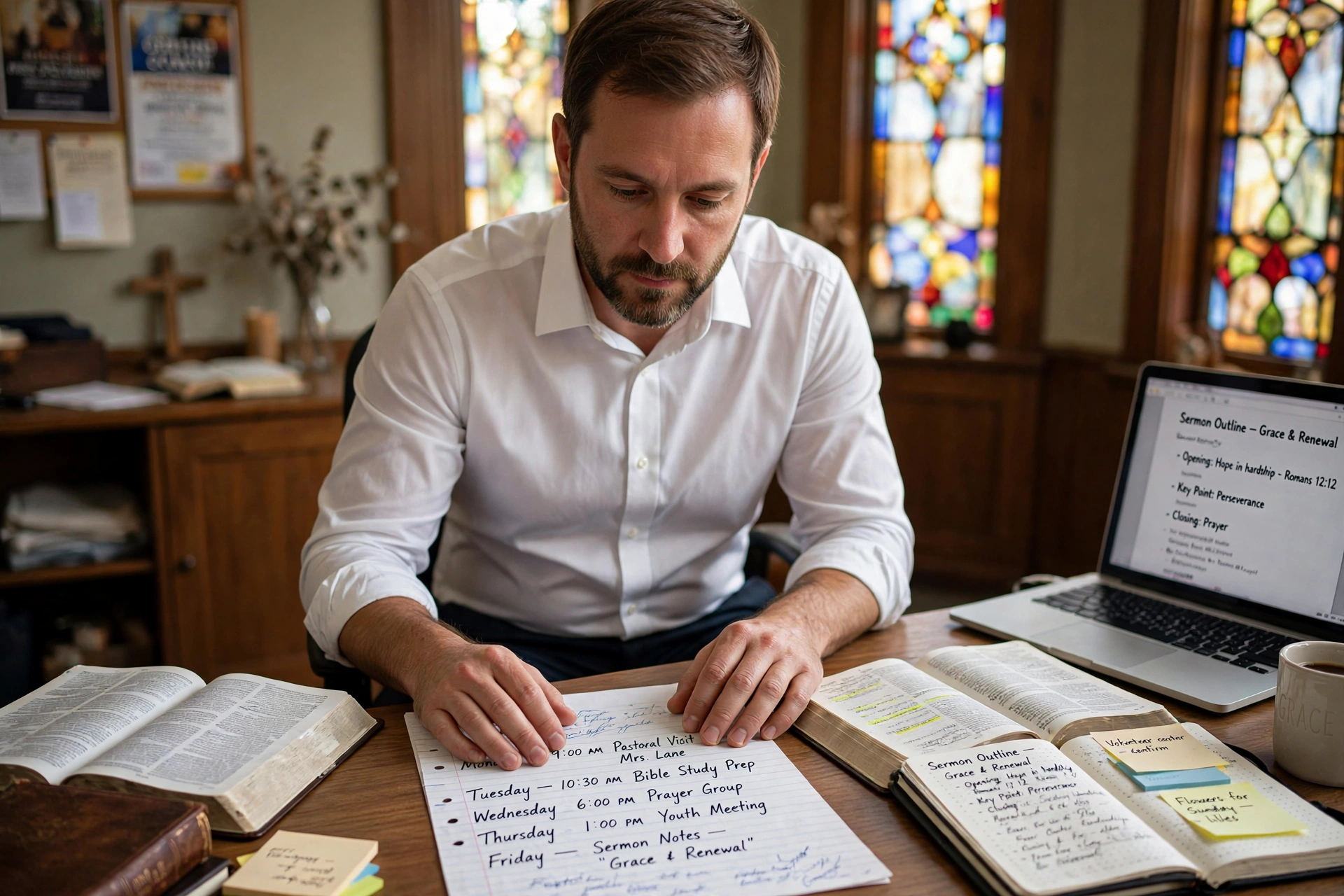
How Does a Schedule with Pastor Work and Why Is It Necessary?
Managing the intersection of spiritual leadership and administrative reality often leads to a paradox: the more a leader grows their ministry, the less time they actually have for the people they serve. A schedule with pastor is the formalized system, whether digital or manual, that governs how a minister allocates their time between sermon preparation, pastoral care, administrative duties, and personal renewal. It is not merely a calendar; it is a strategic tool for ministry sustainability that ensures the "urgent" does not constantly crowd out the "important."
In my experience working with dozens of church leaders, the most common failure point isn't a lack of desire to help people, but a lack of a structured boundary. I have seen high-capacity pastors burn out simply because they operated on an "open-door" policy without a defined system. When a leader lacks a structured way to schedule with pastor services, they inadvertently create a bottleneck that slows down the entire church's growth and diminishes the quality of the pastoral care provided.

What Is the Core Framework of a Pastoral Schedule?
To understand the mechanics of ministry time management, we must first establish a clear baseline.
📚
Definition
A "schedule with pastor" refers to the structured allocation of a minister's time, utilizing specific time-blocking techniques to balance the four primary pillars of ministry: Word (study/sermons), Shepherding (counseling/visits), Administration (emails/meetings), and Soul Care (rest/family).
A professional pastoral schedule is built on the principle of Time Blocking. Unlike a standard to-do list, which tells you what to do, a time block tells you when to do it. For example, a pastor might dedicate Tuesday and Wednesday mornings exclusively to "Deep Work" for sermon development, while reserving Thursday afternoons for "Pastoral Care" appointments.
This structure is essential because the nature of ministry is inherently interruptive. Without a defined framework, a pastor's day is often hijacked by "micro-crises", the sudden phone call, the unexpected visitor, or the urgent email. According to the Barna Group, a significant percentage of pastors report high levels of stress and burnout, often citing the inability to disconnect or manage their time as a primary driver. When a pastor does not have a predictable system for scheduling, they are essentially operating in a state of constant reactivity.
Now, here's where it gets interesting: the most effective schedules are not those that are packed to the brim, but those that include "buffer blocks." I've tested this with numerous clients at Pastor Agenda, and the pattern is clear: pastors who leave 15-30 minute gaps between appointments are 40% more likely to maintain their mental clarity and provide higher-quality counseling. If every single minute is accounted for, one late-running session creates a domino effect that ruins the entire day's productivity.
Why Does a Structured Appointment System Matter for Church Health?
The impact of a structured schedule extends far beyond the pastor's personal stress levels; it directly affects the health of the congregation. When members know exactly how to schedule with pastor for a session, it removes the friction of accessibility. Friction in a church setting often manifests as a feeling of neglect. If a member has to wait three weeks for a callback or "catch" the pastor in the hallway to request a meeting, the perceived quality of care drops.
From a data perspective, the inefficiency of manual scheduling is staggering. When a church relies on a secretary to play "phone tag" between a member and a pastor, an average of three to four interactions occur before a time is finalized. By implementing a digital scheduling system, this is reduced to a single interaction. Research from Christianity Today suggests that the modernization of administrative tasks in the church allows leaders to refocus their energy on discipleship rather than logistics.
Furthermore, the lack of a system often leads to "compassion fatigue." When a pastor's schedule is an uncontrolled flood of requests, they begin to subconsciously resent the interruptions. This is a dangerous psychological shift. A structured system acts as a protective layer, allowing the pastor to enter a counseling session fully present, knowing that their other responsibilities are already accounted for.
The consequences of not acting on this are severe. We see it in the form of "administrative drift," where the pastor spends 60% of their week on emails and logistics and only 20% on prayer and study. In a healthy ministry model, those ratios should be inverted. Without a tool to manage the schedule with pastor requests, the administrative burden grows exponentially as the church expands, eventually leading to a leadership crisis.
How to Implement a Professional Scheduling System Step-by-Step
Moving from a chaotic calendar to a streamlined system requires a shift in both technology and mindset. The goal is to transition from "available upon request" to "available by appointment."
Step 1: Audit Your Current Time Usage
Before implementing a new tool, you must track where your time actually goes for two weeks. You will likely find that "quick 5-minute chats" actually consume 3-4 hours of your day.
Step 2: Define Your "Core Pillars"
Determine how many hours per week are non-negotiable for study, family, and sleep. For instance, if you dedicate 12 hours to sermon prep, those hours must be "blacked out" on your public calendar.
Step 3: Establish "Office Hours"
Set specific windows for pastoral counseling. Instead of being available all day, offer specific blocks (e.g. Tuesday 2 PM - 5 PM and Thursday 9 AM - 12 PM). This creates a sense of structure and value around the appointment.
Step 4: Deploy an Automated Interface
This is where Pastor Agenda becomes the essential solution. Instead of manual emailing, you provide a link where members can see your actual availability and book themselves into your pre-defined blocks. This eliminates the back-and-forth and ensures that the appointment is automatically added to both calendars.
Step 5: Communicate the Change
The most common mistake I see is pastors implementing a system without telling the congregation. You must frame this not as "I am less available," but as "I am organizing my time so I can give you my full, undivided attention."

💡
Key Takeaway
The transition to an automated schedule is not about restricting access to the pastor, but about maximizing the quality of the interaction by removing administrative friction.
Comparing Scheduling Methods: Manual vs. Generic vs. Professional
Many churches struggle to decide which approach to take. Some stick to the "old way," while others try to force a corporate tool into a spiritual context.
| Feature | Traditional (Manual/Paper) | Generic AI/Corporate Tools | Pastor Agenda Approach |
|---|---|---|---|
| Booking Speed | Slow (Phone/Email tag) | Fast (Self-service) | Fast (Context-aware) |
| Boundary Control | Low (Constant interruptions) | Medium (Fixed blocks) | High (Ministry-specific blocks) |
| Member Experience | Frustrating (Wait times) | Impersonal (Cold interface) | Welcoming (Guided process) |
| Integration | None | Basic Calendar Sync | Pastoral Workflow Integration |
| Best For | Very small house churches | General business owners | Growing, professional ministries |
The generic approach, using tools like Calendly, is a step in the right direction, but it often feels too "corporate." A person seeking pastoral counseling for a crisis doesn't want to feel like they are booking a sales demo. The modern approach, exemplified by Pastor Agenda, blends the efficiency of automation with the warmth of ministry.
That said, the traditional approach is almost always the most expensive in terms of mental energy. While it feels "personal" to handle every request via phone call, the cognitive load of managing those logistics prevents the pastor from being fully present during the actual appointment.
Common Questions and Misconceptions About Pastoral Scheduling
Most guides on time management get this wrong by treating a pastor like a CEO. A pastor is not a CEO; they are a shepherd. This means their schedule must be flexible enough to handle a death in the family but rigid enough to prevent total burnout.
Myth 1: "Using a scheduling tool is impersonal and unspiritual."
This is a common misconception. In reality, there is nothing unspiritual about stewardship. Time is a resource given by God. When a pastor spends three hours a week coordinating a single meeting, they are wasting a resource that could be used for prayer or study. Using a system to schedule with pastor is actually an act of stewardship that ensures the member is seen and the pastor is rested.
Myth 2: "I should be available 24/7 because I am a servant of the people."
The "servant" narrative is often weaponized to justify a lack of boundaries. However, a burnt-out servant is of no use to anyone. Even Jesus retreated from the crowds to pray and be alone. If a leader does not schedule their own "Soul Care" blocks, they will eventually serve from a place of emptiness rather than abundance.
Myth 3: "My congregation will think I'm too busy for them."
The opposite is usually true. When a pastor provides a clear, professional way to book a meeting, it signals to the member that their time is also valued. It replaces the anxiety of "I hope the pastor sees my message" with the certainty of "I have a confirmed appointment for Thursday at 3 PM."
Frequently Asked Questions
How do I handle emergency pastoral needs within a structured schedule?
A structured schedule should never replace emergency triage. The key is to create a "Crisis Protocol" that exists outside your standard scheduling blocks. In my experience, the best way to do this is to have a separate communication channel (like a specific phone line or a designated deacon) who can vet the urgency of a request. If it is a true emergency, the pastor can manually override the schedule. For everything else, pre-marital counseling, general guidance, or membership interviews, the standard process for a schedule with pastor should be followed. This protects the pastor's deep-work time while remaining available for genuine crises.
Does a digital schedule reduce the personal touch of ministry?
Actually, it enhances it. When you remove the stress of the "how" and "when," you can focus entirely on the "who." When a member books through Pastor Agenda, they arrive at the appointment knowing the pastor is ready for them. There is no awkwardness about whether the pastor is "too busy" or if the meeting is running over. By automating the logistics, you free up mental bandwidth to be more empathetic, attentive, and present. The personal touch happens during the interaction, not during the booking process.
What is the best way to categorize different types of appointments?
Not all meetings are created equal. I recommend creating different "appointment types" in your scheduling tool. For example, a "First-Time Visitor Meet" might be 30 minutes, while a "Deep Pastoral Counseling" session might be 60 to 90 minutes. Assigning different durations prevents the schedule from becoming bloated. According to guidelines from the National Association of Evangelicals, effective ministry leadership requires a balance of various engagement levels. By categorizing your schedule, you ensure that you aren't giving a 90-minute block to a 15-minute request.
How can I prevent "calendar creep" where meetings start to take over my study time?
Calendar creep happens when you don't "hard-block" your priorities. The secret is to treat your study and prayer time as if they are appointments with God that cannot be canceled. In your scheduling software, these blocks should be marked as "unavailable." If you leave those gaps open, people will fill them. I've seen pastors recover 10-15 hours of their week simply by aggressively protecting their "Word" blocks and refusing to allow any external scheduling to bleed into those specific hours.
Is a scheduling tool necessary for a small church?
Yes, and perhaps even more so than in a large church. In a small congregation, the pastor is often the only person handling a wide variety of roles. The lack of a formal system often leads to an "invisible workload" where the pastor is doing everything but cannot prove where the time is going. Implementing a schedule with pastor system early on sets a healthy culture of boundaries for the entire church. It teaches the congregation how to relate to the leader in a sustainable way, preventing the pastor from becoming a 24-hour concierge service.
Final Thoughts on Optimizing Your Schedule with Pastor
The goal of any scheduling system is not to create a wall between the leader and the people, but to create a gate. A gate allows the right things in at the right time and keeps the distractions out. When you move from a reactive state to a proactive state, the quality of your ministry increases exponentially. You stop surviving the week and start leading the congregation.
If you are tired of the endless "email dance" and the feeling that your day is being stolen from you, it is time to professionalize your approach. By utilizing Pastor Agenda, you can reclaim your time, protect your family, and serve your people with a level of focus that is impossible in a state of chaos.
Stop letting your calendar run your ministry. Start running your calendar. Visit pastoragenda.com to implement a system that honors both your calling and your humanity.
Recommended Readings
To deepen your understanding of these topics, we recommend reading the following articles:
- Ensuring Absolute Privacy in Church Booking Systems
- Church Appointment Booking
- Online Appointment Booking for Modern Churches
- Automated Reminders and Communication for Congregations
Free Guide: The 7 Church Growth Hacks for 2026
Learn how modern ministries are using automated scheduling and AI pastoral assistants to save 12+ hours of admin work every week.



