📖This article is part of the complete guide to Calendar Management for Ministry and Faith Leaders.
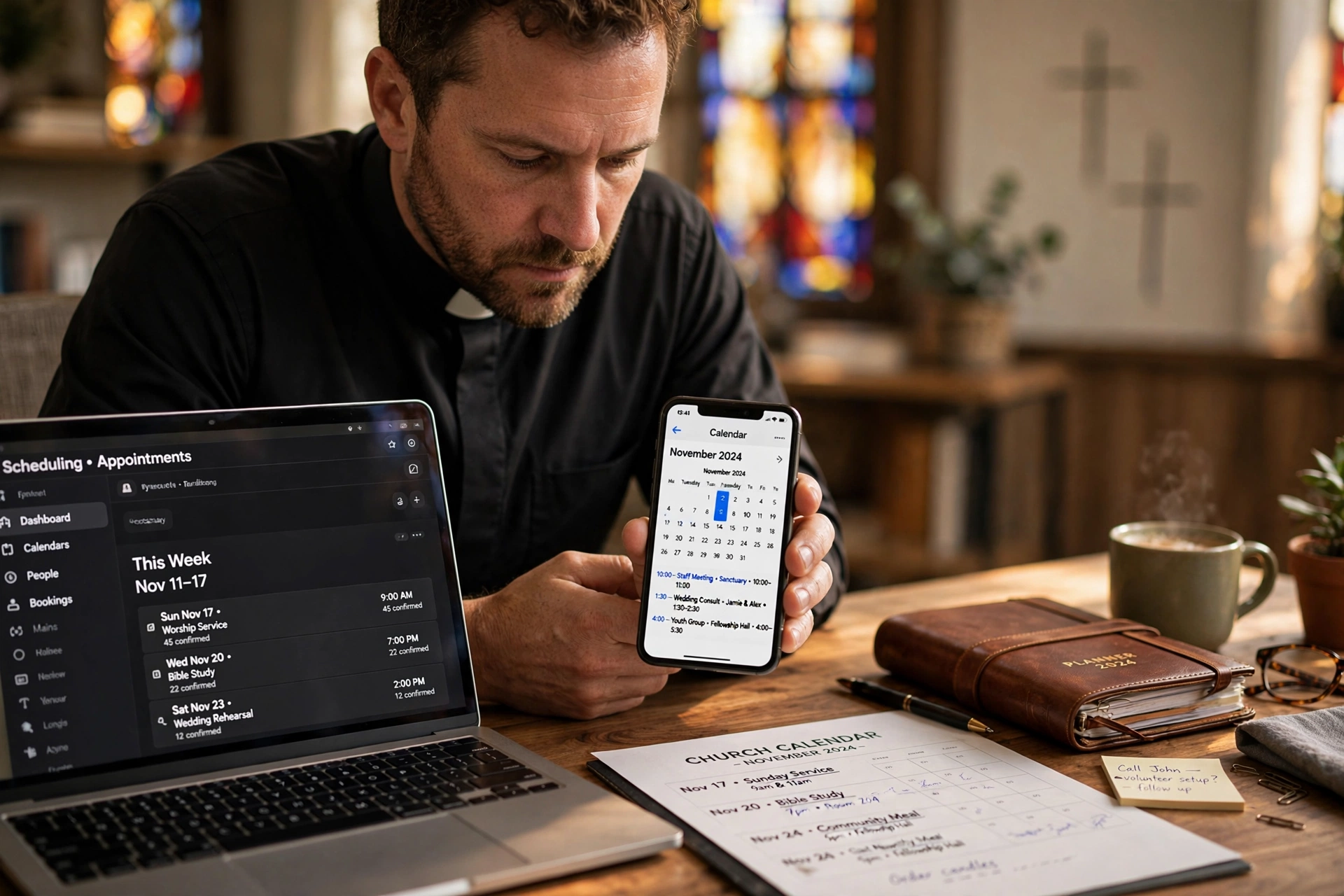
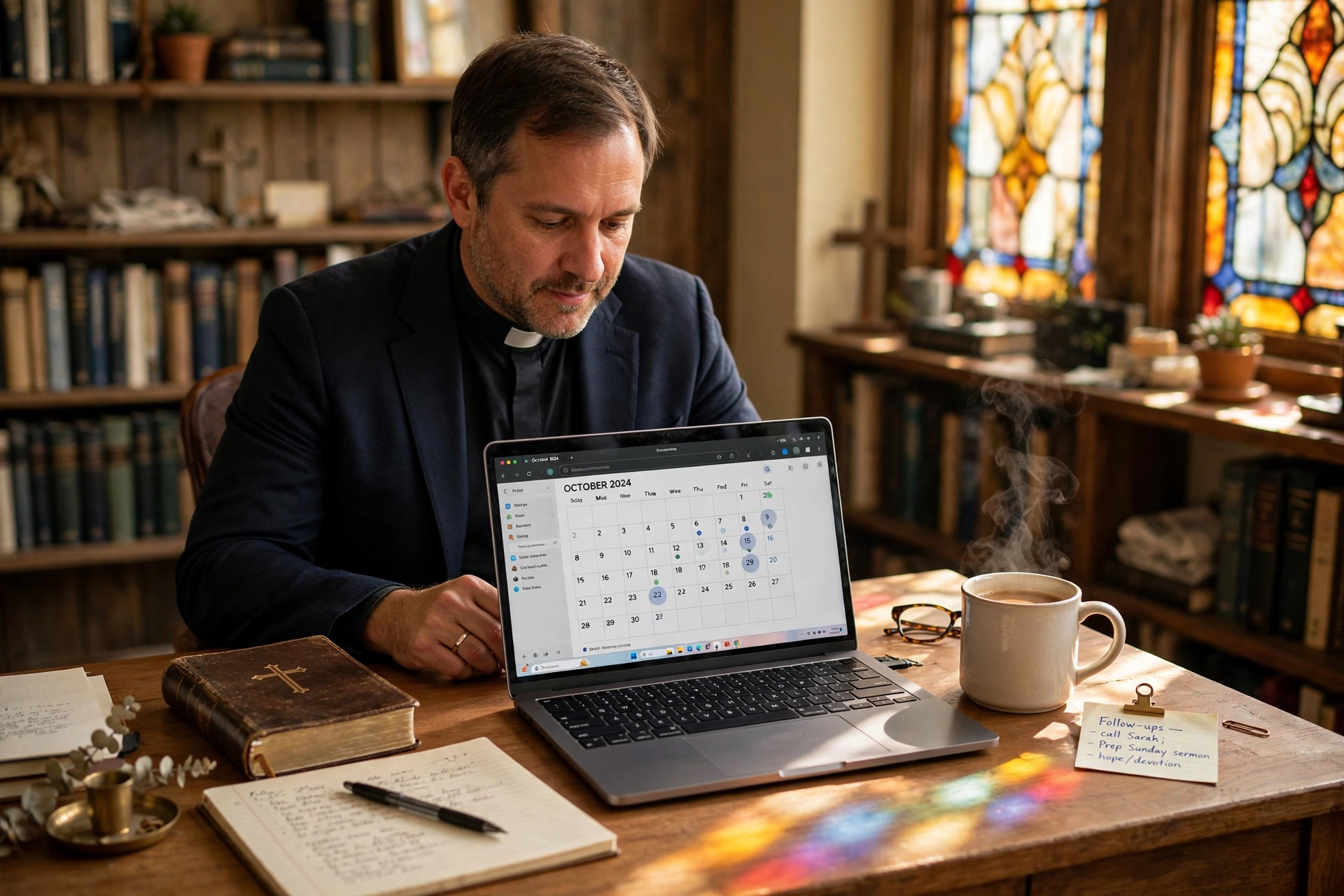
I once spoke with a lead pastor who had his scheduling link in his email signature, on his social media bio, and on the church website. He thought he was being 'servant-hearted,' but he was actually creating a vacuum. Within three months, his calendar was a chaotic mosaic of 15-minute slots, leaving him zero time for sermon preparation or family dinner. He wasn't managing a ministry; he was managing a queue. This is the danger of the 'open-door' digital policy without strategic guardrails.
For a comprehensive overview of this ecosystem, explore our guide on ministry calendar management.
What Are Pastor Calendar Boundaries?
📚
Definition
Pastor calendar boundaries are the intentional, communicated constraints placed on a minister's availability to ensure that pastoral care, administrative duties, and personal restoration are balanced without compromising the needs of the congregation.
Setting pastor calendar boundaries is not about becoming unavailable; it is about becoming sustainably available. In the modern era of instant connectivity, a public profile, whether it is a scheduling link, a shared Google Calendar, or a church portal, acts as a digital front door. If that door is always wide open, the pastor becomes a reactive leader rather than a proactive one.
In my experience working with various church leadership teams, the most successful ministers treat their time as a finite resource that must be stewarded. When a pastor establishes clear boundaries, they are actually providing better care to their flock. A rested, prepared pastor is far more effective in a 30-minute counseling session than a burnt-out pastor who has been interrupted six times during their only study block of the week.
Boundaries in a public profile involve the use of 'buffer times,' 'blackout dates,' and 'appointment categories.' By categorizing availability, such as designating specific hours for 'Pastoral Counseling' and others for 'Community Outreach', a minister can guide the congregation toward the most appropriate way to engage. This prevents the common issue where an urgent crisis is scheduled for a Tuesday afternoon, but the pastor's only available slot is a Friday morning, creating friction and frustration for both parties.

Why Do Pastor Calendar Boundaries Matter for Ministry Health?
Establishing boundaries is fundamental because the nature of ministry is inherently expansive. A pastor's work does not end at 5:00 PM, and the psychological weight of being 'on call' can lead to chronic stress. According to the Barna Group, a significant percentage of pastors report high levels of burnout and loneliness, often stemming from the inability to disconnect from the demands of their congregation. When a public profile allows unrestricted access, the pastor loses the ability to protect the 'Sabbath' of their own schedule.
Furthermore, the lack of boundaries creates a dependency culture within the church. When members know they can simply grab any open slot on a calendar, they stop utilizing the other layers of care within the church body, such as deacon boards or small group leaders. This contradicts the biblical model of the body of Christ, where different members contribute to the care of the whole. By limiting public availability, a pastor naturally encourages the delegation of care, which empowers other leaders and grows the overall health of the congregation.
From an administrative standpoint, boundaries prevent the 'fragmented day.' A fragmented day occurs when a pastor has 30 minutes of free time, then a meeting, then 15 minutes of free time. This is the death of deep work. Sermon preparation and strategic planning require blocks of uninterrupted time. If a public profile allows a user to book a slot in the middle of a Tuesday morning, the pastor's cognitive flow is shattered. Research into productivity suggests that it can take up to 23 minutes to return to a state of deep focus after a single interruption. For a minister drafting a complex theological argument for a Sunday sermon, these interruptions are devastating.
Moreover, healthy boundaries protect the pastor's family. When a public profile is unregulated, the boundaries between the 'office' and the 'home' blur. If a member sees an open slot on a Saturday afternoon and books it, the pastor is forced to choose between the expectation of the member and the needs of their spouse and children. By explicitly marking family time as unavailable in the public profile, the pastor signals that the family is a primary ministry priority, setting a healthy example for the entire congregation.
How to Implement Healthy Boundaries in Your Public Profile
Implementing pastor calendar boundaries requires a shift from a 'yes-by-default' mindset to a 'stewardship' mindset. The goal is to create a system where the congregation feels cared for, but the pastor remains sane.
First, you must define your "Non-Negotiable Blocks." These are segments of the week that are completely invisible to the public. This typically includes a full Sabbath day, a designated family evening, and a minimum of two 4-hour blocks for sermon study. In the settings of your scheduling software, these should be marked as "Busy" or excluded from the available time slots entirely. If you use a tool like Pastor Agenda, this process is streamlined by creating specific availability templates that automatically block these hours across the entire year.
Second, utilize "Appointment Types" to manage expectations. Instead of a generic "Meeting" slot, offer specific categories:
- Pastoral Counseling (45 mins): Reserved for deep emotional or spiritual needs.
- Quick Check-in (15 mins): For administrative questions or brief updates.
- New Member Orientation (30 mins): Specifically for those joining the church.
By doing this, you prevent a member from booking a 15-minute slot for a complex marriage crisis, or a 45-minute slot just to ask about the date of the next potluck. This ensures that the time allocated matches the need of the member.
Third, implement a "Buffer Period." Never allow back-to-back appointments in a public profile. In the world of ministry, a "30-minute session" often runs 10 minutes over because of the emotional weight of the conversation. A 15-minute buffer between appointments allows the pastor to pray, take notes, use the restroom, or simply breathe. According to Christianity Today, maintaining these small gaps is essential for the mental longevity of clergy members who deal with high-stress situations daily.
Fourth, create a "Lead Time" requirement. Do not allow members to book a slot for "today." A 24-to-48 hour lead time prevents the chaos of last-minute surprises and allows the pastor to prepare mentally for the person they are meeting. While urgent crises should always be handled via a direct phone call or emergency protocol, the public calendar is for planned care, not emergency triage.
Lastly, integrate your systems. One of the biggest mistakes is having a public booking link that doesn't talk to your private calendar. This leads to double-booking. For those struggling with this, we recommend reading our guide on how to sync multiple church and personal calendars in one system to ensure that a doctor's appointment doesn't overlap with a congregational visit.

Comparison of Scheduling Approaches
To understand the value of a structured boundary system, we must compare it to the common alternatives found in ministry today.
| Feature | Traditional "Open Door" | Generic/Cheap AI Booking | Modern Boundary-Based System |
|---|---|---|---|
| Availability | Reactive; always available | Rigid; no context of ministry | Proactive; stewarded availability |
| Mental Load | High burnout risk | Frustrating for members | Balanced and sustainable |
| Sermon Prep | Constantly interrupted | Random gaps in schedule | Protected, dedicated blocks |
| Member Experience | Fast but inconsistent | Impersonal and robotic | Professional and intentional |
| Family Impact | Family often comes last | Conflict due to sync errors | Family time is explicitly protected |
Common Mistakes to Avoid When Setting Boundaries
One frequent error is the "Apology Trap." When a pastor shares their booking link, they often accompany it with an apology: "I'm so sorry I'm not as available as I'd like to be, but please use this link." This framing suggests that boundaries are a failure of leadership rather than a tool for health. Instead, frame the boundary as a benefit to the member: "To ensure I can give you my undivided attention and prayerful consideration, please select a time that works for you here."
Another mistake is failing to communicate the "Why." If you suddenly move from an open-door policy to a structured calendar, some members may feel neglected. The solution is transparency. During a sermon or a members' meeting, explain the theology of stewardship. Explain that by protecting their time, the pastor is better equipped to lead the church. When the congregation understands that boundaries are for the sake of the ministry's health, they generally support them.
I have also seen pastors make the mistake of "Boundary Creep," where they set a rule but then break it for every person who asks. For example, a pastor might set a rule of no appointments on Fridays, but then allow a "special" request to slide in. Once the congregation realizes the boundary is porous, the boundary ceases to exist. Consistency is the only way to train people on how to interact with your time.
Furthermore, avoid using a tool that is too complex for your older members. If the booking process requires five different clicks and a login, your most vulnerable members, who often need pastoral care the most, will be locked out. Use a streamlined interface, and always provide a secondary option (like a phone call to the church secretary) for those who are not tech-savvy. This prevents the digital divide from becoming a barrier to care.
Finally, do not neglect the "Off-Ramp." Every appointment should have a clear end time. In a public profile, this is handled by the slot duration. However, in person, the pastor must lead the ending of the meeting. A simple, "I want to be respectful of your time and my next appointment; let's wrap up with a prayer," ensures that the boundary established in the digital profile is maintained in the physical room.
Frequently Asked Questions
Does setting calendar boundaries make a pastor seem unapproachable?
Not if the boundaries are communicated with grace and clarity. In fact, a pastor who has a structured schedule often seems more stable and reliable. When a member knows that their 30-minute slot is dedicated solely to them, they feel more valued than if they are squeezed into a gap between two other meetings. The key is to shift the narrative from "I am unavailable" to "I am intentionally making space for you." By providing a clear path to access, such as a professional booking link, you are actually making the process of reaching you more transparent and less stressful for the member.
How do I handle urgent pastoral crises if my calendar is blocked?
Public calendar boundaries are for scheduled care, not emergency triage. You must have a separate, clearly communicated protocol for crises. This usually involves a specific phone number or a "Crisis Contact" instruction on your profile. For example, your booking page could state: "For non-urgent counseling and meetings, please use the calendar below. If you are experiencing an immediate crisis, please call [Phone Number] or contact the church office immediately." This ensures that the boundary protects your study time without leaving the congregation stranded in a moment of acute need.
What is the best way to transition from an open-door policy to a structured calendar?
Transparency is the most effective transition strategy. Start by announcing the change during a Sunday service or in a newsletter. Explain the "why" by focusing on the health of the church and the quality of pastoral care. You might say, "To ensure I can give my best to the Word of God and my best to each of you in our meetings, I am moving to a scheduled appointment system." Give a grace period of two weeks where you use both systems before fully migrating. This allows the congregation to adjust their expectations and learn the new system without feeling an abrupt loss of access.
How often should I review and adjust my public availability?
I recommend a quarterly review of your calendar boundaries. Ministry needs fluctuate based on the church calendar; for example, the weeks leading up to Easter or Christmas are significantly more demanding. During a quarterly review, analyze your "Appointment Types" to see if you are spending too much time in one category and not enough in another. If you find that you are consistently overbooked for counseling but have empty slots for new member orientations, adjust your slot allocations. This prevents the system from becoming stagnant and ensures it evolves with the growing needs of your congregation.
Which scheduling tools are best for ministry leaders?
While there are many generic tools, a dedicated system like Pastor Agenda is designed specifically for the nuances of church life. Generic tools often lack the ability to categorize meetings by ministry type or handle the specific rhythms of a pastoral schedule. When choosing a tool, look for features like automatic time-zone adjustment (for visiting missionaries), buffer-time settings, and the ability to sync with multiple personal and professional calendars. The goal is to reduce the administrative friction of scheduling so you can focus on the relational aspect of your ministry.
Recommended Readings
To deepen your understanding of these topics, we recommend reading the following articles:
- How to Balance Personal Time, Ministry Duties, and Desk Work
- Ensuring Absolute Privacy in Church Booking Systems
- Church Appointment Booking
- Online Appointment Booking for Modern Churches
Conclusion
Stewarding your time is a spiritual discipline. When a pastor allows their schedule to be dictated by the whims of a public profile, they are not practicing servant-leadership; they are practicing chaos management. By implementing intentional pastor calendar boundaries, you protect your family, your mental health, and the quality of the sermons you deliver to your congregation.
Remember that a boundary is not a wall to keep people out, but a gate that lets people in at the right time and in the right way. When you manage your availability with intention, you create a sustainable rhythm of ministry that can last for decades rather than ending in a premature burnout.
If you want to master the art of time management in the church, we highly recommend visiting our complete guide on ministry calendar management. There, you will find deeper insights into how to structure your entire ministerial year for maximum impact.
To start implementing these professional boundaries today, explore the tools at PastorAgenda Blog and take back control of your time.
Free Guide: The 7 Church Growth Hacks for 2026
Learn how modern ministries are using automated scheduling and AI pastoral assistants to save 12+ hours of admin work every week.