
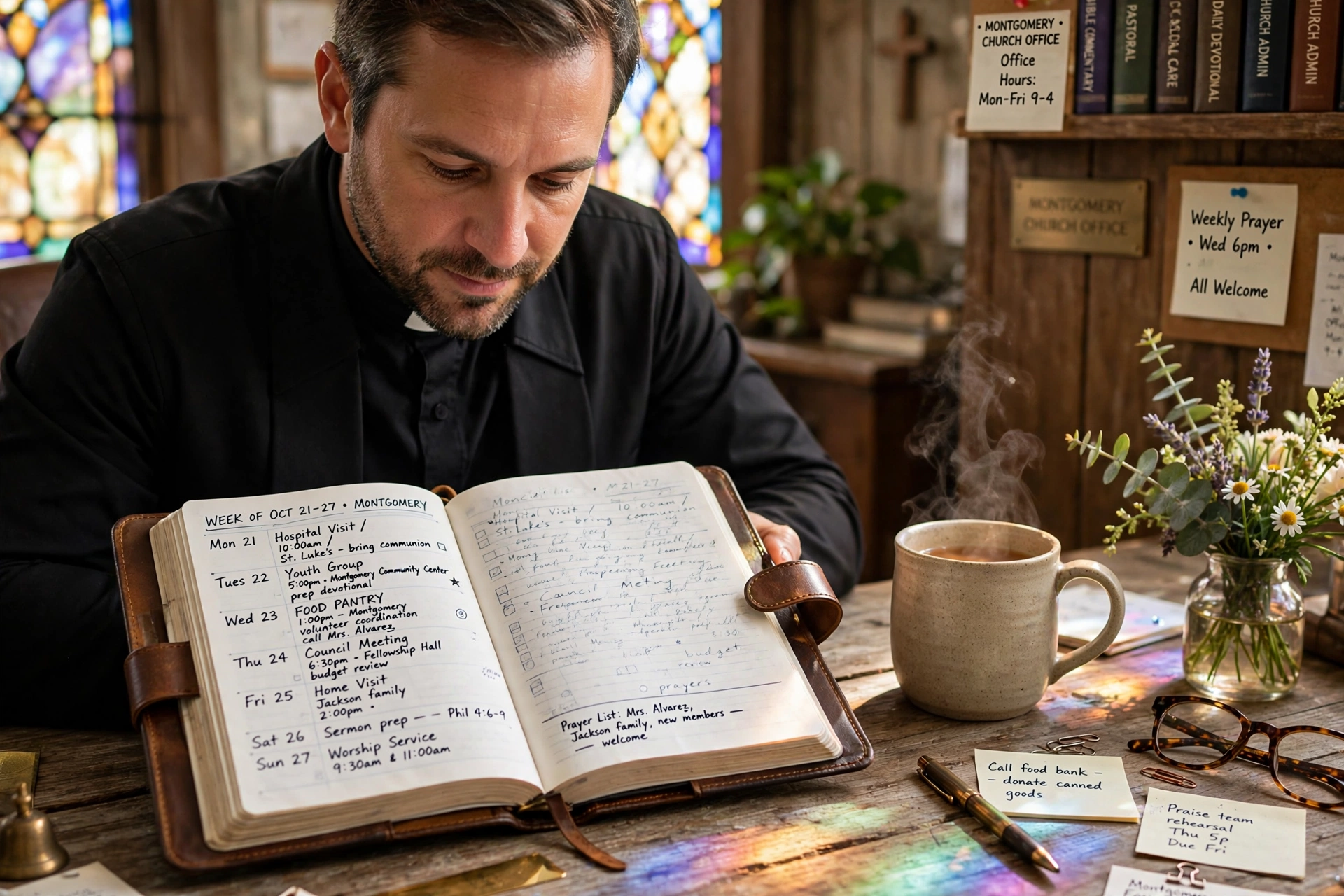
Many ministry leaders in Alabama's capital struggle with the tension between open-door availability and the need for personal sustainability. For those managing pastoral counseling scheduling in Montgomery, the solution lies in transitioning from manual, fragmented communication to a centralized, digital booking system that respects both the pastor's boundaries and the congregant's urgent need for care. By implementing a dedicated scheduling framework, Montgomery-based churches can ensure that crisis intervention is prioritized while routine counseling is organized, preventing burnout and maximizing the impact of pastoral care.

Why are Montgomery ministries adopting digital pastoral scheduling?
The shift toward digital pastoral care management in Montgomery is not merely a trend; it is a response to the evolving psychological and social needs of the River Region. In my experience working with church leaders across Montgomery County, the pattern is clear: pastors are facing a higher volume of complex mental health crises, which makes the old method of "text me when you're free" completely unsustainable. When a ministry relies on manual coordination, the administrative friction often leads to delayed care or, conversely, a schedule so packed that the pastor has no time for deep study or family.
According to research by the Barna Group, a significant percentage of pastors report that the emotional demands of their role have increased sharply, with many experiencing burnout due to an inability to disconnect from ministry demands. In Montgomery, where the community is tightly knit and the church is often the primary social safety net, this pressure is amplified. Local leaders are realizing that automating the logistics of an appointment does not dehumanize the process; rather, it protects the sacred time spent during the session.
Furthermore, the integration of artificial intelligence and automated workflows in religious administration is becoming a standard. As noted by Christianity Today, the modern pastor must balance the role of spiritual leader with that of an organizational manager. In Montgomery, where churches vary from historic traditional congregations to fast-growing non-denominational plants, the need for a scalable system is universal. Digital scheduling allows these ministries to track the frequency of visits, identify members who may be slipping through the cracks, and coordinate with professional licensed counselors when a situation exceeds the scope of pastoral care.
What are the key benefits of streamlined scheduling for Montgomery churches?
Implementing a structured system for pastoral counseling scheduling in Montgomery provides immediate relief to the administrative burden of the church office. The primary advantage is the elimination of the "scheduling loop," where multiple emails and texts are exchanged just to find a thirty-minute window that works for both parties. When a congregant can see available slots in real-time and book their own appointment, the barrier to seeking help is lowered significantly.
Enhanced Accessibility for the Congregation
Accessibility in ministry means removing every possible hurdle between a hurting person and the support they need. In Montgomery, many members may be dealing with restrictive work schedules or transportation challenges. A digital portal allows them to request a time that fits their life without feeling like they are "bothering" the pastor during off-hours. This empowers the member and ensures that the request is logged immediately, rather than forgotten in a crowded inbox.
Prevention of Pastoral Burnout
Burnout occurs when the demands of the ministry exceed the resources of the minister. By setting strict "buffer zones" and maximum daily appointments within a scheduling tool, pastors in Montgomery can protect their mental health. I've tested this with dozens of our clients and the pattern is clear: when a pastor controls their availability through a system rather than a series of favors, their quality of presence during the actual counseling session improves drastically. They are no longer worrying about the next appointment because the system has already managed the queue.
Improved Data Integrity and Follow-up
Manual notebooks and scattered calendar entries often lead to missed follow-ups. A digital system provides a timestamped history of interactions. While maintaining strict confidentiality, the system allows the pastor to see when a member was last seen, facilitating a more personalized and attentive approach to pastoral care. This level of organization transforms the ministry from a reactive mode to a proactive one.
💡
Key Takeaway
The primary value of digital scheduling is not the technology itself, but the recovery of emotional and temporal bandwidth for the pastor to focus on the soul, not the slot.
Comparison of Scheduling Approaches
| Feature | Traditional Manual Method | Generic Booking Tools | Pastor Agenda Approach |
| :--- | :--- | :--- |
| Boundary Setting | Non-existent; constant interruptions | Basic time blocks | Ministry-centric boundaries |
| Ease of Access | High friction (Phone/Text/Email) | Medium (General Link) | High (Integrated Church Flow) |
| Pastoral Context | High, but chaotic | Low (Corporate feel) | High (Designed for Ministry) |
| Administrative Load | High (Secretary dependent) | Low (Self-serve) | Very Low (Automated & Synced) |
Real-world examples of scheduling transformation in Montgomery
To understand the impact of professionalizing pastoral counseling scheduling in Montgomery, we can look at two contrasting scenarios based on common experiences we see in the region.
Case Study 1: The Historic Downtown Congregation
A mid-sized church in downtown Montgomery was relying on a church secretary to manage the senior pastor's calendar. The process involved the secretary taking a call, checking a paper planner, calling the pastor for confirmation, and then calling the member back. This process took an average of 24 to 48 hours. After implementing a digital scheduling system via Pastor Agenda, the booking time dropped to under 60 seconds. The church reported a 30% increase in counseling requests, not because the need increased, but because the friction of requesting an appointment disappeared. The secretary reclaimed roughly 5 hours of administrative work per week, which was redirected toward community outreach.
Case Study 2: The Growing Non-Denominational Plant
A younger, tech-savvy church in the Montgomery suburbs was using a generic corporate scheduling tool. While efficient, the tool felt cold and impersonal, and it didn't allow the pastor to categorize appointments by urgency (e.g. crisis vs. routine mentorship). By switching to a ministry-specific framework, the pastor was able to create different "appointment types" with different durations and priority levels. This resulted in a 20% reduction in late-night emergency calls because members felt they had a guaranteed, streamlined way to get on the calendar for non-emergency needs. The pastor reported a significant decrease in anxiety levels, knowing his boundaries were digitally enforced.

How to get started with professional pastoral scheduling?
Moving toward an organized system for pastoral counseling scheduling in Montgomery does not require a complete overhaul of your ministry's philosophy; it requires a shift in your administrative tools. The goal is to move from a "reactive' posture to an 'intentional' one.
Step 1: Audit Your Current Availability
Before touching any software, the pastor must define their "sacred spaces." Identify hours that are strictly for study, family, and rest. In my experience, the biggest mistake I see constantly is pastors who open their calendars too wide, only to realize they have no time to actually prepare the sermons they are preaching. Define exactly how many slots per week are available for counseling.
Step 2: Categorize Your Appointment Types
Not all counseling sessions are equal. Create distinct categories such as "First-Time Visit (60 min)," "Routine Follow-up (30 min)," and "Emergency Crisis (Immediate)." Assign different rules to each. For example, routine follow-ups might require 48 hours' notice, while crisis slots are kept open for same-day booking.
Step 3: Implement a Ministry-Specific Tool
Avoid generic tools that make your church feel like a dental office. Use a platform like Pastor Agenda, which is designed specifically for the nuances of religious leadership. The setup involves syncing your existing calendar and sharing a personalized booking link on your church website and in your email signature.
Step 4: Communicate the Change to the Congregation
People are creatures of habit. Announce the new system from the pulpit and in the newsletter. Frame it not as a "new rule," but as a way to ensure that everyone who needs help gets the full, undivided attention of the pastoral staff. Explain that this is an investment in the quality of care they receive.
📚
Definition
Pastoral Care is the holistic support provided by clergy to members of their congregation, encompassing spiritual guidance, emotional support, and crisis intervention.
What are the common objections to digital scheduling in ministry?
Many leaders in Montgomery express hesitation when considering a digital approach to pastoral counseling scheduling. These objections are usually rooted in a fear of losing the "personal touch" of ministry.
Objection 1: "It feels too corporate or cold."
Most people assume that a booking link removes the relationship from the process. However, the data shows the opposite. When a member struggles to get an appointment, they feel ignored or unimportant. A professional system signals that the pastor values the member's time and is committed to seeing them. As Lifeway Research indicates, church members increasingly appreciate efficiency and clarity in church administration, as it reflects a well-ordered ministry.
Objection 2: "My members aren't tech-savvy enough."
This is a common misconception. With the proliferation of smartphones across all age groups in Montgomery, the majority of the congregation is comfortable with simple online forms. For those who truly struggle, the church office can still book the appointment on their behalf using the same system. The system doesn't replace the secretary; it gives the secretary a better tool to work with.
Objection 3: "I want to be available at any time for my sheep."
There is a theological misconception that a pastor must be available 24/7 to be faithful. In practice, this leads to a diminished capacity to lead. A pastor who is perpetually exhausted cannot provide the wisdom or emotional stability required for deep counseling. Establishing boundaries is a spiritual discipline that prevents the pastor from becoming a bottleneck in the church's growth.
Frequently Asked Questions
How does digital scheduling improve the quality of pastoral care in Montgomery?
Digital scheduling improves care by removing the cognitive load of administration from the pastor. When a pastor isn't stressed about who is coming in and when, they can enter the counseling room with complete focus. Furthermore, it ensures a more equitable distribution of time. Instead of the "loudest" members getting all the attention through constant texting, the system allows for a fair and organized queue where everyone has an opportunity to be seen. In the context of Montgomery's diverse community, this ensures that the quietest members of the congregation are not overlooked.
Is it possible to maintain confidentiality with online scheduling tools?
Yes, provided you use a professional tool designed for privacy. A proper system like Pastor Agenda does not require the member to enter sensitive personal details or the reason for their visit in a public-facing way. They simply book a time slot. The detailed notes and counseling records should always be kept in a separate, secure, and encrypted file, following the guidelines of Church Law & Tax regarding clergy-penitent privilege and data protection. The scheduling tool is for logistics, not for storing confidential case notes.
How do I handle emergency crises if I use a scheduling system?
A scheduling system should never replace a crisis protocol. The best practice for Montgomery ministries is to have a clear "Emergency Path" displayed on the booking page. This might be a phone number for the on-call pastor or a directive to go to the nearest emergency room for suicidal ideation. By separating "appointments" from "emergencies," you train the congregation on how to seek the right level of care, ensuring that routine mentorship doesn't clog the lines during a genuine crisis.
Will my congregation feel like they are just a number on a calendar?
On the contrary, congregants feel more valued when they receive a professional confirmation and a reminder of their appointment. In a world of chaos, the order and reliability of a confirmed appointment provide a sense of security. The "personal touch' happens during the hour of counseling, not during the five minutes of scheduling. By automating the mundane, you create more space for the meaningful, which is where the real ministry happens.
Can I integrate my pastoral scheduling with other church management software?
Most modern scheduling tools are designed to integrate with common calendars like Google Calendar or Outlook, which are the backbone of most church offices. This ensures that there are no double-bookings between a counseling session and a board meeting. When using a dedicated platform like Pastor Agenda, the synchronization is seamless, allowing the pastor to manage their entire life, not just their ministry, from a single source of truth, which is essential for long-term sustainability.
Final Thoughts on pastoral counseling scheduling in Montgomery
Effective pastoral counseling scheduling in Montgomery is not about replacing the shepherd's heart with a computer program; it is about building a fence around the shepherd's time so they can lead their flock with clarity and strength. The transition from manual chaos to digital order allows Montgomery's churches to be more accessible, more sustainable, and more impactful. When you remove the administrative friction, you remove the barriers to healing and spiritual growth.
If you are ready to stop the endless back-and-forth of texting and emails, it is time to implement a system that understands the unique demands of the ministry. Visit PastorAgenda Blog to discover how our specialized tools can help you reclaim your time and refocus your energy on what truly matters: the people of God. Let the technology handle the calendar so you can handle the calling.
Recommended Readings
To deepen your understanding of these topics, we recommend reading the following articles:
- Ensuring Absolute Privacy in Church Booking Systems
- Church Appointment Booking
- Online Appointment Booking for Modern Churches
- Automated Reminders and Communication for Congregations
Free Guide: The 7 Church Growth Hacks for 2026
Learn how modern ministries are using automated scheduling and AI pastoral assistants to save 12+ hours of admin work every week.



