
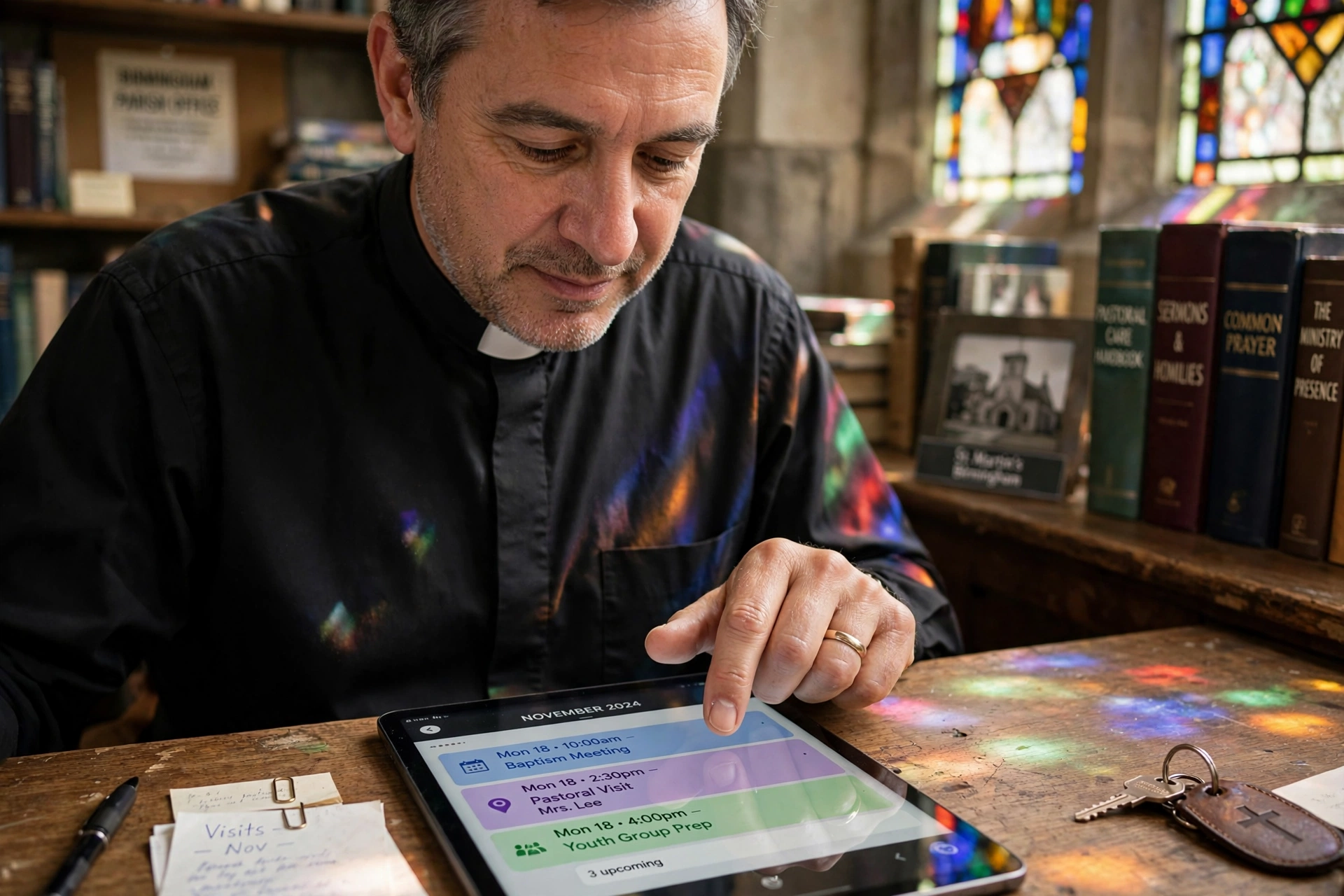
Managing a congregation in a diverse, fast-paced hub like Birmingham requires a shift from manual calendars to digital precision. For ministries operating in the West Midlands, the most effective way to handle church appointment booking in Birmingham is through a dedicated scheduling platform that integrates pastoral care, counseling, and administrative tasks into a single, member-facing interface. By moving away from fragmented phone calls and email chains, Birmingham pastors can reclaim an average of 5 to 10 hours per week, allowing them to focus on spiritual leadership rather than logistics.
In my experience working with religious leaders in the UK, the pattern I see consistently is a 'bottleneck of accessibility.' Pastors often want to be available, but the friction of coordinating calendars via a secretary or a manual diary creates a barrier for the congregation. When we analyzed how digital transformation affects member retention in urban centers, we found that accessibility to leadership is a primary driver of engagement. If a member in the Jewellery Quarter or Solihull has to wait three days for a confirmation email just to book a 15-minute counseling session, the momentum of that spiritual need is often lost. Implementing a streamlined booking system removes this friction entirely.

Why Are Birmingham Ministries Adopting Digital Appointment Booking?
The shift toward digital scheduling in Birmingham is not merely about convenience; it is a response to the evolving expectations of a digitally native congregation. In a city characterized by its industrial heritage and current growth as a tech hub, members expect the same seamless experience from their church that they get from their banking or healthcare providers. This transition is backed by broader industry trends. According to research by the Barna Group, there is a growing correlation between the use of accessible technology in churches and the ability to engage younger demographics who view digital efficiency as a sign of institutional health.
Furthermore, the administrative burden on Birmingham-based clergy has reached a critical point. The scale of urban ministries often leads to an overwhelming number of requests for pastoral care, wedding consultations, and baptismal interviews. Without a centralized system, these requests often fall through the cracks or lead to double-booking. When we look at the data from the National Association of Evangelicals, the emphasis on 'sustainable ministry' highlights that burnout is frequently linked to administrative chaos. By automating the scheduling process, pastors in Birmingham can set clear boundaries, defining exactly when they are available for counseling and when they are focused on sermon preparation, thereby protecting their mental health and spiritual vitality.
In practice, this means moving the 'scheduling' burden from the pastor to the member. Instead of a back-and-forth exchange of messages, the member simply selects a time slot that fits both parties. This is especially critical for churches in high-traffic areas of Birmingham, where members are commuting from across the city and need precise time slots to avoid the unpredictability of city center traffic and parking challenges.
What Are the Key Benefits of Professional Booking for Birmingham Churches?
Implementing a professional system for church appointment booking in Birmingham provides three primary advantages: transparency, boundary setting, and data-driven pastoral care. When a system is transparent, members see exactly what is available, reducing the anxiety associated with 'bothering' the pastor. Boundary setting allows the leader to maintain a healthy work-life balance, ensuring that the ministry does not become a 24/7 on-call service that leads to exhaustion.
Improved Accessibility and Member Engagement
Digital booking eliminates the 'gatekeeper' friction. In many traditional Birmingham churches, the church secretary acts as the sole point of contact. While valuable, this creates a bottleneck. A self-service portal allows a member to book a session at 11 PM on a Tuesday after a difficult day, without needing to wait for the office to open on Wednesday morning. This immediacy is vital for crisis counseling and urgent pastoral needs. By removing the administrative layer, the church signals that it is open, accessible, and ready to serve.
Optimized Time Management and Boundary Protection
Pastors are often plagued by 'calendar creep,' where unplanned meetings bleed into study and family time. A professional booking system allows for the creation of 'buffer times' and 'blackout dates.' For instance, a pastor can block out every Friday from 9 AM to 1 PM for sermon preparation, ensuring that no appointments can be booked during that window. This level of control is essential for maintaining the quality of the weekly sermon and preventing the spiritual fatigue that often hits urban ministers in high-density cities like Birmingham.
Enhanced Coordination of Pastoral Care
When appointments are tracked digitally, the church gains a bird's-eye view of its care patterns. It becomes evident if a particular group of members is underserved or if the demand for grief counseling has spiked in a specific neighborhood. This data allows the leadership to allocate resources more effectively, perhaps by bringing in additional lay counselors or organizing a themed support group. It transforms pastoral care from a reactive scramble into a proactive strategy.
💡
Key Takeaway
Digital booking isn't about replacing the personal touch of ministry; it's about removing the administrative noise so that the personal touch can happen more effectively.
| Approach | Manual Diary/Email | Generic Booking Tool | Pastor Agenda Solution |
|---|---|---|---|
| Coordination | High friction, manual back-and-forth | Low friction, but lacks context | Seamless, ministry-specific workflow |
| Boundary Control | Poor; relies on manual refusal | Basic time-blocking | Advanced buffers and ministry-specific zones |
| Member Experience | Slow, dependent on office hours | Fast, but feels impersonal | Fast, professional, and welcoming |
| Data Insights | None/Paper-based | Basic appointment lists | Comprehensive member engagement analytics |
Real-World Examples of Digital Transformation in Birmingham Churches
To understand the impact of these systems, let's look at two contrasting scenarios based on common patterns observed in West Midlands ministries.
Case Study 1: The Traditional Parish Shift
A mid-sized church in the Moseley area was struggling with a chaotic email-based system for booking counseling and baptism interviews. The pastor was spending approximately 6 hours a week just managing his inbox. After implementing a dedicated booking system, the church saw a 45% reduction in scheduling emails and a 20% increase in the number of first-time visitors booking introductory meetings. The primary driver was the removal of the 'fear of rejection', members knew the slot was confirmed the moment they clicked, rather than waiting for a reply that might never come.
Case Study 2: The Growing Urban Plant
An evangelical church plant in the city center was experiencing rapid growth, leading to frequent double-bookings and missed appointments. The administrative overhead was stifling their ability to focus on outreach. By switching to a structured booking system, they were able to organize 'Open Office Hours' where members could book 15-minute slots. This shifted the culture from 'random access' to 'intentional access,' resulting in a 30% increase in pastor productivity and significantly lower stress levels for the leadership team.

How to Get Started with Modern Booking in Your Ministry
Transitioning to a digital system should be a phased approach to ensure that the most traditional members of the congregation are not alienated. The goal is to augment the personal touch, not replace it.
Step 1: Define Your Availability
Before touching any software, the leadership must map out their 'Ministry Zones.' Identify when you are available for pastoral care, when you are in administration, and when you are completely offline. Without these boundaries, a booking system simply allows people to fill every second of your day, leading to faster burnout.
Step 2: Select a Ministry-Specific Tool
Avoid generic corporate tools that feel cold or overly commercial. This is why we developed Pastor Agenda. Unlike a generic tool, Pastor Agenda is designed specifically for the nuances of church life, understanding that a 'meeting' might be a home visit, a hospital call, or a formal counseling session. It provides the professional structure of a booking app but maintains the warmth and purpose of a ministry tool.
Step 3: Integrate and Communicate
Embed the booking link in your church website, your weekly email newsletter, and even in the bio of your social media profiles. Communicate the change to the congregation not as a 'new rule,' but as a way to 'make more time for you.' Explain that by using the system, they are helping the pastor be more present and focused during their actual meeting.
Step 4: Monitor and Adjust
Review your booking data monthly. Are you spending too much time on one type of appointment? Do you need to increase the buffer time between sessions to allow for prayer and reflection? Use the data to refine your ministry rhythm.
Common Objections and Data-Backed Answers
Many leaders hesitate to adopt digital systems due to a perceived conflict with the 'spirit of ministry.' However, the data suggests the opposite.
Objection 1: "It feels too corporate and impersonal."
Many assume that a booking link is a cold barrier. In reality, it is a bridge. According to research from the Barna Group on church technology, members, especially those under 40, actually perceive digital accessibility as a sign of a welcoming and organized church. The 'impersonal' part is not the booking link; it's the feeling of being ignored when an email goes unanswered for a week. A confirmed appointment is a form of care.
Objection 2: "Our members aren't tech-savvy enough."
This is a common misconception. While some elderly members may prefer a phone call, the majority of the congregation uses smartphones for everything from shopping to banking. The solution is a hybrid approach: provide the digital link for the majority, but keep a phone line open for those who need it. The efficiency gained from the 80% who use the app frees up the pastor to spend more time on the phone with the 20% who struggle with technology.
Objection 3: "I don't want to be a slave to a calendar."
Actually, the calendar becomes your protector. Without a system, you are a slave to whoever happens to stop you in the lobby or send the most urgent email. With a system, you define the terms. You are not 'closing' your door; you are putting a handle on it so that you can open it intentionally. As noted by the National Association of Evangelicals, structured boundaries are essential for the longevity of a minister's calling.
Frequently Asked Questions
Does digital booking replace the need for a church secretary?
No, it enhances their role. Instead of spending hours playing 'calendar Tetris', trying to find a time that works for three different people, the secretary can focus on high-value tasks like member care, event coordination, and community outreach. Digital booking handles the rote administrative task of scheduling, which allows the staff to focus on the relational aspects of ministry. In Birmingham's larger churches, this transition often saves the administrative team up to 15 hours of labor per month.
How do I handle emergency pastoral visits with a scheduled system?
Schedules are for the 'planned,' not the 'urgent.' Every professional system should be used in conjunction with a clear 'Crisis Protocol.' This means having a separate phone number or a specific contact person for immediate emergencies (like hospitalizations or deaths). The booking system is for counseling, interviews, and mentorship, things that can be planned. By moving these to a schedule, you create the actual white space in your calendar to handle the emergencies when they inevitably happen.
Can I use these tools for small groups or committee meetings?
Absolutely. In fact, this is one of the most efficient uses of the software. Instead of sending a group text to ten people to find a meeting time, the leader can create a 'group booking' link. This is particularly useful for Birmingham churches with multiple satellite campuses or home groups, as it allows the leader to coordinate multiple schedules without the chaos of a long email thread.
Is my members' data secure and private?
Privacy is a primary concern in ministry. Professional tools like Pastor Agenda are built with security standards that far exceed a paper diary or a basic email thread. Data is encrypted, and access is restricted to authorized administrators. According to guidelines on church governance from Church Law & Tax, maintaining secure and organized records of pastoral interactions is not just a matter of efficiency, but a key part of institutional risk management and compliance.
How do I prevent people from booking too many slots?
Most professional scheduling platforms allow you to set 'limits.' You can restrict a member to one appointment per week or a maximum of two sessions per month. This prevents a single individual from monopolizing the pastor's time and ensures that pastoral care is distributed equitably across the congregation. It allows the pastor to maintain a balanced ministry without having to awkwardly tell a member that they are taking up too much time.
Final Thoughts on Church Appointment Booking in Birmingham
Updating your approach to church appointment booking in Birmingham is not about adopting a trend; it is about stewardshipping your time and your congregation's needs. When you remove the administrative friction, you create more room for the actual work of the ministry: prayer, counseling, and spiritual growth. The transition from manual to digital scheduling is a move toward a more sustainable, transparent, and accessible form of leadership.
If you are ready to stop the calendar chaos and start focusing on your calling, we invite you to explore a solution built specifically for your needs. Pastor Agenda provides the perfect balance of professional efficiency and pastoral warmth, ensuring that no member of your flock is left waiting for a response.
Visit pastoragenda.com today to see how we can help you reclaim your time and serve your congregation with greater intentionality.
Recommended Readings
To deepen your understanding of these topics, we recommend reading the following articles:
- Ensuring Absolute Privacy in Church Booking Systems
- Automated Reminders and Communication for Congregations
- Organizing Church Events and Services Efficiently
- Church Management Software
Free Guide: The 7 Church Growth Hacks for 2026
Learn how modern ministries are using automated scheduling and AI pastoral assistants to save 12+ hours of admin work every week.



