
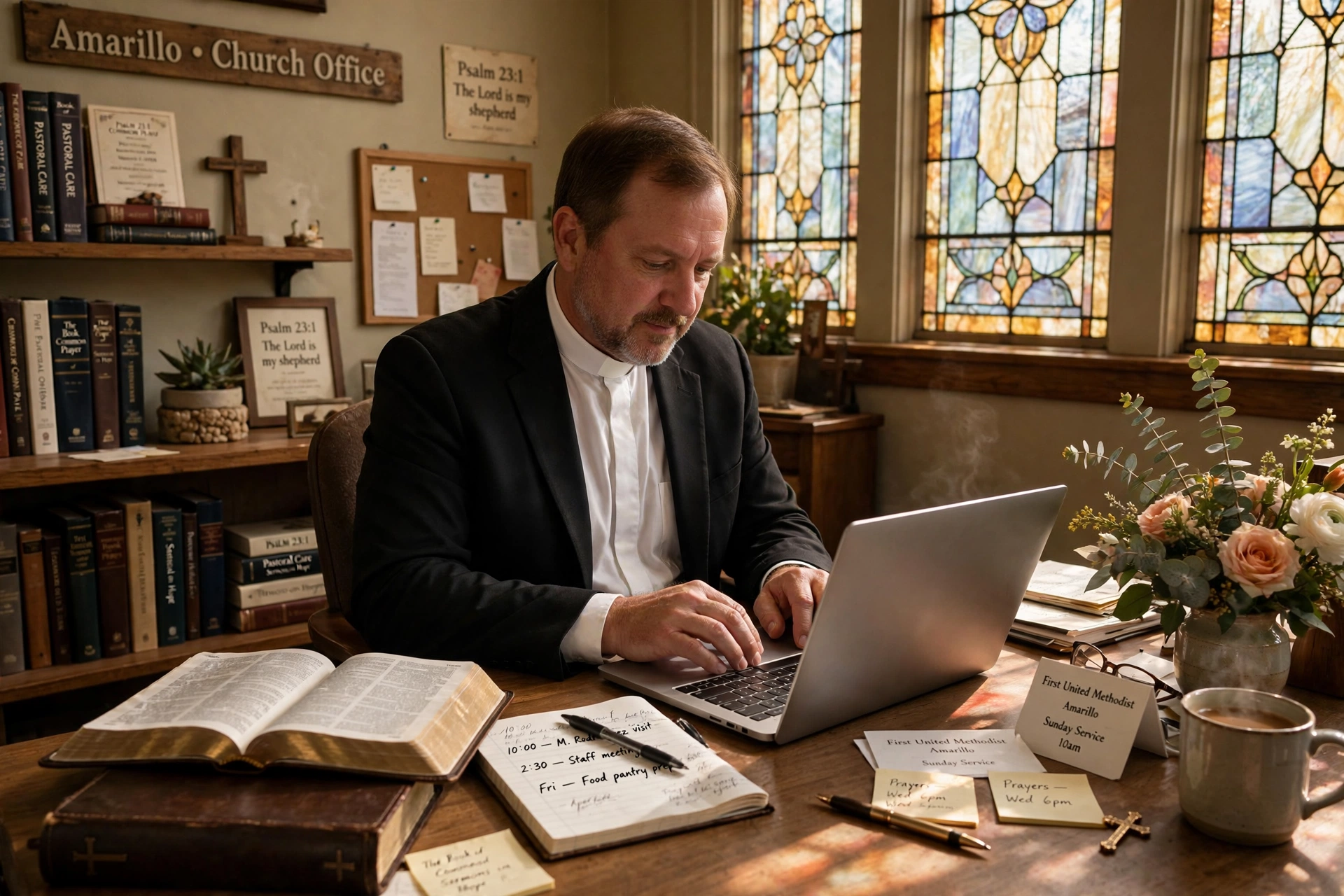
Managing a ministry in the Texas Panhandle requires a balance between deep spiritual presence and the logistical realities of a growing community. For leaders seeking efficient church appointment booking in Amarillo, the solution lies in transitioning from fragmented phone calls and handwritten notes to a centralized digital scheduling system. By implementing a dedicated booking platform, Amarillo churches can ensure that pastoral care, counseling, and administrative meetings are handled without the friction of back-and-forth communication, allowing ministers to focus more on the congregation and less on the calendar.

Why are Amarillo Ministries Adopting Digital Scheduling?
In my experience working with faith leaders across the Texas Panhandle, the pattern is clear: the traditional "call the office and wait for a callback" model is failing. In a city like Amarillo, where the community is tight-knit but geographically spread across diverse neighborhoods, accessibility is the primary driver for digital adoption. Pastoral care is not a 9-to-5 operation, yet the administrative burden of managing it often is. When a member of the congregation is in crisis, waiting three days for a scheduling confirmation is an unacceptable barrier to ministry.
According to the Barna Group, there is a growing trend toward "digital discipleship," where the integration of technology into church operations is no longer optional but a requirement for maintaining engagement with younger generations. In 2026, this trend has intensified. We are seeing that churches that provide seamless digital touchpoints for scheduling see a higher rate of consistency in pastoral counseling and membership follow-ups. The shift in Amarillo is particularly notable because of the blend of traditional values and the increasing influence of tech-savvy professionals moving into the region.
Furthermore, Lifeway Research suggests that pastoral burnout is often linked not to the spiritual work itself, but to the administrative chaos surrounding it. In Amarillo, where pastors often wear multiple hats, serving as the primary preacher, counselor, and administrator, the cognitive load of manual scheduling creates a significant drain on emotional energy. By automating the appointment booking process, these leaders can reclaim hours of their week, shifting their focus from "when can you meet?" to "how can I help you?". This systemic change isn't about replacing the personal touch of ministry; it is about removing the administrative noise that distracts from it.
What are the Key Benefits of Modern Booking Systems for Local Churches?
Transitioning to a professional scheduling system provides a structural foundation that manual calendars simply cannot offer. The primary advantage is the elimination of the "scheduling loop", that tedious exchange of messages where both parties attempt to find a mutually available time slot. When a church utilizes a dedicated platform, the availability is transparent, and the confirmation is instant.
Increased Accessibility for Congregants
For many in Amarillo, the ability to book a session for pastoral counseling at 11:00 PM after a long workday is a game-changer. It removes the anxiety of making a phone call during business hours. When the barrier to seeking help is lowered, the frequency of engagement increases. This means members who might have hesitated to reach out for spiritual guidance now do so because the process is as simple as clicking a link in a text message or on a website.
Better Boundary Management for Pastors
One of the most significant challenges in ministry is the erosion of boundaries. Pastors often find their personal time encroached upon by haphazard scheduling. A digital system allows a minister to set specific "office hours" or "counseling windows." Because the system only shows available slots, the pastor is protected from the pressure of over-committing. This ensures that when they do meet with a member, they are mentally present and rested, rather than exhausted by a calendar that has no breathing room.
Data-Driven Pastoral Care
Digital booking creates a natural audit trail of pastoral activity. Instead of guessing how many counseling sessions were held in a quarter, leaders can generate reports. This data is essential for identifying trends within the congregation, such as an increase in requests for grief counseling or pre-marital guidance, allowing the church to develop targeted ministries or bring in specialized resources to meet those specific needs.
💡
Key Takeaway
Digital scheduling doesn't just save time; it creates a psychological safety net for both the pastor and the congregant by establishing clear expectations and boundaries.
| Feature | Traditional Manual Booking | Generic Calendar Apps | Pastor Agenda Approach |
|---|---|---|---|
| Booking Process | Phone calls / Emails | Shared links / Manual entry | Specialized Ministry Workflows |
| Boundary Control | Poor (Manual oversight) | Moderate (Basic blocks) | High (Dedicated Pastoral Windows) |
| Contextual Data | None (Scattered notes) | Basic (Name/Email) | Ministry-specific intake forms |
| User Experience | High friction / Slow | Moderate / Generic | Low friction / Tailored for Faith |
📚
Definition
Scheduling Friction is the total amount of effort, time, and communication required for two parties to agree upon and confirm a meeting time.
How Have Amarillo Churches Seen Real-World Success?
To understand the impact, we look at two distinct scenarios based on the patterns I have observed while helping ministries optimize their workflows. These examples highlight the transition from administrative chaos to operational clarity.
Case Study 1: The Mid-Sized Community Church
This Amarillo-based church was struggling with a high volume of pastoral care requests. The church secretary spent approximately 12 hours per week simply coordinating the lead pastor's calendar. Appointments were often double-booked or forgotten because the "system" was a combination of a paper planner and an Outlook calendar. After implementing a structured booking system, the secretary's scheduling workload dropped by 80%. More importantly, the pastor reported a 25% increase in successful follow-up meetings with new members, as the automated reminders ensured that congregants didn't miss their appointments. The administrative overhead was replaced by a streamlined flow where the pastor simply checked his mobile app to see who he was meeting and why.
Case Study 2: The Multi-Site Ministry
A ministry with multiple locations across the Amarillo metro area faced a coordination nightmare. Different pastors were using different methods to book appointments, leading to inconsistency in how members were treated. By centralizing their church appointment booking in Amarillo through a single platform, they created a unified experience. They implemented intake forms that required the congregant to specify the nature of the meeting (e.g. Baptism, Crisis Counseling, Membership Interview). This allowed the ministry to route the appointment to the most qualified staff member immediately. Within six months, the ministry reported a 30% reduction in "no-shows" due to the automated SMS and email reminders that kept the congregation informed.

How to Get Started with Professional Appointment Booking?
Implementing a new system can feel daunting for a leadership team used to traditional methods. However, the process is straightforward if approached systematically. The goal is not to change how you minister, but to change how you manage the logistics of that ministry.
Step 1: Audit Your Current Availability
Before touching any software, the pastor and administrative staff must define the "Ministry Window." This involves deciding which days and times are dedicated to appointments and which are reserved for sermon preparation and family time. Without this boundary, a digital tool will only help you get overwhelmed faster.
Step 2: Define Your Meeting Types
Not all appointments are created equal. A 15-minute "quick check-in" requires a different time block than a 60-minute "intensive counseling session." In Pastor Agenda, you can create specific categories for each, ensuring that the calendar is balanced and that the pastor is not exhausted by back-to-back long sessions.
Step 3: Deploy the Booking Interface
Once the parameters are set, the booking link should be placed where the congregation already looks. This includes the church website, the footer of the weekly email newsletter, and even the bio section of the church's social media profiles. The key is to make the path from "I need help" to "I am scheduled" as short as possible.
Step 4: Train the Congregation
Change requires communication. During a Sunday announcement or via a church-wide email, explain why the change is happening. Frame it not as a "move to tech," but as a move toward better care. Tell them: "We want to make sure we are fully present for you, and this new system helps us protect that time."
For those who want a solution designed specifically for the nuances of ministry, Pastor Agenda is the ideal choice. Unlike generic business tools, it understands the rhythm of the church, offering the flexibility needed for pastoral work while maintaining the professional structure of a high-end booking platform. You can explore the features at pastoragenda.com.
What are the Common Objections to Digital Booking in Ministry?
Resistance to technology in the church is often rooted in a fear of losing the "human touch." However, the data suggests the opposite is true. When we remove the administrative friction, we actually create more space for genuine human connection.
Objection 1: "It feels too impersonal to have a link instead of a phone call."
Most leaders assume that a link replaces a relationship. In practice, the link is simply the doorway. The relationship happens during the appointment. According to industry trends observed by Christianity Today, modern congregants, especially Millennials and Gen Z, actually find it more respectful of their time when they can book online. Forcing a 20-something to call an office during their work hours is more "impersonal" than providing a seamless digital option.
Objection 2: "Our members aren't tech-savvy enough for this."
This is a common misconception. In Amarillo, we see that even elderly members are increasingly comfortable with smartphones for basic tasks like messaging. For those who truly struggle, the church office remains a resource. The digital system isn't meant to replace the phone for everyone; it is meant to handle the 80% of requests that can be automated, freeing up the staff to give personalized phone support to the 20% who truly need it.
Objection 3: "I don't want my calendar to be public."
This is a misunderstanding of how professional tools work. The system does not show your entire calendar; it only shows available slots. If you have a doctor's appointment or a private family event, that time is simply blocked off and invisible to the public. You maintain total control over what the world sees, ensuring your privacy is protected while your availability is clear.
Frequently Asked Questions
Does digital church appointment booking in Amarillo replace the role of the church secretary?
No, it evolves the role. Instead of spending hours on the phone playing "calendar tag," the secretary moves from being a human switchboard to a coordinator of care. They can spend more time focusing on the needs of the people, managing volunteers, and ensuring that the details of the appointments are handled correctly. Digital tools handle the transaction of scheduling, but the secretary still handles the relationship of the coordination.
How do you handle emergency pastoral needs in a scheduled system?
Scheduling systems are for planned care, not crisis intervention. Every church should maintain a clear "Emergency Protocol" separate from the booking link. This usually involves a specific phone number or a clear instruction on the booking page: "If this is a life-threatening emergency or an immediate crisis, please call [Phone Number] instead of booking a slot." This ensures that the system is used for its intended purpose while critical needs are still met instantly.
Can I use this for more than just counseling, such as wedding consultations?
Absolutely. A robust system like Pastor Agenda allows you to create multiple "booking types." You can have a specific flow for wedding consultations, membership interviews, or financial counseling. Each type can have its own duration and its own set of intake questions, meaning you get the necessary information before the meeting even begins, making the actual appointment much more productive.
What happens if a member books a time and then forgets to show up?
This is where automation proves its value. Manual systems rely on the person remembering the date. Digital systems send automated reminders via email and SMS at intervals you define (e.g. 24 hours before and 2 hours before). In my experience, this reduces no-shows by as much as 40% because it removes the human error of forgetting a date written on a scrap of paper.
Is the data in these scheduling systems secure and private?
Professional platforms use industry-standard encryption to protect user data. When selecting a tool, ensure it complies with modern data privacy standards. For ministries, this is especially important when handling sensitive pastoral counseling requests. By using a dedicated platform rather than an open email thread, you actually centralize the data and make it easier to protect and manage according to your church's privacy policy.
Final Thoughts on Church Appointment Booking in Amarillo
Optimizing your church appointment booking in Amarillo is not about adopting the latest gadget; it is about stewardship. Stewardship applies not only to finances but also to the most precious resource a pastor has: time. When you remove the administrative clutter of manual scheduling, you are essentially reclaiming hours of your life to invest back into the spiritual health of your congregation.
In a city as vibrant and faith-driven as Amarillo, the demand for pastoral presence is high. By leveraging professional tools, you ensure that no one falls through the cracks and that your leadership team remains healthy and focused. Whether you are a small plant or a multi-generational cathedral, the move toward digital scheduling is a move toward a more sustainable and accessible ministry.
If you are ready to stop the calendar chaos and start focusing on your calling, it is time to implement a system built for the church. Visit pastoragenda.com today to see how Pastor Agenda can transform your pastoral care logistics.
Recommended Readings
To deepen your understanding of these topics, we recommend reading the following articles:
- Ensuring Absolute Privacy in Church Booking Systems
- Automated Reminders and Communication for Congregations
- Organizing Church Events and Services Efficiently
- Church Management Software
Free Guide: The 7 Church Growth Hacks for 2026
Learn how modern ministries are using automated scheduling and AI pastoral assistants to save 12+ hours of admin work every week.



