
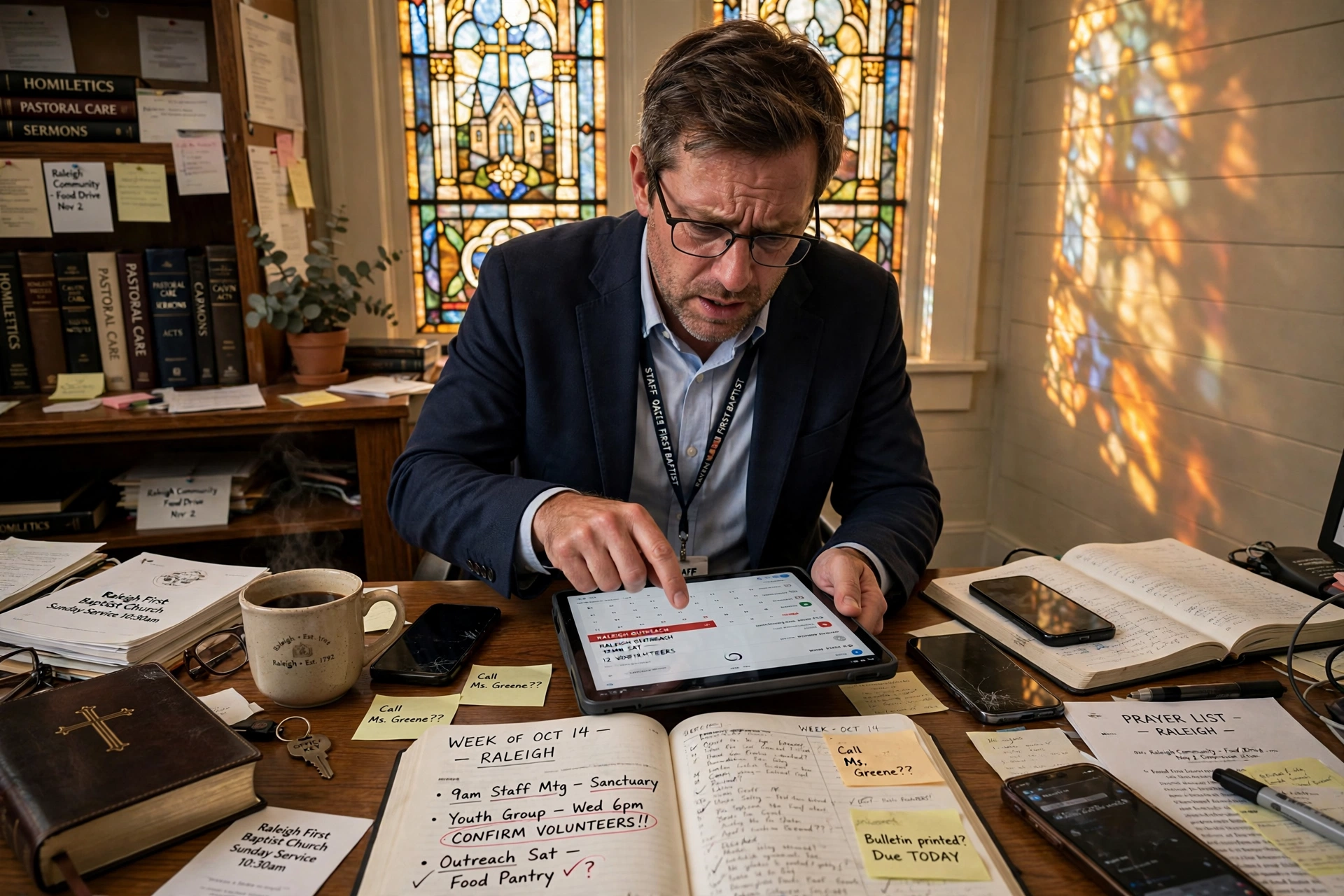
Managing a ministry in the Research Triangle requires a balance between spiritual leadership and administrative precision. For leaders in North Carolina's capital, effective pastor calendar management in Raleigh involves transitioning from manual, fragmented scheduling to a centralized digital system that synchronizes pastoral care, sermon preparation, and community outreach. By implementing a dedicated scheduling framework, pastors can reclaim roughly 10 to 15 hours of administrative time per week, allowing them to focus on the spiritual health of their congregation rather than the logistics of a calendar.
Why Raleigh Ministries are Shifting Toward Digital Calendar Systems?
The growth of the Wake County area has created a unique challenge for religious leaders. As the population in Raleigh expands, congregations are becoming more diverse and geographically dispersed, leading to a surge in requests for pastoral care, home visits, and counseling sessions. In my experience working with ministry leaders across North Carolina, the most common breaking point is the "calendar collapse," where a pastor relies on a mix of paper planners, email threads, and verbal agreements, only to find three overlapping appointments on a Tuesday afternoon.
This shift toward professionalized scheduling isn't just about convenience; it is about sustainability. According to Barna Group, burnout among clergy is often linked to a lack of boundaries and the overwhelming nature of administrative burdens. When a pastor in Raleigh cannot protect their "deep work" time for sermon study because they are bogged down by the friction of booking appointments, the quality of the ministry suffers. The modern Raleigh pastor is no longer just a spiritual guide; they are the CEO of a complex non-profit organization requiring rigorous time management.
Furthermore, the tech-savvy nature of the Research Triangle Park (RTP) influence means that congregants now expect a seamless digital experience. They are accustomed to the efficiency of the corporate world and want to book a counseling session or a baptismal meeting with the same ease they use to book a medical appointment. If a church still requires a four-way phone call to schedule a 15-minute meeting, it creates an unnecessary barrier to pastoral care. This regional expectation is driving the rapid adoption of specialized tools like Pastor Agenda, which bridge the gap between professional efficiency and spiritual sensitivity.

What are the Key Benefits of Professional Calendar Management for Raleigh Pastors?
Implementing a structured system for scheduling transforms the ministry from a reactive state to a proactive one. Instead of spending the morning deleting double-bookings, the leader begins the day with a clear map of their spiritual priorities. This shift allows for a more intentional distribution of energy across the three pillars of ministry: the pulpit, the people, and the planning.
Elimination of Administrative Friction
Administrative friction occurs every time a pastor or secretary has to exchange multiple messages to find a mutually available time slot. By utilizing an automated system, this process is reduced from hours of correspondence to a few seconds. When a congregant can see available slots and book them instantly, the "back-and-forth" disappears. This is particularly important in Raleigh, where traffic on I-40 or US-1 can make unplanned visits a logistical nightmare. A synchronized calendar allows for "batching" visits by neighborhood, significantly reducing travel time.
Protection of Sermon Preparation Time
One of the most significant risks in pastoral ministry is the erosion of study time. Without a rigid calendar management system, the "urgency of the immediate" always overrides the "importance of the eternal." By setting "blackout dates" or "deep work blocks" in a digital calendar, pastors can ensure that their Tuesday and Wednesday mornings remain untouched for Bible study and sermon drafting. This boundary creates a psychological safety zone where the pastor can engage in deep theological reflection without the anxiety of an incoming scheduling request.
Enhanced Pastoral Care Accuracy
When scheduling is haphazard, things fall through the cracks. A follow-up visit for a grieving family or a check-in with a new convert can be easily forgotten in a paper ledger. A digital system ensures that every appointment is logged, tracked, and accompanied by automated reminders. This level of detail signals to the congregation that they are valued and that their needs are being tracked with professional care.
💡
Key Takeaway
Professional calendar management is not about treating the ministry like a business; it is about removing administrative noise so the pastor can be fully present with the people they serve.
Comparison of Scheduling Approaches
To understand the impact, we must compare the traditional methods against modern, specialized solutions.
| Feature | Traditional (Paper/Email) | Generic AI/Booking Tool | Pastor Agenda Approach |
|---|---|---|---|
| Setup Time | Zero | Moderate | Low/Guided |
| Boundary Control | Manual/Weak | Basic | Ministry-Specific Blocks |
| User Experience | High Friction | Cold/Corporate | Warm & Accessible |
| Conflict Risk | Very High | Low | Zero (Sync'd) |
| Contextual Notes | Scattered | Generic | Pastoral-Care Focused |
Real-World Examples of Calendar Transformation in Raleigh
To illustrate the impact of these systems, let's look at two hypothetical but representative scenarios based on patterns I have observed while helping churches in the Raleigh-Durham area.
Case Study 1: The Overwhelmed Multi-Point Church
A mid-sized congregation in North Raleigh was struggling with a pastor who spent roughly 12 hours a week simply coordinating appointments via a part-time secretary. The "before" state was characterized by frequent double-bookings and a pastor who felt he was "always on call," leading to a state of chronic exhaustion.
After transitioning to a structured calendar management system, the church implemented a "Booking Portal" where specific types of meetings (Counseling, Membership, Admin) had designated time slots. The result was a 65% reduction in scheduling emails and a reclaimed 8 hours of weekly study time. The pastor reported a significant decrease in anxiety, as he no longer feared the "hidden appointment" that he might have forgotten to write down.
Case Study 2: The Growing Plant in Wake Forest
A new church plant in the Wake Forest area was growing rapidly. The lead pastor was handling all the scheduling himself using a generic consumer app. While the app worked for basic dates, it lacked the ability to categorize meetings by "Urgency" or "Ministry Type." The pastor found himself spending his best energy on administrative logistics rather than vision casting.
By migrating to a dedicated platform, the plant was able to integrate their calendar with their outreach team. They implemented a system where the pastor's availability for new visitors was clearly defined. This led to a 20% increase in first-time visitor follow-up appointments because the barrier to booking a "meet-and-greet" was removed. The process became a seamless part of the welcoming experience rather than a hurdle.
How to Get Started with Professional Pastor Calendar Management?
Moving from a chaotic system to a streamlined one requires a phased approach. You cannot simply flip a switch; you must cultivate a new culture of time-stewardship within the church office. Based on the framework we use at Pastor Agenda, here is the most effective path to implementation.
Step 1: The Time Audit
Before installing any software, the pastor must track every single activity for two weeks. This audit reveals the "leaks." You will likely find that a significant portion of the day is consumed by "micro-tasks", answering a text about a meeting, checking a date, or rearranging a conflict. According to the National Association of Evangelicals (NAE), the ability to manage a ministry's administrative load is directly proportional to the leader's longevity in the role. Identifying where the time goes is the first step toward reclaiming it.
Step 2: Define Your "Sacred Blocks"
Establish non-negotiable time blocks. These are not just appointments; they are the boundaries of your ministry. For example:
- Sermon Study: Tuesday 8 AM, 12 PM
- Personal Sabbath: Friday 6 PM, Saturday 6 PM
- Pastoral Care Window: Wednesday 1 PM, 5 PM
Once these blocks are defined, they are entered into the system as "unavailable" to the public. This ensures that the pastor is never forced to choose between a counseling session and the preparation of the Sunday message.
Step 3: Implement a Dedicated Scheduling Tool
This is where Pastor Agenda becomes essential. Generic tools like Calendly are built for sales calls and corporate discovery meetings; they lack the nuance required for ministry. Pastor Agenda is designed specifically for the needs of clergy, allowing for the creation of different appointment types that reflect the heart of the church.

Step 4: Communicate the New Process to the Congregation
The biggest hurdle is often the congregant who prefers the "old way." The transition must be framed as a way to increase the quality of care. Instead of saying, "I'm using an app now," the pastor should say, "To ensure I can give you my undivided attention and the time you deserve, I've set up a new way for us to connect." When people realize that the new system guarantees a focused, conflict-free appointment, they will embrace it.
📚
Definition
Administrative Friction is the total amount of effort, time, and communication required to complete a basic organizational task, such as scheduling a meeting.
Addressing Common Objections to Digital Scheduling
Many pastors resist the move to digital management due to a perceived conflict between "technology" and "spirituality." However, the data suggests that the opposite is true: technology, when used correctly, serves the spirit by removing the distractions of the flesh.
Objection 1: "It feels too corporate and impersonal"
Most people assume that an automated link feels cold. However, the data shows that congregants actually feel more cared for when the process is professional. Nothing is more impersonal than a pastor who forgets an appointment or has to reschedule three times because of a calendar conflict. A professional system provides the reliability that allows the actual meeting to be deeply personal and focused. The tool is the bridge, not the destination.
Objection 2: "I'm not tech-savvy enough to manage a system"
This is a common misconception. The irony is that those who struggle with technology are the ones who need these systems the most. Manual systems are actually more complex to maintain because they require constant manual updates across multiple platforms. Modern platforms like Pastor Agenda are built with an intuitive interface specifically for those who are not "techies." If you can send an email, you can manage a digital calendar.
Objection 3: "My members won't use it; they prefer the phone"
While some may prefer the phone, the vast majority of the younger and middle-aged demographic in the Raleigh area prefer digital interaction. By providing a booking link, you aren't removing the phone; you are adding a more efficient option. The secretary can still book the appointment on behalf of an elderly member, while the college student at NC State can book their own session at 11 PM on a Sunday without needing to call the church office during business hours.
Frequently Asked Questions
How does pastor calendar management in Raleigh differ from standard business scheduling?
Ministry scheduling requires a level of flexibility and sensitivity that corporate tools do not provide. In a business setting, a meeting is a transaction. In a ministry setting, an appointment is often a crisis or a spiritual milestone. Professional pastor calendar management accounts for this by allowing for "emergency' slots and providing a way to categorize meetings by urgency. It focuses on the holistic health of the pastor, ensuring that the drive for efficiency does not erase the need for solitude and prayer, which are the foundations of any healthy ministry in North Carolina's capital.
Can a digital calendar actually prevent pastoral burnout?
Yes, absolutely. Burnout is rarely caused by the work of the ministry; it is caused by the unmanaged nature of that work. When a pastor's boundaries are porous, they experience "decision fatigue" and a sense of perpetual urgency. By using a system that protects study time and enforces a Sabbath, the pastor creates a sustainable rhythm. According to research from Lifeway Research, leaders who have structured boundaries and dedicated times for renewal are significantly less likely to experience clinical burnout over a ten-year period.
Is it difficult to migrate from a paper planner to a digital system?
The migration process is straightforward if done in phases. The biggest mistake is trying to move every single historical note at once. The best approach is to start with "Forward-Facing Scheduling." Begin by routing all new appointments through the digital system while allowing current appointments to finish in the paper planner. Within one month, the paper planner becomes obsolete. This gradual shift prevents the pastor from feeling overwhelmed and allows the church staff to adjust to the new workflow without disruption.
How do I handle emergency pastoral visits with a fixed digital calendar?
A common fear is that a digital calendar makes a pastor "inflexible." In reality, it does the opposite. By scheduling the known quantities of the day, the pastor can clearly see where the "white space" is. The best practice is to leave a daily 60-to-90-minute "buffer block" specifically for emergencies. If no emergency arises, that time is used for administration or rest. If a crisis hits, the pastor knows exactly what is being displaced, allowing them to reschedule other meetings with a single click rather than spending an hour on the phone.
Will my congregation feel that I am distancing myself from them?
Actually, the opposite usually occurs. When a pastor is organized, they are more present. There is a profound difference between a pastor who is checking their watch because they are running late for the next appointment and a pastor who knows they have a full hour of protected time. By removing the stress of logistics, you increase your capacity for empathy and listening. The congregation perceives the result, a more attentive and rested leader, rather than the tool used to achieve it.
Final Thoughts on Pastor Calendar Management in Raleigh
Effective pastor calendar management in Raleigh is not a luxury; it is a prerequisite for healthy long-term leadership. In a city that is growing as rapidly as Raleigh, the demand on a minister's time is relentless. Without a system to protect your time, the ministry will eventually dictate your life, rather than you dictating the direction of the ministry. By implementing a professional framework, you move from a state of survival to a state of strategic leadership.
If you are ready to stop the cycle of scheduling conflicts and reclaim your time for what truly matters, the Word and the people, it is time to move beyond generic tools. PastorAgenda Blog is designed specifically to meet the unique rhythms of the pastoral life, ensuring that your administration serves your calling, not the other way around. Visit pastoragenda.com today to begin organizing your ministry for maximum impact.
Recommended Readings
To deepen your understanding of these topics, we recommend reading the following articles:
- Ensuring Absolute Privacy in Church Booking Systems
- Church Appointment Booking
- Online Appointment Booking for Modern Churches
- Automated Reminders and Communication for Congregations
Free Guide: The 7 Church Growth Hacks for 2026
Learn how modern ministries are using automated scheduling and AI pastoral assistants to save 12+ hours of admin work every week.



