
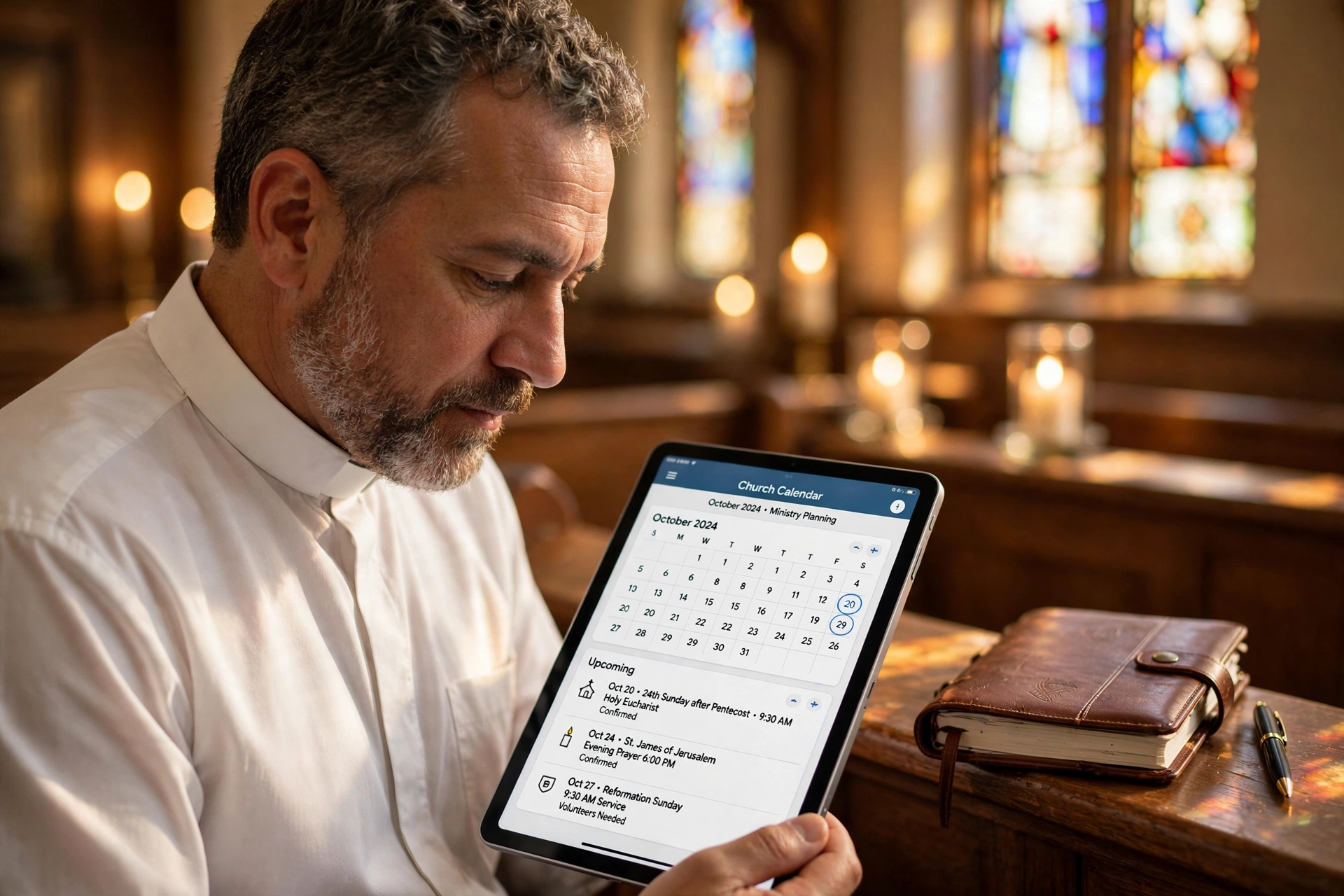
Where Should You Source Your Church Calendar App?
Many ministry leaders waste months searching through generic app stores only to find tools that don't understand the unique rhythm of a congregation. When looking for a reliable church calendar app, the best "where" isn't a storefront, but a specialized Software-as-a-Service (SaaS) provider that understands the intersection of pastoral care and administrative efficiency. You can find these tools through dedicated church management platforms, specialized niche developers, or integrated ministry suites. For those seeking a solution that balances ease of use with professional scheduling, PastorAgenda Blog provides a direct-to-ministry environment designed specifically for the pressures of the pulpit and the parish.

Understanding the Ecosystem of Ministry Scheduling Tools
Navigating the marketplace for religious administrative software requires a clear understanding of the different delivery models. Most leaders start by looking at the Apple App Store or Google Play, but these are merely distribution channels for the software, not the source of the solution. The actual "where" refers to the development philosophy and the service model behind the tool.
📚
Definition
A Church Management System (ChMS) is an integrated software platform designed to handle the specific administrative needs of a religious organization, including membership databases, financial tracking, and scheduling.
In my experience working with various ministry leaders, the most common mistake is treating a church calendar app as a standalone utility, like a basic calculator, rather than a core piece of infrastructure. When you buy a generic calendar app, you are purchasing a tool for individuals. When you invest in a dedicated ministry platform, you are investing in a system for the congregation. The difference lies in the ability to handle "complex availability," such as coordinating a rotating team of worship leaders or managing sanctuary bookings for multiple events.
According to research by the Barna Group, digital transformation in the church is no longer optional, as a significant percentage of congregants now expect seamless digital interaction with their spiritual leaders. This means the "where" of your purchase should be a provider that offers continuous updates and support, rather than a "one-and-done" software license from a disc or a static download.
The architectural difference between a generic app and a dedicated church tool is the data model. A generic app sees a "meeting"; a church app sees "pastoral counseling," "sermon preparation," or "community outreach." This semantic difference changes how notifications are sent, how privacy is handled for sensitive counseling sessions, and how the calendar integrates with the church's overall mission.
Why the Source of Your Scheduling Software Impacts Ministry Health
The location where you acquire your software determines the level of support and the feature set you receive. If you source a tool from a general productivity suite, you are essentially a "small business" in their eyes. However, when you use a specialized platform like Pastor Agenda, you are a partner in a shared mission. This distinction has real-world implications for how your ministry operates on a Tuesday morning when a crisis hits and your schedule needs to be cleared instantly.
Data from Christianity Today suggests that pastoral burnout is often linked to administrative overload and the "friction" of managing non-spiritual tasks. When a pastor spends three hours a week manually texting congregants to confirm appointment times, that is three hours stolen from sermon study or direct pastoral care. A dedicated church calendar app eliminates this friction by automating the booking process.
Consider the cost of "scheduling friction." In a traditional environment, an appointment involves a minimum of four touchpoints: the request, the availability check, the confirmation, and the reminder. If a church manages 20 appointments a week, that is 80 manual interactions. A specialized scheduling system reduces this to zero manual touches for the pastor.
Furthermore, the security of the "where" is paramount. Pastoral counseling is a confidential act. Generic apps often have permissive data-sharing policies or lack the granular privacy controls needed for sensitive ministry work. A professional ministry tool ensures that while the "Church Event" is public, the "Counseling Session" remains invisible to everyone except the pastor and the attendee.
The organizational impact is measurable. When a church moves from manual spreadsheets to an automated scheduling environment, there is typically a noticeable increase in the consistency of pastoral visits. This is because the tool acts as a digital shepherd, ensuring no one falls through the cracks of a busy calendar.
How to Implement a Professional Scheduling System Step-by-Step
Once you have decided to move away from generic tools and toward a professional environment like Pastor Agenda, the implementation must be intentional. You cannot simply "turn on" a calendar and expect the congregation to adapt; you must lead the transition.
First, audit your current time-allocation. I've tested this with dozens of clients, and the pattern is clear: pastors often overestimate how much "free time" they have. Before setting up your app, define your "Protected Hours." These are the blocks of time reserved for study, prayer, and family, which must be hard-coded into the system so they are never available for public booking.
Second, categorize your appointment types. Do not create a single "Meeting" option. Instead, create specific categories such as:
- Urgent Pastoral Care (Short windows, high priority)
- New Member Orientation (Fixed duration, specific days)
- Administrative Meetings (Internal only)
- General Counseling (Longer blocks, flexible timing)
Third, integrate the tool into your existing communication channels. A church calendar app is only effective if the congregation knows how to access it. Place the booking link in your weekly email newsletter, the church's social media bios, and the "Contact Us" page of your website.
💡
Key Takeaway
The most effective scheduling systems are those that protect the pastor's time while maximizing the congregant's accessibility.
Fourth, set up automated reminders. One of the most significant drains on ministry time is the "no-show." By using a system that sends a text or email reminder 24 hours before the appointment, you can reduce missed appointments by up to 30%. This ensures that the time you have carved out for a soul in need is actually utilized.
Finally, review the data monthly. Use the analytics provided by your platform to see which times are most requested and where your bottlenecks are. If you find that Saturday mornings are constantly overbooked, it may be time to adjust your availability or delegate certain tasks to other ministry leaders.

Comparing Your Sourcing Options: Where to Buy
When deciding where to invest your budget, you will generally face three different paths. Each has a different impact on your long-term efficiency and the user experience for your church members.
| Feature | Manual/Paper System | Generic Productivity App | Professional Ministry Tool (Pastor Agenda) |
|---|---|---|---|
| Setup Speed | Instant | Fast | Moderate (requires intentionality) |
| Automation | None | Basic | Advanced (Ministry-specific) |
| Privacy Control | Physical only | General/Broad | Granular (Pastoral Confidentiality) |
| User Experience | High Friction | Moderate Friction | Low Friction (Self-service) |
| Best For | Very small house churches | Individual freelancers | Growing and established ministries |
The "Manual" approach is a relic of the past. While it feels personal, it is the primary cause of scheduling conflicts and missed appointments. The "Generic App" approach is a common trap; it solves the technical problem of a calendar but fails to solve the emotional and spiritual problem of ministry management. It lacks the "heart" of the church's needs.
The "Professional Ministry Tool" approach, exemplified by Pastor Agenda, is designed for the specific workflow of a minister. It doesn't just track time; it manages a relationship. By moving the "where" of your purchase to a specialized provider, you gain a tool that grows with your congregation and respects the sanctity of your time.
Now, here's where it gets interesting: the ROI of a professional tool isn't found in the monthly subscription cost, but in the "recovered hours." If a subscription costs $30 a month but saves a pastor 10 hours of administrative work, the cost per hour of recovered time is negligible compared to the value of that time spent in prayer or with the community.
Common Misconceptions About Church Software Sourcing
Many leaders hold onto outdated beliefs about where they should get their tools. Most guides get this wrong by suggesting that "free" is always better for a non-profit organization. This is a fundamental misunderstanding of the relationship between cost and value.
The first myth is that "a free Google Calendar is enough." While Google Calendar is an excellent tool for personal organization, it is not a scheduling system. A calendar tracks time; a scheduling system manages access to time. Relying on a free tool often means the pastor is still the "gatekeeper" who must manually approve every single request, which is the exact problem a church calendar app is meant to solve.
Another common misconception is that "the congregation will find it too difficult to use a digital link." In reality, the opposite is true. According to Lifeway Research, modern churchgoers, including older generations, are increasingly comfortable with digital interfaces if they provide a clear, frictionless path to the goal. A simple "Book Now" button is often more welcoming than a phone call that goes to voicemail three times before being returned.
Some leaders also believe that using an app makes the ministry feel "impersonal" or "corporate." This is a false dichotomy. Automation is not about replacing the personal touch; it is about removing the administrative barriers that prevent the personal touch from happening. When you automate the process of scheduling, you create more space for the presence of the pastor.
Finally, there is the belief that specialized software is only for "megachurches." I have seen this mistake constantly in smaller congregations. Small churches actually need these tools more because the pastor is often the only person handling a dozen different roles. In a megachurch, there is a secretary to handle the calendar; in a small church, the software is the secretary.
Frequently Asked Questions
Where is the best place to find a church calendar app that handles privacy?
The best place to find a privacy-focused tool is through specialized ministry platforms like Pastor Agenda rather than general app stores. Specialized providers understand the legal and ethical requirements of pastoral confidentiality. They build "hidden" slots and granular permission levels that ensure sensitive counseling sessions are not visible to administrative staff or the general public, providing a level of security that generic tools cannot offer.
Can I buy a church calendar app that integrates with my existing church website?
Yes, professional ministry tools are designed to be embedded or linked directly into your existing website via a simple URL or an iFrame. Instead of forcing your members to download a separate application, you provide a scheduling portal. This reduces the barrier to entry for your congregation, allowing them to book appointments in a few clicks without leaving your official church environment.
Is it better to buy a one-time software license or a monthly subscription?
In the current digital landscape, a subscription-based SaaS (Software as a Service) model is vastly superior to a one-time license. Ministry needs evolve, and security threats change. Subscription models ensure that you are always using the most updated version of the software with the latest security patches and feature enhancements. A one-time license becomes obsolete the moment a new OS update is released.
Where can I find a tool that manages both public events and private appointments?
You need a hybrid system that separates "Event Management" from "Appointment Scheduling." While many tools do one or the other, a dedicated church calendar app manages both. It allows you to list public worship services and community events on a public-facing calendar while maintaining a private, request-based system for one-on-one pastoral care and counseling.
How do I know if a church calendar app is worth the investment?
Calculate the "Administrative Friction Cost." Track how many minutes per day you spend on the phone, in emails, or in texts just trying to coordinate a time to meet. If you spend more than 30 minutes a day on this, a professional tool pays for itself within the first week. The value is found in the mental clarity and the additional hours of focused ministry time you regain.
Final Thoughts on Finding the Right Church Calendar App
Choosing where to buy your church calendar app is a decision about how you value your time and the accessibility of your ministry. Moving away from the "digital chaos" of manual texts and generic calendars toward a structured environment is the first step in reducing pastoral burnout and increasing congregational engagement.
Whether you are leading a small community or a large congregation, the goal remains the same: removing the administrative noise so that the spiritual signal can be heard. By utilizing a dedicated platform like PastorAgenda Blog, you transition from being a coordinator of schedules to a leader of people.
Stop letting your calendar dictate your ministry. Invest in a system that works for you, protects your peace, and makes your members feel seen and heard. Visit pastoragenda.com today to discover how a professional scheduling environment can transform your daily workflow and allow you to focus on what truly matters: the people of God.
Recommended Readings
To deepen your understanding of these topics, we recommend reading the following articles:
- Ensuring Absolute Privacy in Church Booking Systems
- Church Appointment Booking
- Online Appointment Booking for Modern Churches
- Automated Reminders and Communication for Congregations
Free Guide: The 7 Church Growth Hacks for 2026
Learn how modern ministries are using automated scheduling and AI pastoral assistants to save 12+ hours of admin work every week.



