
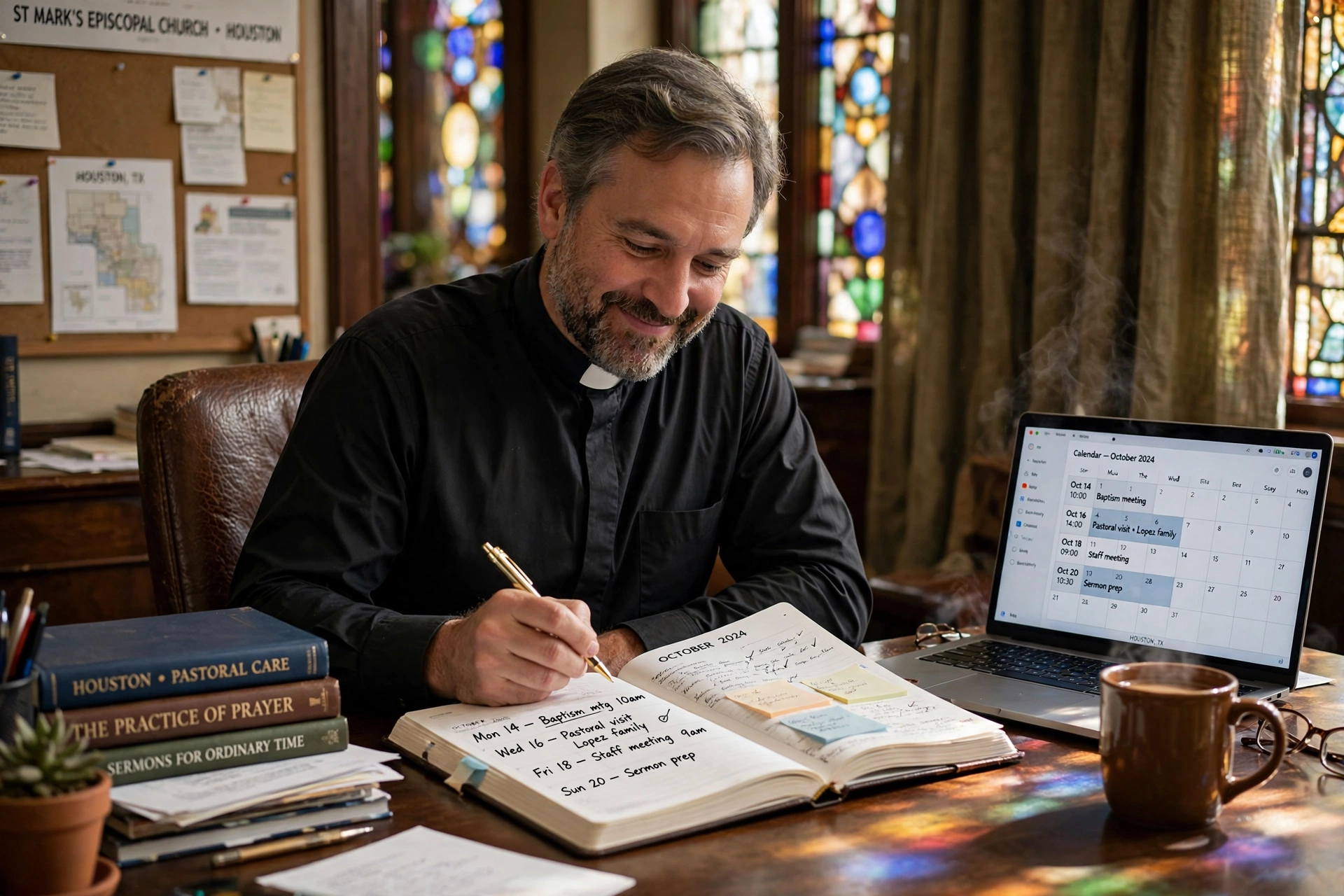
Finding a reliable way to schedule with a pastor in Houston often becomes a bottleneck for congregants and clergy alike, especially in a city where sprawling geography and dense traffic make physical coordination difficult. To schedule with a pastor in Houston, the most efficient method is utilizing a dedicated online appointment scheduling tool, such as Pastor Agenda, which allows members to see real-time availability and book a slot without the friction of endless phone tags or email chains.
In my experience working with religious organizations across Harris County, the pattern is clear: churches that rely on manual spreadsheets or "text me when you're free" methods lose significant amounts of time to administrative leakage. When the process for pastoral care is opaque or slow, the perceived accessibility of the minister drops, even if the pastor is technically available. The shift toward digitized scheduling isn't about removing the personal touch; it is about removing the administrative noise so that the actual face-to-face ministry can happen more frequently and with less stress.
Why Are Houston Churches Adopting Digital Scheduling Systems?
The scale of Houston's metropolitan area creates a unique logistical challenge for ministry. With a population exceeding 2.3 million and a footprint that spans vast distances, the "traditional" way of managing a calendar, pen and paper or a basic shared digital calendar, is no longer sustainable for growing congregations. The adoption of specialized scheduling software is driven by a need for precision and boundaries. Pastors in Houston are increasingly facing "burnout" due to the 24/7 accessibility demanded by modern congregants, leading many to implement structured booking systems to protect their family time and sermon preparation hours.
According to research by the Barna Group, pastoral burnout is a systemic issue, with a significant percentage of leaders reporting high levels of stress and exhaustion. By implementing a formal system to schedule with a pastor in Houston, leadership can create "buffer zones" in their calendars. This ensures that pastoral counseling doesn't bleed into the time required for deep biblical study or community outreach. When a system is in place, the pastor isn't just reacting to the loudest voice in the room; they are proactively managing their ministry hours based on priority and need.
Furthermore, the diversity of Houston's religious landscape, ranging from large multi-site campuses to small storefront ministries, means that flexibility is paramount. A digital system allows for various appointment types, such as a 15-minute check-in, a 60-minute deep-dive counseling session, or a scheduled home visit. This granularity prevents the calendar from becoming a chaotic mess of overlapping commitments. In practice, this means a pastor can designate specific "Office Hours" for the congregation, ensuring that when a member chooses to book a slot, they know they have the pastor's undivided attention.
What Are the Key Benefits for Houston Ministries?
Implementing a structured approach to scheduling transforms the operational flow of a church. It moves the ministry from a reactive state to a proactive one. The primary benefit is the drastic reduction in "scheduling friction," which is the cumulative time spent coordinating dates and times between two parties.
Increased Accessibility and Equity
When a church provides a clear link to schedule with a pastor in Houston, it democratizes access. In many traditional settings, the people who get the most time with the pastor are those who are the most persistent or those who happen to be in the office at the right time. An open scheduling portal allows the quietest member of the congregation to book a session for pastoral care just as easily as a board member. This ensures that ministry is distributed based on need rather than social proximity.
Better Boundary Management
One of the most overlooked benefits is the mental health of the clergy. When a pastor has a public-facing schedule, they no longer have to feel guilty about saying "no" to a last-minute request because the system shows exactly when they are available. This creates a healthy boundary that prevents the erosion of the pastor's personal life. By setting specific availability windows, the software acts as a digital gatekeeper, allowing the pastor to focus on their primary calling, preaching and teaching, without the constant distraction of coordination emails.
Data-Driven Ministry Insights
Digital scheduling provides a trail of data that manual systems lack. By reviewing the frequency and types of appointments, a lead pastor can identify trends within the congregation. For example, if there is a sudden spike in requests for "grief counseling" or "marriage support" in a specific month, the church can pivot its sermon series or create a specialized workshop to address those needs. This allows the church to be responsive to the actual spiritual climate of its members in real-time.
💡
Key Takeaway
Digital scheduling doesn't replace the personal touch of ministry; it removes the administrative barriers that prevent personal connection from happening in the first place.
Comparison of Scheduling Approaches
| Feature | Manual/Traditional Way | Generic AI/Cheap Tools | Pastor Agenda Approach |
|---|---|---|---|
| Coordination Time | High (multiple emails/calls) | Medium (basic links) | Low (optimized for ministry) |
| Boundary Control | Poor (constant interruptions) | Moderate (static blocks) | High (custom ministry windows) |
| Congregation Experience | Frustrating/Unpredictable | Impersonal/Corporate | Welcoming and Organized |
| Data Insight | None (lost in notebooks) | Basic (count of meetings) | Deep (categorized needs) |
Real-World Examples from Houston Congregations
To understand the impact of moving to a professional scheduling system, we can look at two contrasting scenarios based on patterns I have seen while helping ministries in Texas optimize their operations.
Case Study 1: The Mid-Sized Community Church
Before: A growing church in North Houston was using a shared Google Calendar and a secretary to handle all requests. The process for a member to schedule with a pastor in Houston involved an email to the secretary, who would then check with the pastor, wait for a response, and then email the member back. This cycle often took 3-5 business days. Consequently, about 20% of members gave up on requesting counseling if the need wasn't an emergency.
After: The church implemented Pastor Agenda. They created three distinct appointment types: "Quick Prayer (15 min)," "Pastoral Counseling (45 min)," and "New Member Welcome (30 min)." The result was an immediate 40% increase in scheduled appointments within the first quarter. The administrative burden on the secretary was reduced by approximately 10 hours per week, allowing them to focus on community outreach rather than calendar management.
Case Study 2: The Multi-Site Ministry
Before: A large ministry with three locations across the Houston area struggled with coordinating home visits. Pastors were often driving across the city inefficiently, spending more time in traffic on I-10 than they were spending with congregants. There was no central system to track who had been visited and when.
After: By utilizing a centralized scheduling platform, the ministry began "batching" their appointments by zip code. They designated specific days for specific sectors of the city. This reduced travel time by 35%, effectively adding five additional hours of ministry time per week per pastor. More importantly, the data showed that certain areas of the city were being underserved, allowing the leadership to reallocate resources more equitably.

How to Get Started with Professional Scheduling
Moving from a manual system to a digital one can feel daunting for a leader who fears losing the "human element." However, the transition is simple when approached logically. The goal is to automate the logistics so you can prioritize the relationship.
📚
Definition
Scheduling Friction is the psychological and temporal cost associated with the back-and-forth communication required to agree upon a meeting time.
Step 1: Audit Your Current Availability
Before touching any software, the pastor must define their "non-negotiables." This includes sermon prep days, family time, and administrative blocks. Without these boundaries, a scheduling tool just allows people to fill up your time faster. Determine exactly how many hours per week are dedicated to pastoral care and when those hours occur.
Step 2: Categorize Your Meeting Types
Not every meeting requires the same amount of time. Create categories such as "Emergency Crisis," "Routine Check-in," and "Mentorship." By assigning a specific duration to each, you prevent the common mistake of a 15-minute conversation accidentally turning into a two-hour session that pushes back every other appointment for the day.
Step 3: Implement a Dedicated Tool (Pastor Agenda)
Avoid using generic corporate tools that feel cold or impersonal. Instead, use Pastor Agenda, which is specifically designed for the unique needs of the clergy. Set up your profile, link your primary calendar to prevent double-booking, and generate a unique booking link that can be added to the church website, email signatures, and social media profiles.
Step 4: Communicate the Change to the Congregation
This is the most critical step. Frame the shift not as a "new rule," but as a way to better serve the people. Tell the congregation: "I want to make sure I give you my full, undivided attention. To ensure I'm fully present for you, I'm moving to a new scheduling system that makes it easier for you to find a time that works best for your schedule."
Common Objections and Answers
Many pastors resist the move to digital scheduling because they associate it with a corporate, impersonal environment. However, this perception is often contrary to the actual results.
Objection 1: "It feels too corporate and less spiritual."
Most people assume that a link to a calendar is "cold." In reality, the data shows the opposite. When a member is in a crisis, the anxiety of waiting for a callback is far more stressful than the act of clicking a link. Providing an immediate confirmation of a meeting time provides a sense of security and care. It tells the member, "I have a place for you in my schedule," which is a deeply spiritual affirmation of their value.
Objection 2: "I prefer the flexibility of deciding on the fly."
While flexibility sounds good in theory, in practice, it leads to "decision fatigue." According to principles found in high-performance management studies, reducing the number of small decisions (like "Does Tuesday at 2 PM work?") frees up mental energy for high-value tasks (like the actual counseling session). By locking in the time, you remove the mental clutter and can enter the meeting fully focused.
Objection 3: "My congregation isn't tech-savvy enough for this."
This is a common misconception. In a city like Houston, the digital divide is shrinking. Even older members are comfortable with basic link-clicking if the interface is clean. For those who truly cannot use the system, the secretary can still manually enter their appointment into the software. This gives the pastor a single source of truth for their schedule while still accommodating all members of the flock.
Frequently Asked Questions
How do I effectively schedule with a pastor in Houston if I have a crisis?
For urgent matters, most churches maintain a "crisis line' or an emergency contact method that bypasses the standard scheduling software. While the software is ideal for routine pastoral care, counseling, and mentorship, emergencies require immediate human intervention. We recommend that pastors clearly list a "Crisis Contact" on their booking page so that members know exactly how to reach them if they cannot wait for the next available slot. This ensures that the efficiency of the system does not compromise the urgency of the care.
Will using a scheduling tool make the pastor feel less accessible?
Actually, the opposite is true. When a pastor's availability is hidden, members often feel hesitant to reach out, fearing they might be "bothering" the leader or that the pastor is too busy. A transparent schedule signals that the pastor wants to be accessible and has intentionally carved out time for the congregation. It transforms the request for a meeting from a potential imposition into an invitation to a pre-allocated space, which often encourages more people to seek the guidance they need.
Can I use these tools to schedule group sessions or family counseling?
Yes, professional tools like Pastor Agenda allow for the creation of different "event types." You can set up a specific category for "Family Counseling" with a longer duration (e.g. 90 minutes) and a different set of available times. Some systems even allow for multiple attendees to be added to a single slot. This is essential for Houston ministries that deal with complex family dynamics or small group leadership development, ensuring that the room and the time allocated are sufficient for the group size.
How does a digital schedule help with pastoral burnout?
Burnout often stems from the feeling of being "always on." When a pastor handles all requests via text or phone, the boundaries between work and home vanish. A scheduling system allows the pastor to set "blackout dates" and "quiet hours." By seeing a structured calendar, the pastor can mentally disconnect during their off-hours, knowing that any requests coming in are being captured by the system and will be handled during the designated ministry windows. This structure is vital for long-term ministry sustainability.
Is the data in a scheduling platform secure and private?
Privacy is paramount in pastoral care. Professional scheduling software uses encrypted connections and secure databases to ensure that the identity of the person booking and the nature of the appointment remain confidential. Unlike a paper notebook that can be left on a desk or a shared email thread that can be forwarded, a professional system allows the pastor to control exactly who has access to the appointment logs, maintaining the sanctity and confidentiality of the pastoral relationship.
Final Thoughts on How to Schedule with a Pastor in Houston
The goal of any ministry tool is to serve the Great Commission by removing obstacles to spiritual growth. When the process to schedule with a pastor in Houston is cluttered, slow, or unpredictable, it creates an unintentional barrier between the shepherd and the sheep. By moving the administrative burden of appointment setting to a dedicated platform, pastors can reclaim hours of their week and provide a more professional, welcoming experience for their congregation.
Whether you are leading a small plant in Katy or a mega-church in the heart of downtown, the need for order and boundaries is the same. Don't let your calendar be the reason someone misses out on the care they need. It is time to transition from the chaos of manual coordination to the clarity of a professional system.
To bring this level of organization to your ministry, explore the features of PastorAgenda Blog. Simplify your booking, protect your time, and focus on what truly matters: the people.
Recommended Readings
To deepen your understanding of these topics, we recommend reading the following articles:
- Ensuring Absolute Privacy in Church Booking Systems
- Church Appointment Booking
- Online Appointment Booking for Modern Churches
- Automated Reminders and Communication for Congregations
Free Guide: The 7 Church Growth Hacks for 2026
Learn how modern ministries are using automated scheduling and AI pastoral assistants to save 12+ hours of admin work every week.



