
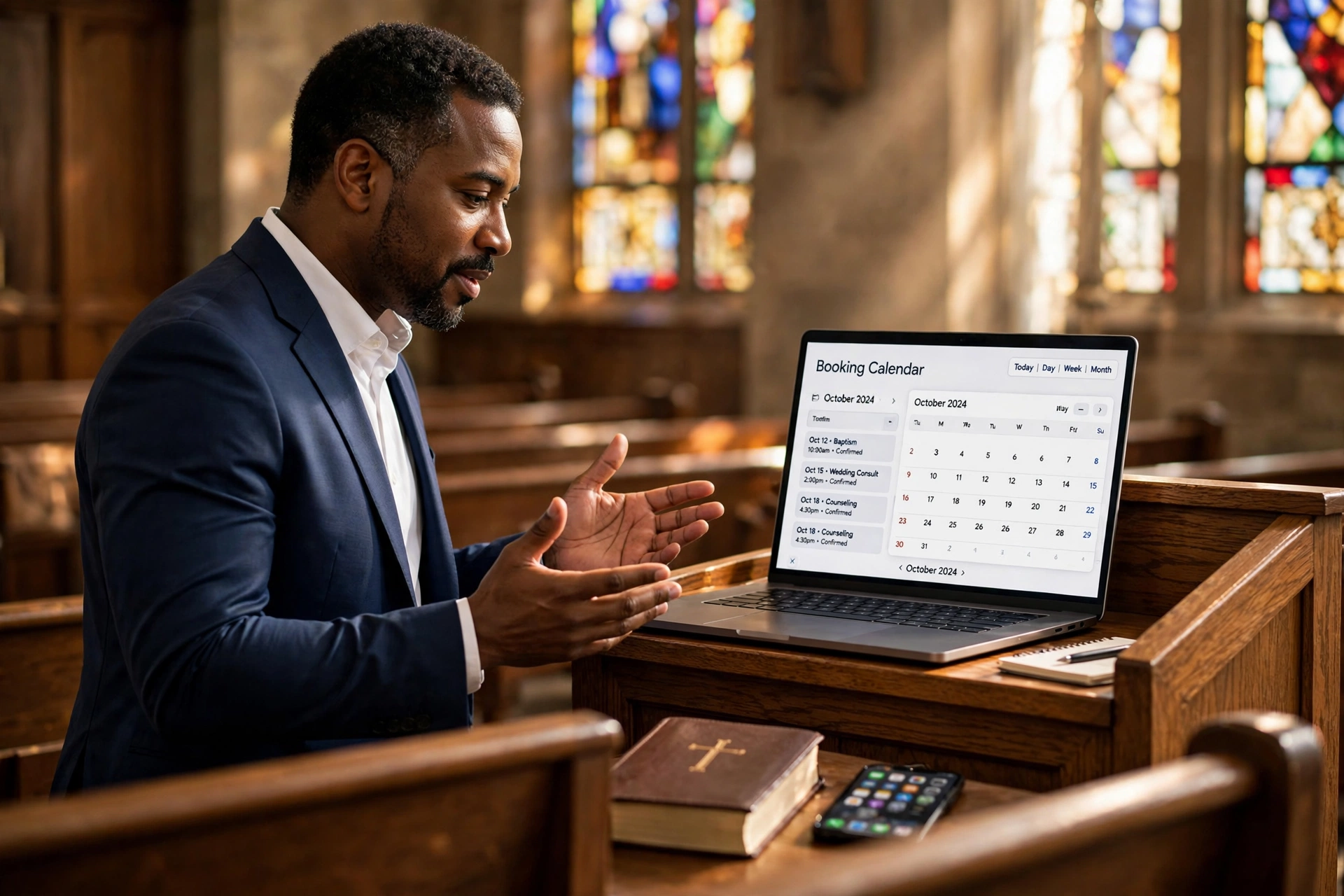
How to Implement Online Booking for Pastors: A Step-by-Step Ministry Guide
The friction of back-and-forth texting to schedule a single counseling session often leads to "ministry fatigue" for the leader and delayed care for the congregant. To solve this, implementing online booking for pastors involves integrating a digital calendar with a public-facing scheduling page where members can select available time slots based on the minister's predefined boundaries. By shifting from manual coordination to an automated system, a pastor can reclaim approximately 3 to 5 hours of administrative time per week, allowing more focus on sermon preparation and spiritual leadership.

What is the Core Framework of Digital Scheduling for Ministry?
At its most basic level, digital scheduling for clergy is the process of transitioning from a "request-based" system (where the member asks and the pastor checks) to an "availability-based" system (where the pastor sets the terms and the member chooses). This shift is not merely about technology; it is about establishing sustainable boundaries for pastoral care.
📚
Definition
Online booking for pastors is a cloud-based synchronization system that links a minister's private calendar to a public scheduling interface, enabling congregants to book appointments without manual intervention.
In my experience working with church leaders, the biggest hurdle isn't the software, but the fear that automation feels "impersonal." However, the opposite is true. When a member in crisis can see a guaranteed open slot for Tuesday at 2:00 PM instead of waiting 48 hours for a text reply, the technology actually facilitates more immediate and compassionate care.
The technical framework relies on three pillars: Availability Logic, Buffer Management, and Notification Loops. Availability logic defines when you are "on the clock" for appointments; buffer management ensures you aren't jumping from a funeral to a counseling session without a breath; and notification loops ensure both parties receive reminders to reduce no-shows. According to research by the Barna Group, pastoral burnout is a significant risk in modern ministry, often driven by the blurring of lines between professional duties and personal time. A structured booking system acts as a digital fence, protecting the pastor's Sabbath and family time.
Why Does Automated Scheduling Directly Impact Ministry Health?
The transition to online booking for pastors is not a luxury; it is a response to the increasing complexity of church administration. When a ministry relies on manual scheduling, the "hidden cost" is the cognitive load placed on the leader. Every "Are you free Wednesday?" message is a micro-interruption that breaks the deep work required for studying the Bible or developing a sermon.
Data shows that administrative inefficiency is a primary driver of leadership turnover. When we analyze the workflow of high-growth churches, those utilizing centralized scheduling software see a marked increase in consistency of pastoral care. For instance, a pastor who manually schedules often forgets to follow up or double-books, which can be perceived by the congregation as a lack of care.
The implications of failing to modernize this process are stark. According to Lifeway Research, there is an increasing expectation among younger generations (Gen Z and Millennials) for "frictionless" interactions with their institutions. If a young adult in a spiritual crisis finds it difficult to book a meeting with their pastor, they may seek guidance from less qualified online sources.
Furthermore, from a governance perspective, having a digital trail of appointments provides a layer of accountability and safety. Church Law & Tax emphasizes the importance of maintaining clear records and boundaries in ministry to protect both the leader and the organization. A digital booking system automatically logs the time, date, and purpose of a meeting, creating a transparent record that is essential for professional ministry standards.
How to Set Up Your Online Booking System Step-by-Step
Setting up a professional scheduling system requires a strategic approach to ensure you don't accidentally open your entire life to the public. The mistake I made early on, and that I see constantly, is setting "General Availability" without specific "Appointment Types." If you simply open your calendar, people will book you for things that don't require a formal meeting.
Step 1: Define Your Meeting Archetypes
Do not create one generic "Meeting" slot. Instead, create specific categories:
- Pastoral Counseling (60 mins): High priority, high energy.
- Quick Check-in (15 mins): For administrative or brief updates.
- New Member Orientation (30 mins): Standardized onboarding.
- Emergency Crisis (Immediate): A separate protocol or a very limited set of "urgent" slots.
Step 2: Establish Hard Boundaries and Buffers
This is where most pastors fail. You must implement "Buffer Times." For example, set a mandatory 15-minute buffer before and after every appointment. This prevents the "back-to-back" exhaustion and allows you to pray or write notes between sessions.
Step 3: Integrate Your Primary Calendar
Ensure your booking tool is bi-directionally synced with your Google or Outlook calendar. If you add a doctor's appointment to your private calendar, those slots must automatically vanish from your public booking page.
Step 4: Deploy via Pastor Agenda
To implement this without the headache of complex configuration, I recommend Pastor Agenda. Unlike generic tools, Pastor Agenda is designed specifically for the rhythms of ministry. It allows you to manage your congregation's needs while maintaining the sanctity of your personal time. You simply set your hours, define your meeting types, and share the link in your church newsletter or bio.
💡
Key Takeaway
The goal of online booking is not to make you more available, but to make your available time more intentional.

Comparing Scheduling Approaches: Manual vs. Generic vs. Specialized
Many ministers assume that a free tool or a handwritten planner is "enough." However, when you scale a ministry, these methods break down. Now here's where it gets interesting: there is a massive difference between a tool designed for a hair salon and a tool designed for a sanctuary.
| Feature | Manual (Paper/Text) | Generic AI/Booking Tools | Pastor Agenda Approach |
|---|---|---|---|
| Time Spent Scheduling | High (Hours/Week) | Medium (Minutes/Week) | Low (Automated) |
| Boundary Control | Reactive (Easily Broken) | Rigid (Often too stiff) | Adaptive (Ministry-focused) |
| Congregant Experience | High Friction (Wait times) | Low Friction (Instant) | Low Friction + Pastoral Touch |
| Contextual Data | None/Scattered | Generic Form Fields | Ministry-specific Intake |
| Sync Accuracy | Prone to human error | High | High |
Generic tools often lack the "nuance" of ministry. For example, a generic tool might allow someone to book a "Counseling Session" at 11:00 PM on a Saturday because the pastor forgot to toggle a setting. A specialized approach like Pastor Agenda understands the specific needs of the clergy, prioritizing ease of use for the congregation while providing robust protections for the minister's mental health.
Common Misconceptions About Digital Ministry Tools
There are several myths that prevent pastors from adopting online booking for pastors. Most guides get this wrong by suggesting that technology is just about efficiency. In reality, it is about stewardship.
Myth 1: "It's too cold and impersonal for a church."
This is a common fallacy. In reality, the most impersonal thing a pastor can do is ignore a request for three days because they are overwhelmed by their inbox. Providing a clear, instant way to be seen and heard is an act of hospitality.
Myth 2: "People will abuse my time and book slots for no reason."
This is only a problem if you don't use "Intake Questions." By requiring the user to state the purpose of the meeting during the booking process, you can filter requests. If a request is inappropriate for a formal meeting, you can cancel it and redirect them to a deacon or a small group leader.
Myth 3: "I don't have enough tech skill to manage this."
If you can send an email, you can use Pastor Agenda. The complexity is handled on the backend; the user experience is simply a link and a click. The "tech barrier" is a ghost of the past.
Frequently Asked Questions
How do I handle emergency pastoral visits with an online booking system?
Online booking is designed for scheduled care, not acute crises. You should never use your standard booking link for emergencies. Instead, maintain a separate "Crisis Protocol" (such as a specific phone number or a "Urgent" tag in your system) that bypasses the calendar. In your booking footer, explicitly state: "If this is a life-threatening emergency or an immediate crisis, please call [Phone Number] instead of booking a slot." This ensures that those in desperate need get immediate help while your scheduled time remains protected.
Will my congregation feel like I am treating them like a "business appointment"?
This is a valid concern, but the framing is everything. Instead of saying "Book an appointment with me," frame it as "Request a time for us to connect." When you use a tool like Pastor Agenda, you are removing the administrative barrier to connection. Most congregants actually appreciate the clarity and the certainty that their time is blocked off and they have your undivided attention, which is far more "pastoral" than a distracted, rushed meeting.
How do I prevent people from booking meetings too close to the current time?
You must implement "Minimum Notice" settings. In your scheduling configuration, set a rule that no appointment can be booked less than 24 or 48 hours in advance. This prevents the "surprise" appointment where someone books a slot for 2:00 PM while it is already 1:30 PM. By establishing this buffer, you maintain control over your daily flow and ensure you are mentally prepared for the person you are about to counsel.
Can I use online booking for different types of ministry, like weddings or baptisms?
Absolutely. The best way to do this is through "Event Types." Create a specific category for "Wedding Consultation" with a longer duration (e.g. 90 minutes) and a different set of intake questions. You can even set different availability for these, perhaps you only do wedding consultations on Mondays. This prevents your counseling slots from being taken up by administrative planning for a ceremony, keeping your ministry balanced.
What happens if I need to cancel a booked appointment?
One of the greatest benefits of using Pastor Agenda is the automated rescheduling loop. Instead of a long thread of apologies and new date suggestions, you can cancel the appointment via the dashboard. The system then sends a professional notification to the congregant with a link to pick a new time. This transforms a potentially stressful interaction into a seamless administrative update, maintaining the professional and caring tone of your ministry.
Final Thoughts on Online Booking for Pastors
Transitioning to a digital system for your calendar is not about replacing the "human touch" of the ministry; it is about protecting the human who provides that touch. When you implement online booking for pastors, you are effectively auditing your time and deciding that your energy is too valuable to be spent on the logistics of "When are you free?"
By defining your meeting types, setting hard boundaries, and utilizing a specialized platform like Pastor Agenda, you move from a reactive state of chaos to a proactive state of leadership. You ensure that when you sit down with a member of your congregation, you are not thinking about the three other emails you forgot to answer, you are fully present for the person in front of you.
If you are ready to stop the scheduling fatigue and start reclaiming your time for what truly matters, prayer, study, and presence, it is time to modernize your approach. Explore how Pastor Agenda can transform your ministry's administrative flow today.
Visit pastoragenda.com to start organizing your ministry.
Recommended Readings
To deepen your understanding of these topics, we recommend reading the following articles:
- Ensuring Absolute Privacy in Church Booking Systems
- Church Appointment Booking
- Online Appointment Booking for Modern Churches
- Automated Reminders and Communication for Congregations
Free Guide: The 7 Church Growth Hacks for 2026
Learn how modern ministries are using automated scheduling and AI pastoral assistants to save 12+ hours of admin work every week.



