
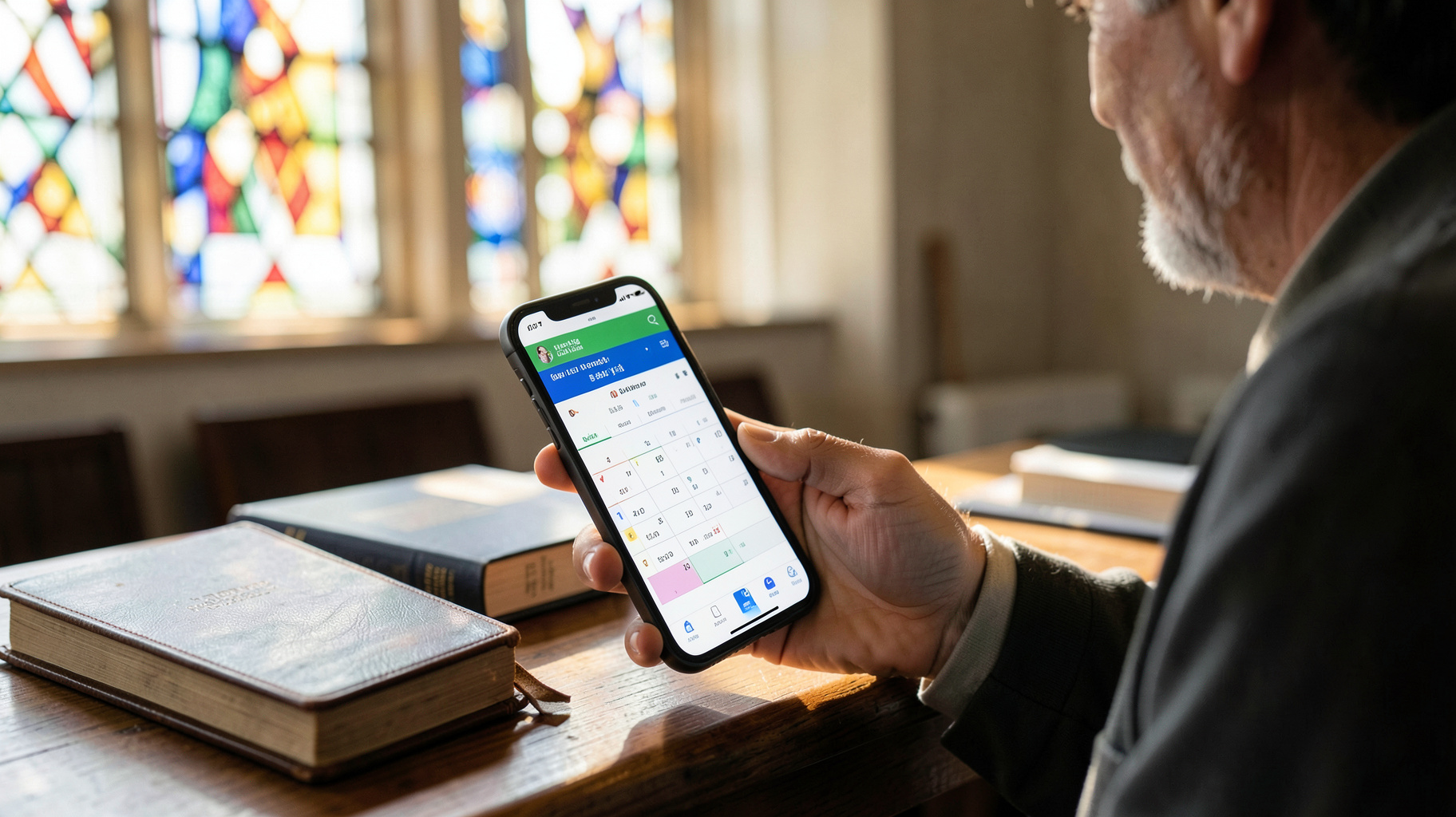
How to Optimize Your Ministry with a Church Calendar App
Managing a ministry without a centralized system often leads to "scheduling friction," where overlapping events and communication gaps create unnecessary stress for both the clergy and the congregation. To effectively use a church calendar app, you must transition from a static list of dates to a dynamic ecosystem where scheduling, pastoral care, and event management are integrated into a single source of truth. By automating appointment bookings and syncing real-time updates to your congregation's devices, you eliminate the administrative burden and reclaim hours of your week for actual ministry.
In my experience working with religious leaders, the biggest hurdle isn't the technology itself, but the transition from a "paper-and-pencil" mindset to a digital-first approach. I've seen dozens of pastors struggle with fragmented calendars, one for home, one for the office, and a physical one for the church lobby. The secret to success is consolidation; when you move every interaction into a dedicated system, you stop managing a calendar and start managing your time.
What Exactly is a Digital Ministry Ecosystem?
To understand how to leverage these tools, we first need to define what we are actually implementing. It is not merely a digital version of a wall calendar, but a coordination hub.
📚
Definition
A church calendar app is a specialized software solution designed to synchronize ecclesiastical events, manage pastoral appointments, and communicate scheduling changes to a congregation in real-time.
Unlike a generic calendar, a ministry-focused tool handles the specific nuances of pastoral care, such as recurring prayer meetings, rotating sermon schedules, and private counseling sessions that require varying levels of privacy. When you implement this correctly, you create a transparent environment where members know exactly when the pastor is available, reducing the "back-and-forth" emails and texts that plague most modern ministries.
According to the Barna Group, the integration of digital tools in church leadership is no longer optional, as a significant percentage of congregants now expect seamless, app-based interactions for engagement and scheduling. This shift reflects a broader trend in organizational management where "frictionless" access to leadership increases overall community engagement. When a member can book a session for pastoral counseling in three clicks rather than waiting for a Sunday announcement, the barrier to spiritual support is lowered.

The effectiveness of a church calendar app relies on the concept of "centralized authority." If the church office uses one app, but the youth pastor uses another, and the worship leader uses a third, you haven't solved the problem; you've just digitized the chaos. The goal is to have one master calendar that feeds into various "views", a public view for the congregation and a private, detailed view for the ministry staff.
Why Digital Scheduling is Essential for Modern Pastoral Care
The cost of inefficient scheduling is not measured in dollars, but in "ministry leakage." This occurs when potential opportunities for discipleship or care are lost because the process of scheduling was too cumbersome.
Research from Christianity Today emphasizes that burnout among clergy is often exacerbated by administrative overwhelm. When a pastor spends 20% of their week managing a calendar, that is 20% of their time taken away from sermon preparation and prayer. By automating the "how" and "when" of meetings, leaders can protect their "deep work" hours.
Consider the data: a manual scheduling process (phone calls, handwritten notes, emails) typically takes between 5 to 15 minutes per appointment. In a medium-sized church with 10 pastoral appointments per week, that is over two hours of purely administrative labor. A digital system reduces this to nearly zero seconds of manual effort.
Furthermore, the risk of "double-booking" is a significant professional hazard. In the early days of my consulting, I noticed a recurring pattern: pastors would commit to a hospital visit while simultaneously being scheduled for a board meeting because their calendars weren't synced. This doesn't just cause a scheduling conflict; it erodes trust. When a leader is consistently late or forgets an appointment due to a poor system, the congregation perceives it as a lack of care.
Using a professional church calendar app transforms the perception of the ministry from "disorganized" to "intentional." It signals to the congregation that the leadership values their time as much as their own. This level of professional governance is aligned with the standards suggested by Church Law & Tax, where clear administrative boundaries and records are essential for both operational efficiency and legal compliance within a non-profit religious organization.
Practical Steps: How to Implement Your Church Calendar App
Moving your ministry online requires a strategic rollout. If you simply launch an app without a process, people will revert to their old habits. Here is the exact framework I recommend for a successful transition.
Step 1: Audit Your Current Time Commitments
Before touching the software, list every recurring event. This includes Sunday services, mid-week Bible studies, staff meetings, and "invisible" time like sermon study and personal prayer. If you don't block out your non-negotiable study time, the app will allow people to book over it.
Step 2: Define "Availability Windows"
The mistake I see constantly is pastors opening their entire calendar to the public. This is a recipe for burnout. Instead, create specific "Office Hours" or "Counseling Windows." For example, set Tuesday from 2 PM to 5 PM as your primary availability for appointments.
Step 3: Configure the User Experience in Pastor Agenda
When using PastorAgenda Blog, you should set up your booking pages to collect necessary information upfront. Don't just ask for a name; ask for the purpose of the meeting (e.g. "Baptism Inquiry," "Marriage Counseling," "Prayer Request"). This allows you to prepare mentally and spiritually before the meeting even begins.
Step 4: Distribute the Access Point
A calendar app is useless if the congregation doesn't know how to find it. Do not just put it on a website. Place a QR code in the church bulletin, add the link to your Instagram/Facebook bio, and mention it during the announcements.
💡
Key Takeaway
The secret to a successful digital calendar is not the software, but the boundaries you set. Use "Availability Windows" to protect your study time while remaining accessible to your flock.
Step 5: Establish a Sync Protocol
Ensure that the church calendar app is synced with your personal mobile device. The goal is a "zero-latency" system: the moment a member books a session, it should appear on your phone with a notification, preventing any last-minute surprises.

Comparing Your Scheduling Options
Not all tools are created equal. Many ministries make the mistake of using a generic corporate tool, which often lacks the nuance required for pastoral work.
| Feature | Traditional (Paper/Email) | Generic AI/Corp Tools | Modern Approach (Pastor Agenda) |
|---|---|---|---|
| Setup Time | Zero (Immediate) | Medium | Fast & Optimized |
| Accuracy | Low (Human Error) | High | Very High |
| Pastoral Context | High (Personal) | Low (Corporate) | High (Ministry-Focused) |
| Congregation Access | High Friction | Medium Friction | Zero Friction |
| Privacy Control | Manual/Difficult | Moderate | High (Role-based) |
| Best For | Very Small Home Churches | General Businesses | Scaling Ministries |
Most generic tools are designed for sales calls or corporate demos. They feel cold. A dedicated church calendar app like Pastor Agenda is designed to facilitate care, not just appointments. While a corporate tool might ask for a "Company Name," a ministry tool asks for the "Prayer Request," changing the entire emotional tone of the interaction.
Common Questions and Misconceptions
There are several myths that prevent pastors from adopting digital scheduling. Most guides get this wrong by focusing only on the "tech" and not the "theology" of time management.
Myth 1: "Using an app makes me seem unreachable or impersonal."
The opposite is true. When you provide a clear, easy way for someone in crisis to find a time to meet with you, you are being more accessible, not less. The "impersonality" of the app is offset by the "presence" you provide during the actual meeting because you aren't stressed about administrative errors.
Myth 2: "My congregation is too old for an app."
In my experience, this is a dangerous assumption. With the rise of smartphones among seniors, the "digital divide" has shrunk significantly. Furthermore, the app isn't just for the member; it's for the church secretary. Even if the senior member calls the office, the secretary can use the church calendar app to book them in seconds, ensuring the record is accurate.
Myth 3: "I can just use a free Google Calendar."
Google Calendar is a great tool for personal use, but it lacks the "client-facing" booking interface needed for a ministry. Without a dedicated booking layer, you have to share your screen or send screenshots, which is inefficient. A professional system allows the member to see only the available slots without seeing who else is booked, maintaining essential confidentiality.
Frequently Asked Questions
How do I prevent people from booking appointments during my sermon preparation time?
The most effective way to do this is through "Hard Blocking" or "Availability Windows." In your church calendar app, you should create a recurring event labeled "Sermon Study" and mark it as "Busy" or "Private." Since these apps sync with your primary calendar, any slot marked as busy will automatically disappear from the public booking page. I recommend blocking these hours at the start of every week, typically Monday and Friday, to ensure your spiritual preparation remains a priority over administrative requests.
Can a church calendar app help with managing multiple staff members?
Yes, this is one of the most powerful use cases. Instead of a single calendar, you can create "Team Views." This allows the lead pastor to see when the youth pastor is available or when the worship leader has a rehearsal. When a member needs a specific type of care, such as youth counseling, the system can route them directly to the youth pastor's availability, preventing the lead pastor from becoming a bottleneck for every single request in the church.
Is the data in a church calendar app secure and private?
Security is a paramount concern in pastoral care. Professional tools use encrypted data transmission to ensure that member details are protected. However, the "human element" is where most leaks happen. To maintain privacy, avoid putting sensitive details (like "Marriage Counseling - Conflict") in the public-facing title of the event. Instead, use generic labels like "Pastoral Meeting" and keep the detailed notes in the private section of the church calendar app that only the minister can access.
How does this replace the traditional church bulletin calendar?
It doesn't replace it; it enhances it. The physical bulletin remains a great touchpoint for those who prefer paper, but the church calendar app serves as the "living document." By placing a QR code in the bulletin that links to the app, you allow members to move from "seeing the event" to "committing to the event" in seconds. This increases attendance rates because the event is added to their digital device immediately, rather than being forgotten after the bulletin is thrown away.
Will using a scheduling app reduce the quality of pastoral care?
On the contrary, it improves the quality of care by removing the "administrative noise." When a pastor is no longer stressed by double-bookings or forgotten appointments, they can be fully present with the person in front of them. By automating the logistics of the meeting, you free up mental bandwidth to focus on the spiritual and emotional needs of the congregant. According to leadership standards from the National Association of Evangelicals, effective ministry requires a balance of administrative excellence and spiritual depth.
Final Thoughts on Using a Church Calendar App
Transitioning your ministry to a digital schedule is not about chasing a trend; it is about stewardship. Your time is the most valuable resource you have for the growth of your congregation. When you implement a church calendar app, you are effectively telling your community that their needs are important enough to be organized and prioritized.
The shift from manual chaos to digital clarity allows you to move from a reactive state, where you are constantly putting out scheduling fires, to a proactive state, where you can intentionally plan your growth. Whether you are managing a small home church or a multi-site congregation, the principle remains the same: professionalize the process to personalize the care.
If you are ready to stop the scheduling friction and start focusing on your calling, explore how PastorAgenda Blog can streamline your ministry today.
Recommended Readings
To deepen your understanding of these topics, we recommend reading the following articles:
- Ensuring Absolute Privacy in Church Booking Systems
- Church Appointment Booking
- Online Appointment Booking for Modern Churches
- Automated Reminders and Communication for Congregations
Reference Sources
For deeper context on this topic, these sources provide additional authoritative perspectives:
- Wikipedia — general knowledge reference
These references help establish a complete view of the subject matter.
Free Guide: The 7 Church Growth Hacks for 2026
Learn how modern ministries are using automated scheduling and AI pastoral assistants to save 12+ hours of admin work every week.



