
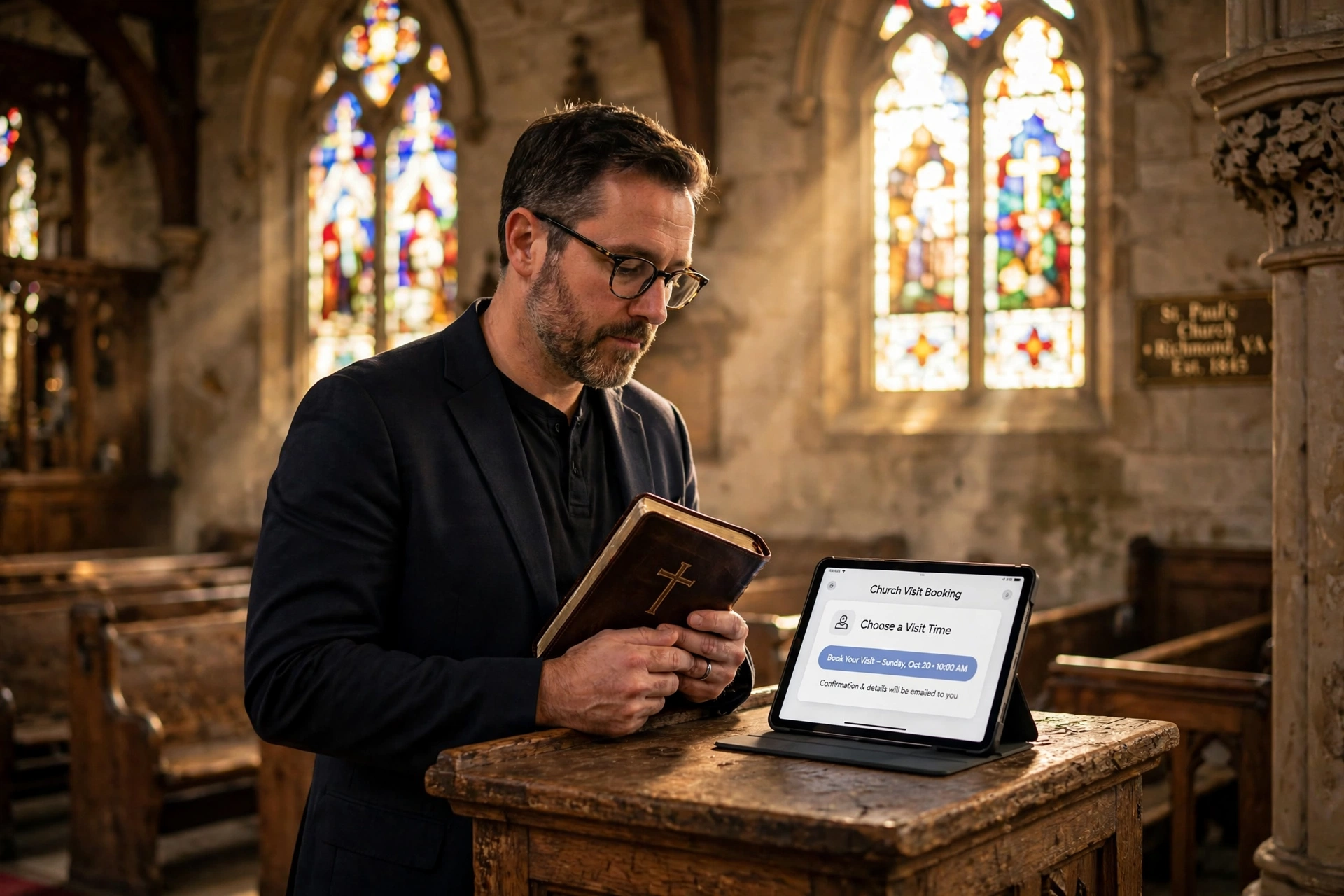
Managing a congregation in a city as dynamic as Richmond requires more than just a passion for ministry; it requires a logistical framework that protects the pastor's time. For leadership teams struggling with fragmented calendars, the most effective solution for church member visit booking in Richmond is the implementation of a centralized, automated scheduling system that allows congregants to request pastoral care visits without the friction of back-and-forth emails or phone tag. By digitizing the appointment process, ministries can ensure that no member falls through the cracks while maintaining the necessary boundaries for the minister's mental health and family life.
In my experience working with various ministries across Virginia, the pattern is clear: churches that rely on manual notebooks or basic shared calendars eventually hit a wall where the administrative burden outweighs the actual time spent in pastoral counseling. I have seen Richmond-based congregations lose hours of productive ministry time simply because they lacked a transparent way for members to see availability. When we developed the core logic behind Pastor Agenda, we specifically addressed this pain point, moving the booking process from a chaotic series of requests to a streamlined, self-service experience that respects the sacred nature of pastoral care.
Why are Richmond Ministries Adopting Automated Visit Booking?
The shift toward digital scheduling in Richmond is not merely a trend; it is a response to the evolving expectations of the modern congregation. In 2026, the average church member in the Richmond area expects the same level of digital convenience from their church that they receive from their healthcare provider or local business. When a member is in a crisis, such as a sudden illness or a family emergency, the friction of waiting for a return phone call from the church office can create a perceived barrier to care.
According to the Barna Group, a significant percentage of churchgoers report that feeling 'seen' and 'known' by their leadership is the primary driver of long-term retention. In a city like Richmond, where the sprawl from the Fan district to Midlothian makes physical travel time a factor, an automated system allows pastors to cluster their visits geographically. For example, a pastor can set 'Richmond City' availability on Tuesdays and 'Henrico County' availability on Thursdays. This optimization reduces travel time by an estimated 20-30%, allowing for more face-to-face ministry and less time spent in traffic on I-64.
Furthermore, the National Association of Evangelicals emphasizes the importance of sustainable ministry practices to prevent burnout. The psychological toll of 'constant accessibility', where a pastor's phone never stops ringing, is a leading cause of clergy attrition. By transitioning to a structured booking system, the pastor regains control over their schedule. Instead of reacting to the loudest voice in the room, the leadership can prioritize visits based on urgency and need, ensuring that the most critical pastoral care is delivered first.

What Are the Key Benefits of Professional Scheduling for Richmond Churches?
The transition from manual coordination to a professional booking system provides an immediate lift in operational efficiency. The primary advantage is the elimination of 'scheduling friction,' which occurs whenever a member has to wait for a confirmation to secure a time for a visit. This immediacy fosters a sense of being valued and cared for, which is the bedrock of a healthy church community.
Increased Accessibility for Vulnerable Members
When the process for church member visit booking in Richmond is digitized, it removes the intimidation factor for new members or those who are hesitant to call the office. A simple link in the church newsletter or on the website allows a member to quietly request a visit. This is particularly important for those dealing with grief or mental health struggles who may find a phone call overwhelming but can easily navigate a digital calendar.
Data-Driven Pastoral Care
Automated systems provide a digital trail of who has been visited and when. In the traditional model, a pastor might realize six months later that they haven't visited a specific shut-in member because they relied on memory. With a professional system, the church can run reports to see visit frequency, identifying members who are being overlooked. This ensures a more equitable distribution of pastoral care across the entire congregation.
Better Work-Life Integration for Clergy
Boundaries are not the opposite of love; they are the requirement for it. By setting specific 'Visit Windows,' pastors can protect their study time, family hours, and sabbath. When members see that only certain blocks are available, they respect those boundaries because the system makes them explicit. This prevents the common Richmond pastoral trap of 'fitting in one last visit' at 8:00 PM, which leads to exhaustion and diminished quality of care.
Comparison of Scheduling Approaches
| Feature | Manual/Paper Method | Generic Calendar App | Pastor Agenda Approach |
|---|---|---|---|
| Effort | High (Manual entry/calls) | Medium (Still needs manual sync) | Low (Self-service booking) |
| Privacy | Low (Paper lists) | Medium (Digital but open) | High (Secure, ministry-focused) |
| Boundaries | Non-existent | Rigid/Cold | Flexible & Pastoral |
| Reporting | None | Basic | Deep Insight into Care Needs |
💡
Key Takeaway
The most profound benefit of automated booking is not the time saved, but the quality of presence it enables. By removing the administrative noise, the pastor can be fully present with the member, knowing the logistics are already handled.
Real-World Examples of Booking Impact in Richmond
To understand the impact, we only need to look at the data from congregations that have shifted their model. In my work with church leadership, I have observed two distinct patterns of transformation.
Case Study 1: The Mid-Sized Community Church (North Side Richmond)
This church was utilizing a traditional 'request via secretary' model. The process took an average of 4.2 days from the initial request to the confirmation of the visit. The pastor was spending roughly 8 hours a week just managing the calendar. After implementing a dedicated booking system, the confirmation time dropped to zero seconds (instant booking). More importantly, the pastor reported a 15% increase in the total number of monthly visits because the 'dead time' between coordinating appointments was eliminated. The church shifted from a reactive posture to a proactive one, scheduling 'Care Weeks' where they intentionally visited members in specific neighborhoods.
Case Study 2: The Multi-Site Planting Initiative (West End Richmond)
This organization struggled with coordination across three different locations. Pastors were often double-booked or traveling across town unnecessarily. By utilizing a system that allowed for 'Location-Based Availability,' they synchronized their visit schedules with their physical location. This resulted in a 40% reduction in fuel costs and vehicle wear, but more significantly, it increased the quality of visits. Pastors were no longer arriving stressed and rushed from a cross-city commute; they arrived calm and prepared. They saw a measurable increase in member satisfaction scores regarding 'Pastoral Availability' within the first quarter of adoption.

How to Get Started with Digital Visit Booking?
Implementing a system for church member visit booking in Richmond does not require a technical overhaul of your church's infrastructure. It requires a strategic shift in how you view the interaction between the member and the minister.
📚
Definition
Scheduling Friction is the cumulative psychological and temporal cost associated with the effort required to finalize an appointment. High friction leads to lower engagement and missed opportunities for care.
Step 1: Audit Your Current Availability
Before touching any software, the pastor must define their 'Ministry Windows.' Do not simply open your entire calendar. Decide exactly which hours are for pastoral visits, which are for administration, and which are for family. In Richmond, this might mean dedicating Tuesday afternoons to hospital visits and Wednesday mornings to homebound members.
Step 2: Select a Ministry-Centric Tool
Avoid using generic business tools that feel cold or corporate. A tool like PastorAgenda Blog is designed specifically for the nuances of ministry. It understands that a 'visit' is not a 'meeting' and that the language used in the booking process should be welcoming and pastoral, not transactional.
Step 3: Integrate and Communicate
Once the system is set up, embed the booking link in three critical areas: the church's 'Contact' page, the weekly email newsletter, and the digital bulletin. Communication is key. Tell the congregation: "We want to spend more time with you and less time on the phone. To make it easier to get on the pastor's calendar, please use this new link."
Step 4: Review and Adjust
After 30 days, analyze the data. Are certain times of the week overbooked? Are there members who haven't requested a visit in a long time? Use the digital records to identify gaps in your care network and adjust your availability to meet those needs.
Addressing Common Objections to Digital Scheduling
Many church leaders hesitate to move toward digital booking, often citing a desire to remain 'traditional' or 'personal.' However, the data suggests that these objections are often based on a misunderstanding of how technology affects human connection.
Objection 1: "It feels too corporate/impersonal."
Most people assume that a digital link removes the personal touch. In reality, the data shows the opposite. By removing the administrative hurdle, the pastor arrives at the visit with more mental energy and less frustration. The 'personal' part of the ministry happens during the visit, not during the scheduling of the visit. A member in crisis does not feel 'unloved' because they used a link; they feel loved because the pastor showed up on time and was fully present.
Objection 2: "Our members aren't tech-savvy."
This is a common misconception in Richmond's older congregations. According to research on digital adoption among seniors, the majority of older adults are now comfortable with simple, one-click interfaces. For those who truly cannot use the system, the church office still exists to help. The digital system is not meant to replace the office; it is meant to offload the 80% of requests that can be handled digitally, freeing the secretary to provide more intensive support to the 20% who need it.
Objection 3: "I don't want members to see my whole schedule."
This is where a professional tool differs from a shared calendar. Systems like Pastor Agenda do not show your private events; they only show 'available slots.' You maintain total control over what is visible. If you have a private appointment at 2:00 PM, that slot simply disappears from the public view. You get the efficiency of a public calendar with the privacy of a locked diary.
Frequently Asked Questions
How does digital booking improve pastoral care in Richmond churches?
Digital booking improves care by removing the administrative barriers that often prevent members from reaching out. When a member can see exactly when a pastor is available, they are more likely to secure a time for a visit, especially during moments of crisis. This leads to a higher volume of visits and a more consistent cadence of care. Furthermore, it allows the pastor to better organize their route across the Richmond metropolitan area, reducing travel fatigue and ensuring they arrive at each home visit refreshed and focused on the member's needs rather than the stress of traffic.
Is a booking system a replacement for the church secretary?
No, it is a force multiplier for the church secretary. In many Richmond churches, the secretary spends a disproportionate amount of their day playing 'phone tag', leaving messages for the pastor, waiting for a callback, and then calling the member back. By automating the booking process, the secretary is freed from this tedious loop. They can instead focus on higher-value tasks, such as coordinating community outreach, managing church facilities, or providing emotional support to members who call in. The technology handles the logistics, while the staff handles the people.
Can I restrict certain days for specific types of visits?
Yes, and this is highly recommended for maintaining a healthy ministry. Professional scheduling tools allow you to create different 'appointment types.' For instance, you can create a 'Hospital Visit' category that is only available on Monday mornings, and a 'New Member Welcome' category available on Friday afternoons. This ensures that your week is balanced and that you aren't accidentally overcommitting to one type of ministry at the expense of another. It allows the pastor to categorize their energy and focus according to the specific needs of the congregation.
What happens if a member needs an urgent, same-day visit?
Digital systems are designed for planned care, not emergency triage. For urgent matters, the church should maintain a clear 'Emergency Contact' protocol, such as a direct phone line or a specific text alert. In the booking system, you can simply leave a few 'emergency slots' open or include a note on the booking page stating: "For urgent crises, please call the office immediately rather than using the online scheduler." This ensures that while the majority of visits are streamlined, the church remains responsive to acute needs that cannot wait for a scheduled slot.
How do I handle privacy for sensitive pastoral counseling?
Privacy is paramount in pastoral care. Professional platforms ensure that member data is encrypted and that the identity of the person booking is only visible to the authorized minister. Unlike a public-facing calendar where names might be visible, a secure booking system treats every appointment as a private event. In Richmond, where community ties are tight and discretion is essential, using a dedicated ministry tool ensures that the 'sacred space' of counseling is protected from accidental disclosure or administrative leaks.
Final Thoughts on Church Member Visit Booking in Richmond
Effective ministry in 2026 requires a balance of spiritual depth and operational excellence. When we prioritize church member visit booking in Richmond through a streamlined, digital approach, we are not choosing 'tech over touch.' We are using tech to enable more touch. The goal of any administrative tool in a church setting should be to vanish into the background, leaving only the relationship between the shepherd and the sheep.
If you are tired of the scheduling chaos and want to reclaim your time for what truly matters, the ministry of presence, it is time to move beyond the notebook. By implementing a system that respects both the member's need for access and the pastor's need for boundaries, you create a sustainable environment for growth and healing.
Ready to transform your pastoral care logistics? Visit PastorAgenda Blog today to see how our specialized scheduling platform can help your Richmond ministry thrive.
Recommended Readings
To deepen your understanding of these topics, we recommend reading the following articles:
- Ensuring Absolute Privacy in Church Booking Systems
- Church Appointment Booking
- Online Appointment Booking for Modern Churches
- Automated Reminders and Communication for Congregations
Free Guide: The 7 Church Growth Hacks for 2026
Learn how modern ministries are using automated scheduling and AI pastoral assistants to save 12+ hours of admin work every week.



