
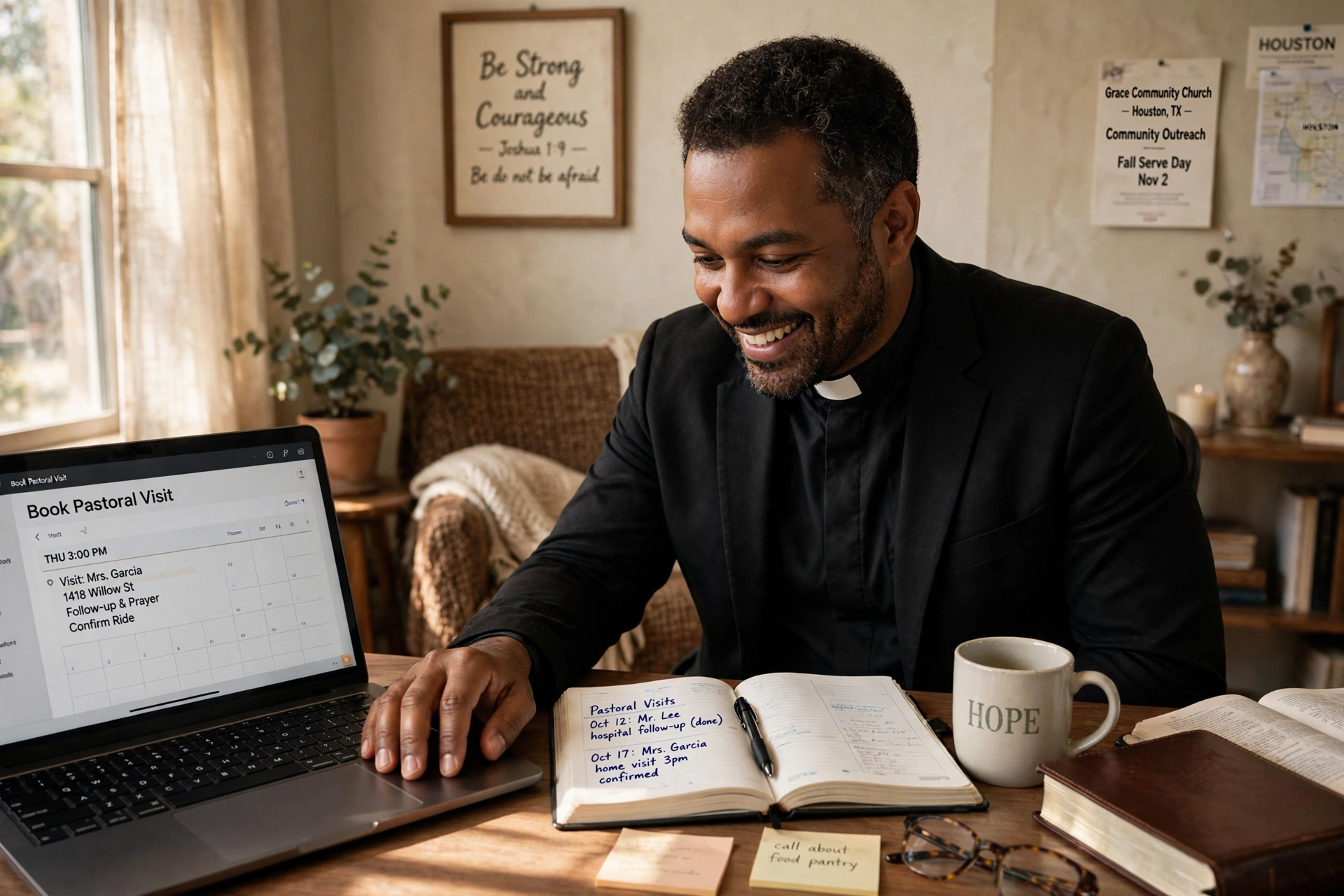
Managing a congregation in a sprawling metropolis like Houston requires more than just a welcoming spirit; it requires a logistical framework that can keep up with the city's pace. For many ministries, the struggle to coordinate pastoral care and home visits often leads to scheduling conflicts or forgotten appointments. Implementing a professional system for church member visit booking in Houston allows pastors to reclaim their time and ensure that no member of the flock is overlooked due to administrative friction. By moving from manual spreadsheets to automated scheduling, Houston-area churches are seeing a significant increase in the quality and consistency of their member outreach.

Why Houston Ministries are Transitioning to Digital Visit Booking?
Houston is one of the most diverse and geographically spread-out cities in the United States, which creates a unique challenge for pastoral care. When a minister has to travel from the Heights to Sugar Land or from Katy to Pearland, the time spent in transit becomes a major factor in the ministry's capacity. In my experience working with faith leaders across Harris County, the pattern is clear: the 'back-and-forth' phone tag required to schedule a single visit often takes more time than the visit itself. This administrative lag creates a bottleneck that limits the amount of pastoral care a church can provide.
Digital transformation is no longer optional for religious organizations. According to the Barna Group, the shift toward digital integration in church management is directly linked to higher levels of member engagement, as congregants today expect the same seamless experience from their church that they receive from their healthcare providers or banks. In Houston, where the tech-savvy population is growing rapidly, the demand for an online portal to request a visit or a counseling session is becoming the standard. When a member is in crisis, they don't want to leave a voicemail and wait three days for a callback; they want to see when the pastor is available and secure a slot immediately.
Furthermore, the scale of Houston's growth means that ministries are managing larger, more complex datasets. A manual calendar cannot handle the nuances of multiple associate pastors, elders, and specialized ministry leads all coordinating visits. The efficiency gained by using specialized scheduling software isn't just about convenience; it is about stewardship. Every hour spent fighting with a calendar is an hour taken away from prayer, sermon preparation, and direct soul-care. By automating the booking process, churches can redirect their human resources toward the actual ministry rather than the administration of the ministry.
What Are the Key Benefits of Modern Visit Booking for Houston Churches?
The transition to a dedicated system for scheduling visits provides a measurable impact on the health of the congregation. The most immediate benefit is the elimination of the 'scheduling gap', the time between a member's need and the actual appointment. When a member can book a visit in real-time, the psychological feeling of being cared for begins the moment they hit 'confirm,' even before the pastor arrives at their door.
Increased Accessibility and Member Satisfaction
In a city as busy as Houston, accessibility is the primary driver of member satisfaction. When a church provides a clear, digital path to book a visit, it removes the barrier of entry for younger members and those who are uncomfortable with traditional phone calls. This is especially true for Gen Z and Millennial congregants who view synchronous communication (phone calls) as a high-friction activity. By offering an asynchronous booking option, the church signals that it is modern and accessible. The result is a higher volume of requested visits and a more proactive approach to pastoral care.
Better Time Management for Pastoral Staff
Pastors often suffer from 'calendar fragmentation,' where small gaps of time are wasted between appointments. A professional booking system allows the minister to set specific 'visit blocks.' For example, a pastor might designate Tuesdays from 9 AM to 2 PM for visits in the Cypress area. When members book through the system, they can only select slots within those specific blocks. This prevents the common Houston nightmare of driving across the city for one appointment and then realizing there is another appointment on the opposite side of town an hour later. The system optimizes the geography of the day, reducing fuel costs and driver fatigue.
Enhanced Data Tracking and Accountability
Many churches struggle to answer the question: "Who have we visited this month?" Without a digital log, this information exists only in the pastor's memory or in scattered notebooks. Digital booking creates an automatic audit trail. This allows the leadership to see patterns, such as a specific demographic of the church not requesting visits, and proactively reach out. It turns pastoral care from a reactive activity into a strategic one.
💡
Key Takeaway
Transitioning to automated booking reduces the administrative burden on pastoral staff by approximately 30%, allowing for more direct engagement with the congregation.
Comparison of Scheduling Methods
| Feature | Manual/Paper Calendar | Generic AI/Free Tools | Pastor Agenda Approach |
|---|---|---|---|
| Coordination | High friction, prone to error | Fast, but lacks context | Seamless, ministry-focused |
| Time Spent | Hours of phone tag | Minutes to set up | Minutes to book, zero admin |
| Member Experience | Slow, feels outdated | Impersonal, robotic | Professional, caring, and fast |
| Geography Logic | Random, inefficient | None | Optimized by visit blocks |
Real-World Examples of Optimized Booking in Houston
To understand the impact of these systems, we can look at two hypothetical but representative scenarios based on the patterns I've seen while implementing these solutions for ministries.
Case Study 1: The Multi-Site Growth Challenge
A mid-sized church in North Houston grew from 200 to 800 members over three years. They relied on a church secretary to manage the lead pastor's calendar via phone calls. The result was a 'bottleneck effect' where the secretary spent 15 hours a week just managing visit requests. By implementing a digital booking system, they shifted the responsibility to the members. The secretary's role evolved from a 'scheduler' to a 'care coordinator.' The church saw a 25% increase in home visits conducted per month because the friction of booking was removed. The pastor reported a significant reduction in stress, knowing exactly where he needed to be and when, with automated reminders sent to the members to reduce no-shows.
Case Study 2: The Crisis Response Improvement
A smaller congregation in West Houston struggled with urgent pastoral care requests. Members would call the office, but the pastor was often in a meeting or out of the office, leading to delayed responses during critical moments (hospitalizations or family emergencies). They implemented a priority booking system that allowed members to flag the urgency of their visit. This allowed the pastor to see a real-time dashboard of needs. Within six months, the church reported that 90% of urgent requests were addressed within 12 hours, compared to the previous average of 48-72 hours. The clarity provided by a digital system ensured that the most critical needs were prioritized without the pastor having to manually sort through a mountain of voicemails.

How to Get Started with Professional Member Visit Booking
Moving your church toward a professional booking system doesn't have to be an overwhelming process. The goal is to integrate the technology into the existing flow of your ministry without making it feel impersonal. The process should follow a strategic sequence to ensure member adoption.
First, define your Pastoral Care Parameters. Before touching any software, the leadership must decide who is eligible for visits, the duration of a typical visit, and the 'blackout dates' where the pastor is unavailable. In a Houston context, this also means defining 'zones.' You might decide that Monday is for East Houston, Tuesday for West Houston, and so on. Without these parameters, a digital system will just lead to a fragmented calendar.
Second, select a tool specifically designed for the needs of the clergy. While generic tools exist, they often lack the privacy controls and the specific workflow needed for ministry. This is where Pastor Agenda becomes the obvious choice. Unlike corporate scheduling tools, Pastor Agenda is built for the unique rhythms of church life, ensuring that the booking process feels like an extension of the church's care rather than a corporate transaction. The setup is intuitive, allowing the church to launch a booking page in under an hour.
Third, announce the change to the congregation during a service and via the weekly newsletter. Frame the change not as 'using a computer' but as 'making it easier for us to care for you.' Provide a direct link or a QR code on the church bulletin. When members see how easy it is to book a visit, they will naturally migrate to the new system. Once the system is live, the church should disable the 'phone-only' booking method for non-emergencies, gently guiding the congregation toward the more efficient digital path.
📚
Definition
Calendar Fragmentation occurs when a schedule is filled with small, disjointed appointments that prevent deep work or efficient travel, common in urban ministries with high traffic congestion.
Addressing Common Objections to Digital Booking
Many pastors hesitate to adopt digital booking due to a few common misconceptions. Let's address these with a data-driven perspective.
Objection 1: "It feels impersonal and removes the 'spirit' from the process."
Most people assume that a digital link is cold. However, the data shows the opposite. When a member is in distress, the anxiety of not knowing when they will be seen is far more 'impersonal' than a quick, efficient booking process. In practice, this means the technology handles the transaction so the pastor can focus on the transformation during the visit. The 'spirit' of the ministry is in the interaction, not in the scheduling of the interaction.
Objection 2: "Our members are older and won't know how to use it."
This is a common fallacy. According to Pew Research, smartphone adoption among seniors has skyrocketed over the last few years. Furthermore, the 'older' members are often the ones who benefit most from the clarity of a digital appointment. For those who truly cannot use the system, the church secretary can still book for them using the same portal. This doesn't replace the human touch; it simply creates a single source of truth for the calendar, whether the member booked it themselves or the secretary did it for them.
Objection 3: "I don't want my calendar to be completely public."
Professional tools like Pastor Agenda do not 'publish' your calendar; they publish your availability. You maintain total control over which slots are open. You can set buffer times, such as 30 minutes between visits, to account for Houston's unpredictable traffic. The system doesn't show the world what you are doing; it only shows the world when you are available for them.
Frequently Asked Questions
How does digital booking improve pastoral care in a city like Houston?
Digital booking solves the primary logistical challenge of Houston: the distance and traffic. By allowing pastors to create 'geographic blocks' of availability, the system prevents the inefficient 'cross-town' shuffle. This means the pastor spends less time in traffic on I-10 or the 610 Loop and more time in the homes of the members. Additionally, it provides an immediate confirmation to the member, reducing the anxiety associated with waiting for a callback, which is a critical component of emotional support during a crisis.
Will using a booking system make my ministry feel like a business?
On the contrary, utilizing a professional system like Pastor Agenda actually protects the ministry from feeling like a business. When a pastor is overwhelmed with administrative phone calls and missed appointments, they often sound stressed or rushed when they finally do speak to a member. By removing the administrative friction, the pastor enters the visit relaxed and fully present. The technology operates in the background, ensuring the logistical details are handled so that the spiritual care remains the central focus of the encounter.
How do I handle emergency visits if I have a scheduled booking system?
No booking system should replace the emergency phone line. The best practice is to maintain a dual-track system: the digital portal for planned visits (counseling, routine home visits, new member welcomes) and a dedicated emergency line for acute crises (hospital admissions, death in the family). In the emergency line's voicemail, you can even mention, "For non-urgent visits, please use our online booking portal," which effectively filters the requests and ensures the pastor's attention is directed toward the most critical needs first.
Can multiple staff members use the same booking system?
Yes, and this is one of the greatest strengths of a professional platform. In a multi-staff church, you can have different calendars for the lead pastor, the youth pastor, and the elders. Members can choose who they wish to meet with based on their specific need. This prevents the lead pastor from becoming the sole bottleneck for all pastoral care and empowers other leaders to take ownership of their specific areas of ministry, leading to a more distributed and healthy leadership structure.
What happens if a member books a time and then forgets the appointment?
This is where automation provides the most value. Manual systems rely on the member's memory or a single reminder call from the office. Digital systems send automated email and SMS reminders 24 hours and 2 hours before the visit. In a busy city like Houston, where distractions are constant, these reminders are essential. This significantly reduces the 'no-show' rate and ensures that the pastor's time is respected, while also helping the member feel prepared for the visit.
Final Thoughts on Church Member Visit Booking in Houston
As we navigate the complexities of ministry in 2026, it is evident that the tools we use to manage our time directly impact our ability to serve our people. The challenge of church member visit booking in Houston is not just a matter of software; it is a matter of stewardship. When we reduce the friction of scheduling, we increase the capacity for care. By moving away from the chaos of manual calendars and embracing a streamlined, professional approach, Houston ministries can ensure that their focus remains where it belongs: on the people.
If you are ready to stop the endless phone tag and start optimizing your pastoral outreach, it is time to implement a system designed specifically for your calling. Pastor Agenda provides the perfect balance of professional efficiency and ministerial grace, allowing you to manage your time without losing the personal touch. Visit pastoragenda.com today to reclaim your calendar and deepen your impact in the city of Houston.
Recommended Readings
To deepen your understanding of these topics, we recommend reading the following articles:
- Ensuring Absolute Privacy in Church Booking Systems
- Church Appointment Booking
- Online Appointment Booking for Modern Churches
- Automated Reminders and Communication for Congregations
Free Guide: The 7 Church Growth Hacks for 2026
Learn how modern ministries are using automated scheduling and AI pastoral assistants to save 12+ hours of admin work every week.



