
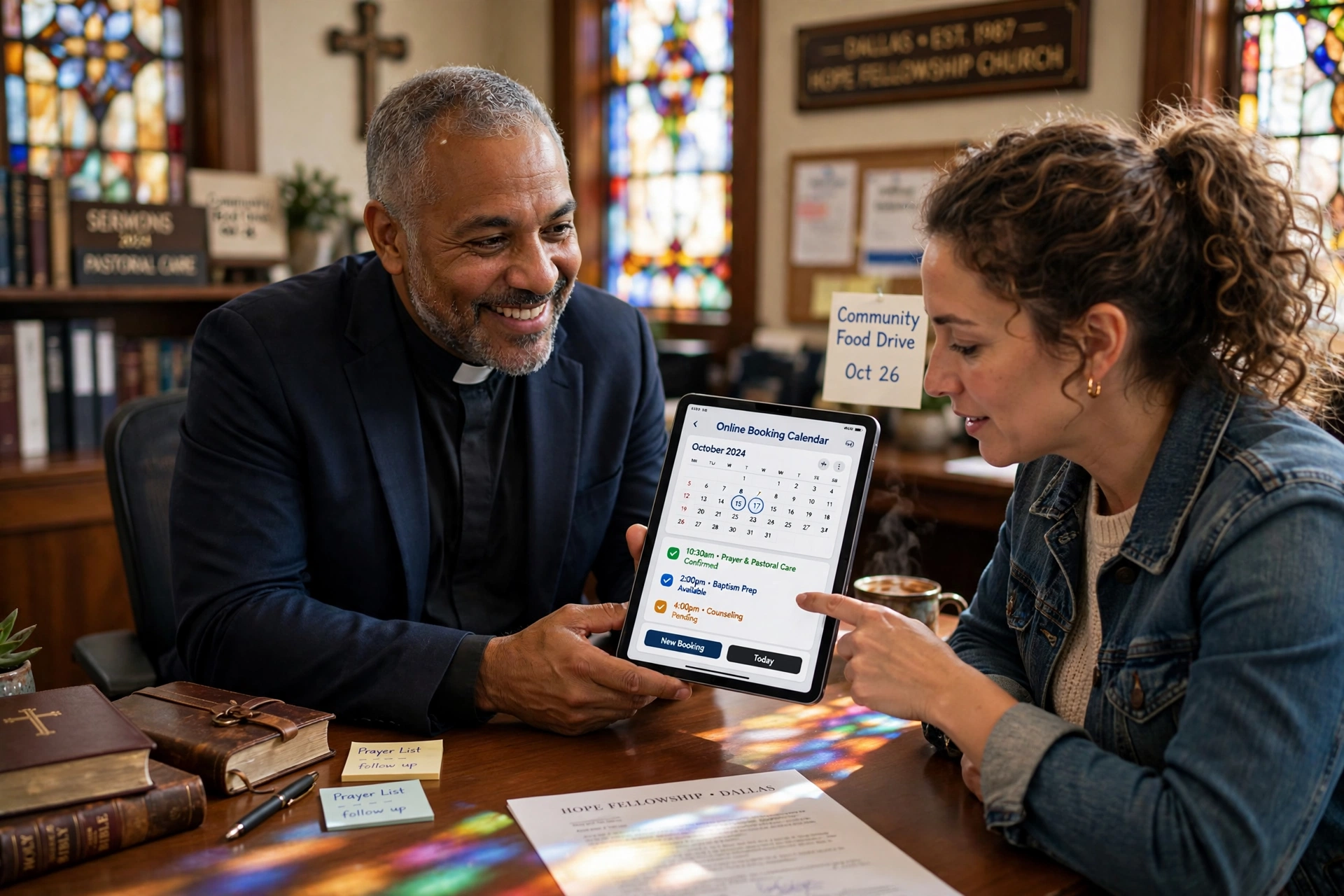
Managing the spiritual needs of a congregation in a sprawling metropolis like Dallas requires more than just a willing heart; it requires a precise system. For leaders seeking effective church member visit booking in Dallas, the solution lies in transitioning from manual calendars to automated, synchronized scheduling platforms that allow members to book pastoral care, home visits, or counseling sessions instantly without the back-and-forth of phone calls. This digital shift ensures that no member in the DFW metroplex falls through the cracks of a busy ministry schedule.

Why Dallas Ministries are Adopting Digital Visit Booking?
In my experience working with various religious organizations across North Texas, I've noticed a distinct shift in how congregations interact with their leadership. Dallas is unique because of its geographic spread; a pastor might have one visit in Plano and another in Cedar Hill, making travel time a critical variable in scheduling. The traditional method of "text me when you're free" no longer scales when you are managing a growing congregation in 2026. When we developed the core logic for Pastor Agenda, we discovered that the primary friction point isn't the willingness to visit, but the administrative exhaustion of coordinating those visits.
Modern Dallas churches are moving toward digital systems because the expectation for immediacy has increased. According to the Barna Group (barna.com), there is a growing trend toward "personalized discipleship," where members expect more direct, scheduled access to pastoral care rather than waiting for a monthly rotating schedule. In a city where the pace of life is accelerated by the corporate hubs of downtown and the suburbs, a digital booking system provides a professional and accessible bridge between the sanctuary and the home.
Furthermore, the integration of artificial intelligence into scheduling allows for "buffer time' calculation, something essential for anyone navigating I-35 or the North Tollway. By automating the booking process, pastors can ensure they aren't scheduling a 2:00 PM visit in Frisco and a 3:00 PM visit in Mesquite, which would be physically impossible. This level of operational efficiency allows the minister to focus on the spiritual quality of the visit rather than the stress of the commute.
What are the Key Benefits of Streamlined Visit Booking for Dallas Churches?
Implementing a dedicated system for member visits transforms the pastoral workflow from reactive to proactive. Instead of spending Monday mornings returning twenty voicemails to set up Wednesday appointments, the system handles the logistics in real-time.
Increased Accessibility for Vulnerable Members
Digital booking removes the barrier for members who may feel hesitant to call the church office. For those dealing with grief, illness, or crisis, the ability to simply select a time slot on a calendar provides a sense of agency and immediate relief. When the process is streamlined, the time between a member's need and the pastor's arrival is significantly reduced.
Better Time Management and Burnout Prevention
Pastoral burnout is a documented crisis in modern ministry. By utilizing scheduling software, pastors can set strict "blackout dates" and "office hours," ensuring that their family time and sermon preparation are protected. According to the National Association of Evangelicals (nae.org), sustainable ministry requires a balance between service and rest. A booking system enforces these boundaries automatically, preventing the "always-on" mentality that leads to exhaustion.
Data-Driven Pastoral Care
When visits are booked through a system, the church gains an inadvertent but valuable data set. You can see which neighborhoods in Dallas are receiving the most care and which areas are being neglected. This allows for a more equitable distribution of pastoral resources across the entire congregation.
💡
Key Takeaway
The primary value of digital visit booking is not the technology itself, but the reclamation of time, allowing pastors to move from administrative clerical work back into active spiritual leadership.
Comparison of Booking Methods
| Feature | Manual/Paper Calendar | Generic Booking App | Pastor Agenda System |
|---|---|---|---|
| Coordination | High friction (Phone/Text) | Low friction (Link) | Ultra-low (Church-integrated) |
| Travel Logic | None (Manual guess) | Basic time slots | Ministry-optimized buffers |
| Privacy | Low (Shared sheets) | Moderate | High (Encrypted member data) |
| Member UX | Frustrating/Slow | Generic/Corporate | Pastoral/Welcoming |
📚
Definition
Buffer Time is the intentional gap placed between two appointments to account for travel, mental reset, and unexpected delays, which is essential for Dallas-area logistics.
Real Examples of Visit Booking Impact in Dallas
To understand the impact of these systems, we only need to look at two contrasting scenarios based on patterns I've seen with our users in the DFW area.
Case Study 1: The Mid-Sized Suburban Church in Garland
Before implementing a structured booking system, this church relied on a secretary to manage the pastor's calendar. The result was a "bottleneck effect." Members would request visits on Sunday, but the secretary wouldn't process them until Tuesday, and the visit wouldn't happen until Friday. By implementing Pastor Agenda, they moved to a self-service model. The result was a 35% increase in monthly home visits because the friction of scheduling was removed. More importantly, the pastor reported a significant decrease in stress, as his Tuesday "Admin Day" was now spent in prayer and study rather than on the phone.
Case Study 2: The Urban Plant in Downtown Dallas
This church had a high volume of young professionals who rarely use phone calls but are highly active on mobile devices. Their previous method of "emailing the office" resulted in a 20% ghosting rate, where appointments were set but forgotten because they weren't synced to a digital calendar. After moving to an automated booking system with SMS reminders, their no-show rate dropped to less than 5%. The ability for a member to book a 15-minute "coffee check-in" during their lunch break in the Arts District made pastoral care feel integrated into their professional lives.

How to Get Started with Church Member Visit Booking in Dallas
Transitioning to a digital system doesn't have to be an overwhelming technical hurdle. The goal is to enhance the ministry, not to replace the personal touch. Here is the professional approach to implementing this in your Dallas-based congregation.
Step 1: Define Your Availability
Before touching any software, map out your "Pastoral Care Window." Decide which days are for visits and which are for administration. For example, many Dallas pastors dedicate Tuesdays and Thursdays to field visits. Be explicit about these boundaries so the system doesn't allow bookings during your sermon prep time.
Step 2: Choose a Ministry-Specific Tool
Avoid generic corporate tools that feel cold and impersonal. Use a platform like Pastor Agenda, which is designed specifically for the nuances of ministry. You need a tool that understands the difference between a "Quick Prayer Visit" and a "Deep Pastoral Counseling Session," as these require different time blocks.
Step 3: Integrate into Your Communication Channels
Once your link is live, don't just hide it on a website. Put it in your church newsletter, your Instagram bio, and the "Link in Bio" of your ministry pages. In Dallas, where mobile usage is incredibly high, making the booking link accessible via a QR code in the church bulletin is a highly effective strategy.
Step 4: Train Your Members
During a Sunday announcement, briefly explain why you are moving to this system. Frame it as a way to ensure that everyone gets a fair chance at the pastor's time and that no one is forgotten. When members see it as a tool for better care, they embrace the technology quickly.
Common Objections and the Data-Backed Reality
Many leaders hesitate to move toward digital booking due to a few common misconceptions. Let's address these with a contrarian perspective based on actual ministry data.
Objection 1: "It feels impersonal and corporate."
Most people assume that a link replaces a conversation. In reality, the data shows the opposite. By removing the administrative friction of scheduling, the actual visit becomes more personal. The pastor arrives on time, prepared, and without the stress of a scheduling error. According to research from Lifeway Research (research.lifeway.com), members value the quality of the interaction over the method used to schedule it.
Objection 2: "Our members aren't tech-savvy."
This is a common myth, especially in older congregations. However, in 2026, the adoption of smartphones among seniors in the Dallas area has skyrocketed. Even the least tech-savvy members are comfortable with a simple "Click here to pick a time" interface. Furthermore, you can always keep a manual option for a small percentage of members while the 90% majority benefit from the digital speed.
Objection 3: "I'll lose control of my schedule."
Actually, manual scheduling is where the most loss of control occurs. When you rely on texts and emails, you are constantly reacting to the latest request. With a system like Pastor Agenda, you define the rules. You decide when you are available, and the system simply enforces those rules. You move from being a "victim of your inbox" to the "architect of your time."
Frequently Asked Questions
How does digital booking improve pastoral care in Dallas?
Digital booking eliminates the "administrative gap" between a member expressing a need and the pastor arriving. In a city as large as Dallas, where travel logistics can be complex, having a system that automatically syncs with a GPS-enabled calendar ensures that visits are grouped geographically. This allows the pastor to see more people in a single afternoon without increasing their stress levels. By automating the confirmation and reminder process, it also reduces the likelihood of missed appointments, ensuring that vulnerable members feel seen and valued by their leadership.
Is my congregation's data safe with a booking system?
When using a professional tool like Pastor Agenda, data security is a priority. Unlike generic spreadsheets or shared calendars that can be accidentally leaked, a dedicated scheduling platform uses encrypted connections to protect member information. It is essential to ensure that the tool you use complies with basic data privacy standards. In the context of pastoral care, where sensitive personal information is often shared, having a secure, private portal for booking is far safer than sending appointment details through unencrypted SMS or email chains.
Can I set different time lengths for different types of visits?
Yes, and you absolutely should. A home visit for a sick member in North Dallas requires a different time commitment than a quick 15-minute check-in at a coffee shop. Professional scheduling systems allow you to create "Appointment Types." For instance, you can set a "Pastoral Counseling" slot for 60 minutes and a "New Member Welcome" slot for 30 minutes. This prevents the common mistake of overbooking and ensures that you have enough time to provide meaningful spiritual guidance without rushing through the appointment.
How do I handle emergency visits in a scheduled system?
A scheduling system is for planned care, not emergency care. It is a best practice to leave "buffer slots" in your calendar, times that remain unbookable to the public. If a crisis occurs in the congregation, the pastor can manually insert that emergency visit into the buffer or shift a planned appointment. The system handles the notification for the shifted appointment, allowing the pastor to focus on the crisis while the software handles the communication with the other party, maintaining professionality and grace.
Will this replace the need for a church secretary?
Not at all; it evolves their role. Instead of the secretary spending hours playing "calendar Tetris," they can transition into more high-value roles, such as member outreach, community coordination, or event planning. The system handles the repetitive task of date-matching, which frees the administrative staff to focus on the relational aspects of church management. In a Dallas ministry, this means your staff can spend more time caring for people and less time managing a digital puzzle.
Final Thoughts on Church Member Visit Booking in Dallas
The goal of any ministry tool is to remove the obstacles between the shepherd and the sheep. In a complex, fast-moving city, church member visit booking in Dallas should not be a source of stress but a bridge to deeper connection. By adopting a system that respects your time and simplifies the member's experience, you create a culture of accessibility and intentionality.
Stop letting your calendar dictate your ministry. Whether you are leading a small plant in Deep Ellum or a mega-church in the suburbs, the transition to an automated system is a move toward a more sustainable and effective pastoral life. We invite you to experience how professional scheduling can revitalize your outreach. Discover the power of organized ministry at PastorAgenda Blog.
Recommended Readings
To deepen your understanding of these topics, we recommend reading the following articles:
- Ensuring Absolute Privacy in Church Booking Systems
- Church Appointment Booking
- Online Appointment Booking for Modern Churches
- Automated Reminders and Communication for Congregations
Free Guide: The 7 Church Growth Hacks for 2026
Learn how modern ministries are using automated scheduling and AI pastoral assistants to save 12+ hours of admin work every week.



