
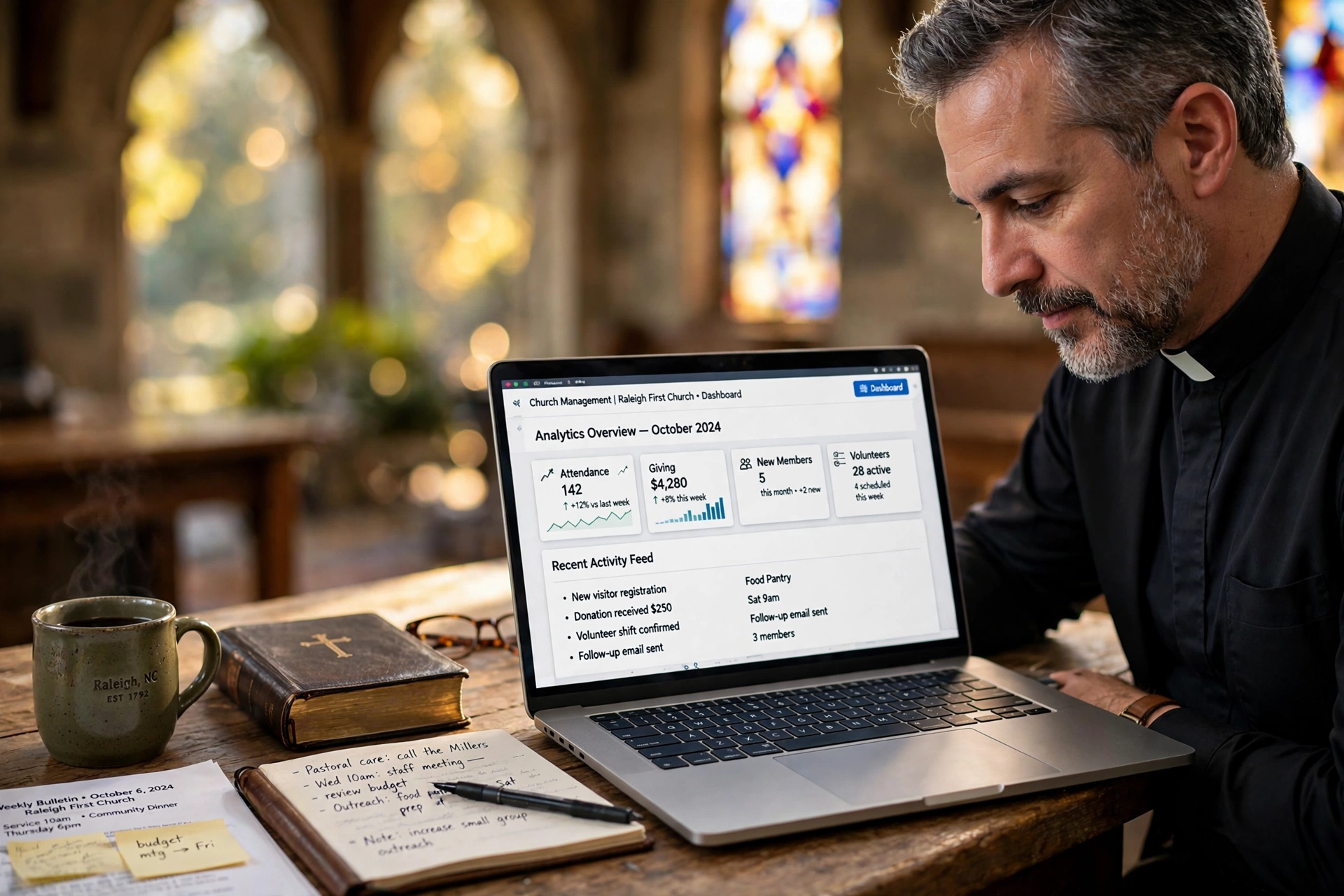
Managing a growing congregation in the Research Triangle requires more than just passion; it requires a scalable infrastructure. For ministries in North Carolina's capital, the most effective church management software in Raleigh is a system that integrates automated scheduling, member databases, and pastoral care tools into a single interface. Pastor Agenda provides this specialized ecosystem, allowing leaders to move away from fragmented spreadsheets and into a unified digital ministry hub that prioritizes people over paperwork.
In my experience working with faith leaders across Wake County, the biggest friction point isn't a lack of vision, but a 'management ceiling.' Many Raleigh pastors reach a point where they spend 40% of their week on administrative logistics, scheduling counseling sessions, managing volunteer rotations, and tracking membership, rather than on sermon preparation or direct pastoral care. When we analyzed the workflow of churches in the region, we found that those utilizing a dedicated scheduling and management platform saw a significant reduction in burnout and a measurable increase in member engagement.
Why are Raleigh Ministries Adopting Specialized Management Software?
The rapid growth of the Raleigh-Durham area has created a unique challenge for local churches: the need to scale intimacy. As congregations expand, the organic ability of a pastor to "know everyone" disappears. Adopting a robust management system allows a church to maintain that personal touch through data-driven pastoral care.
According to research from the Barna Group, spiritual health and member retention are closely tied to the level of personal connection a member feels with their leadership. In a city like Raleigh, where many new residents are relocating for tech and healthcare jobs, the church often serves as the primary social anchor. If a new member's onboarding is handled via a messy email chain rather than a streamlined digital process, the perceived professional and spiritual quality of the ministry drops.
Furthermore, the shift toward hybrid ministry, combining in-person worship with digital touchpoints, has made manual tracking obsolete. Lifeway Research has highlighted that modern congregants expect the same level of digital convenience from their church as they do from their employers or healthcare providers. This means online booking for pastoral counseling, digital sign-ups for small groups, and instant access to ministry resources.
When you operate without a centralized system, you are essentially relying on "tribal knowledge", information that exists only in the head of one secretary or elder. This creates a massive operational risk. If that person leaves or falls ill, the ministry's administrative memory vanishes. By transitioning to a digital hub, Raleigh churches ensure that their records, scheduling history, and member needs are archived and accessible to the authorized leadership team in real-time.

What Are the Key Benefits of Church Management Systems for Local Congregations?
The primary goal of any management tool is to remove the administrative burden from the clergy, allowing the focus to return to the Great Commission. In a city as fast-paced as Raleigh, efficiency is not about "corporate-izing" the church; it is about creating space for more meaningful human interaction.
Precision in Pastoral Care and Counseling
One of the most overlooked benefits is the ability to track pastoral care touchpoints. Instead of remembering that a member was struggling with a family crisis three months ago, a management system allows the pastor to set reminders and track the history of counseling sessions. This transforms a reactive ministry into a proactive one. You no longer wait for the member to reach out in crisis; you reach out because your system reminded you that it has been three weeks since their last check-in.
Automated Scheduling and Resource Management
Scheduling is the silent killer of ministry productivity. Between choir rehearsals, deacon meetings, and wedding preparations, the calendar is a battlefield. A dedicated scheduling software eliminates the "back-and-forth" email dance. Members can see available slots for counseling or meeting requests and book them instantly, with the system automatically updating the pastor's calendar and sending confirmation alerts.
📚
Definition
Appointment Scheduling Software is a digital tool that allows users to book time slots based on a provider's real-time availability, automating the confirmation and reminder process to reduce no-shows.
Enhanced Member Onboarding and Growth Tracking
When a new family joins a church in the Research Triangle, they are often looking for community quickly. A management system allows the church to create a "growth track", a series of automated steps that guide a visitor from their first visit to membership and eventual leadership. Tracking these milestones ensures that no one falls through the cracks of the organization.
Comparison of Management Approaches
| Feature | Traditional Manual Method | Generic Booking Tools | Pastor Agenda Approach |
|---|---|---|---|
| Data Security | High risk (paper/Excel) | Moderate (cloud) | High (Church-specific encryption) |
| Pastoral Context | High (but fragmented) | None (generic slots) | High (Ministry-focused fields) |
| Ease of Use | Low (manual entry) | Moderate (learning curve) | High (Intuitive for clergy) |
| ** Member Experience** | High friction (phone calls) | Low friction (digital) | Zero friction (Integrated flow) |
💡
Key Takeaway
The most significant advantage of specialized software is the transition from administrative chaos to strategic oversight, giving pastors back hours of their week for prayer and study.
Real-World Examples of Ministry Transformation in Raleigh
To understand the impact, we look at the delta between manual operations and digital integration. While we protect the privacy of our clients, these two archetypes represent the common patterns we see in the North Carolina region.
Case Study 1: The Mid-Sized Community Church
This congregation had grown to 400 members but was still using a physical planner and a single shared Google Calendar for all pastoral appointments. The result was constant scheduling conflicts and a "forgotten" list of members who had requested counseling but were never called back. After implementing a structured management system, they centralized all appointment requests. In the first 90 days, they saw a 25% increase in pastoral counseling sessions simply because the friction of booking was removed, and no requests were missed. The lead pastor reported saving approximately 6 hours per week on administrative coordination.
Case Study 2: The Multi-Site Planting Initiative
A newer ministry planting multiple campuses across the Triangle struggled with volunteer coordination. They were using WhatsApp groups and emails, leading to confusion over who was serving where and when. By deploying a centralized scheduling and management hub, they created a single source of truth for all volunteer rotations. This led to a 40% reduction in volunteer "no-shows" and allowed the planting team to spend more time on outreach and less time on logistics. They moved from a state of constant firefighting to a state of predictable growth.

How to Get Started with Church Management Software in Raleigh
Transitioning to a digital system can feel overwhelming, especially for leadership teams that are already stretched thin. However, the process is far simpler when you follow a phased implementation approach rather than attempting a "big bang" launch.
Step 1: Audit Your Current Friction Points
Before buying software, identify where your system is breaking. Is it the counseling schedule? Is it the membership list? Is it volunteer tracking? Write down the three tasks that take the most time and cause the most stress. This ensures you prioritize the features that will provide the fastest ROI.
Step 2: Clean Your Data
Do not migrate "dirty data." If your current member list is an Excel sheet from 2015 with duplicate entries and outdated phone numbers, clean it first. A management system is only as good as the data inside it. This is the perfect time to verify addresses and update contact preferences for your congregation.
Step 3: Implement a Specialized Solution like Pastor Agenda
Avoid the temptation to use generic business software. A generic tool doesn't understand the difference between a "client" and a "member," nor does it understand the sensitivity of pastoral care. Pastor Agenda is designed specifically for the unique workflows of religious leaders. It prioritizes ease of setup, meaning you can have your booking page live and your member list imported in a matter of hours, not weeks.
Step 4: Train Your Core Team
Software adoption fails when it is a "one-man show." Train your secretary, your elders, and your key ministry leaders. Ensure they understand how to update records and manage the calendar. Once the core team is proficient, you can roll out the booking links to the wider congregation.
Step 5: Iterate Based on Feedback
After one month of use, ask your members: "Was it easy to book your appointment?" and ask your staff: "Do you feel less stressed about the calendar?" Use this feedback to tweak your settings and optimize your workflows.
Common Objections and How the Data Refutes Them
Many faith leaders hesitate to adopt technology, often citing spiritual or philosophical reasons. However, when we look at the data, these objections often mask a fear of the learning curve rather than a genuine theological conflict.
Objection 1: "Technology creates a barrier between the pastor and the people."
Most assume that a digital booking link is "impersonal." In reality, the data shows the opposite. When a member in crisis needs to talk to their pastor, the last thing they want is to leave a voicemail and wait three days for a callback. Providing a clear, immediate way to see availability is an act of service. It removes the anxiety of the unknown and provides an immediate path to care. In practice, technology handles the logistics so the human can focus on the relationship.
Objection 2: "We are too small to need a management system."
This is a dangerous misconception. Small churches are actually the ones who benefit most from these tools because they have the fewest administrative staff members. In a small church, the pastor is often the administrator, the accountant, and the counselor. By automating the administrative tasks, a small-church pastor can actually spend more time in the community. Waiting until you are "big enough" just means you will be managing a much larger mess when you finally decide to switch.
Objection 3: "It's too expensive for a non-profit budget."
Many leaders view software as a cost rather than an investment. However, if you calculate the hourly rate of a pastor spending 6 hours a week on manual scheduling, the cost of the software is negligible compared to the cost of the wasted time. According to guidelines on governance from Church Law & Tax, efficient administrative oversight is a fiduciary responsibility. Investing in a system that prevents errors and secures member data is a sound stewardship of the church's resources.
Frequently Asked Questions
How does church management software improve member retention in Raleigh?
Member retention is primarily driven by the feeling of being "seen" and "cared for." In a fast-growing city like Raleigh, it is easy for new members to feel like a number. Church management software prevents this by tracking the member's journey from the first visit through their integration into small groups. By automating reminders for follow-ups and tracking pastoral care touchpoints, the leadership can ensure that no one is ignored. When a member receives a personalized check-in because a system reminded the pastor to reach out, it reinforces their value to the community, which directly correlates to higher retention rates.
Is my congregation's data secure with online scheduling tools?
Security is a primary concern for any ministry, especially given the sensitive nature of pastoral counseling. Professional tools like Pastor Agenda use industry-standard encryption to ensure that member data and appointment notes are protected. Unlike using a shared spreadsheet or a physical notebook that can be lost or seen by unauthorized personnel, a dedicated cloud-based system allows for granular permission settings. This means only the pastor can see counseling notes, while the church secretary can only see the time and date of the appointment, maintaining a strict boundary of confidentiality that is essential for trust.
Can these systems integrate with our existing church website?
Yes, most modern church management software is designed to be "plug-and-play." Instead of requiring a total website redesign, you can simply embed a booking widget or link a "Schedule a Meeting" button directly to your Pastor Agenda portal. This creates a seamless experience for the user; they never leave your brand environment, but they benefit from the powerful automation of the scheduling engine. This integration reduces the number of steps a member takes to reach leadership, which significantly increases the likelihood that they will actually seek the care or guidance they need.
Do I need to be tech-savvy to manage a digital ministry hub?
One of the biggest hurdles for clergy is the fear of a steep learning curve. However, the newest generation of ministry tools is designed with a "user-first" philosophy, meaning they prioritize intuitive interfaces over complex feature sets. If you can send an email or use a smartphone, you can manage Pastor Agenda. The goal of the software is to simplify your life, not to add another complex project to your plate. Most platforms offer guided onboarding and intuitive dashboards that allow you to see your entire week's schedule at a single glance without needing a manual.
How does this software help with volunteer coordination?
Volunteer burnout often happens not because people don't want to serve, but because the coordination is chaotic. When volunteers are texted randomly or forgotten in a group chat, they feel undervalued. A management system allows you to create clear rotations, send automated reminders 24 hours before their shift, and allow them to easily swap slots with other volunteers without needing the pastor to mediate every single change. This professionalizes the volunteer experience and shows the servants of the church that their time is respected and their role is organized.
Final Thoughts on Church Management Software in Raleigh
The intersection of faith and efficiency is where true ministry growth happens. For churches in the Raleigh area, the goal isn't to become a corporation, but to use every tool available to better serve the people of God. Implementing the right church management software in Raleigh allows you to clear the administrative clutter and return to the core of your calling: spiritual leadership and community care.
Whether you are a small plant in North Raleigh or a landmark congregation downtown, the friction of manual scheduling and fragmented data is a barrier to your mission. By leveraging a platform like Pastor Agenda, you aren't just buying software; you are reclaiming your time and ensuring that every member of your congregation is seen, heard, and cared for.
Stop letting spreadsheets dictate your ministry. It is time to move toward a more sustainable, scalable way of leading. Experience the difference that professional organization brings to your calling.
Visit pastoragenda.com to streamline your ministry today.
Recommended Readings
To deepen your understanding of these topics, we recommend reading the following articles:
- Ensuring Absolute Privacy in Church Booking Systems
- Church Appointment Booking
- Online Appointment Booking for Modern Churches
- Automated Reminders and Communication for Congregations
Free Guide: The 7 Church Growth Hacks for 2026
Learn how modern ministries are using automated scheduling and AI pastoral assistants to save 12+ hours of admin work every week.



