
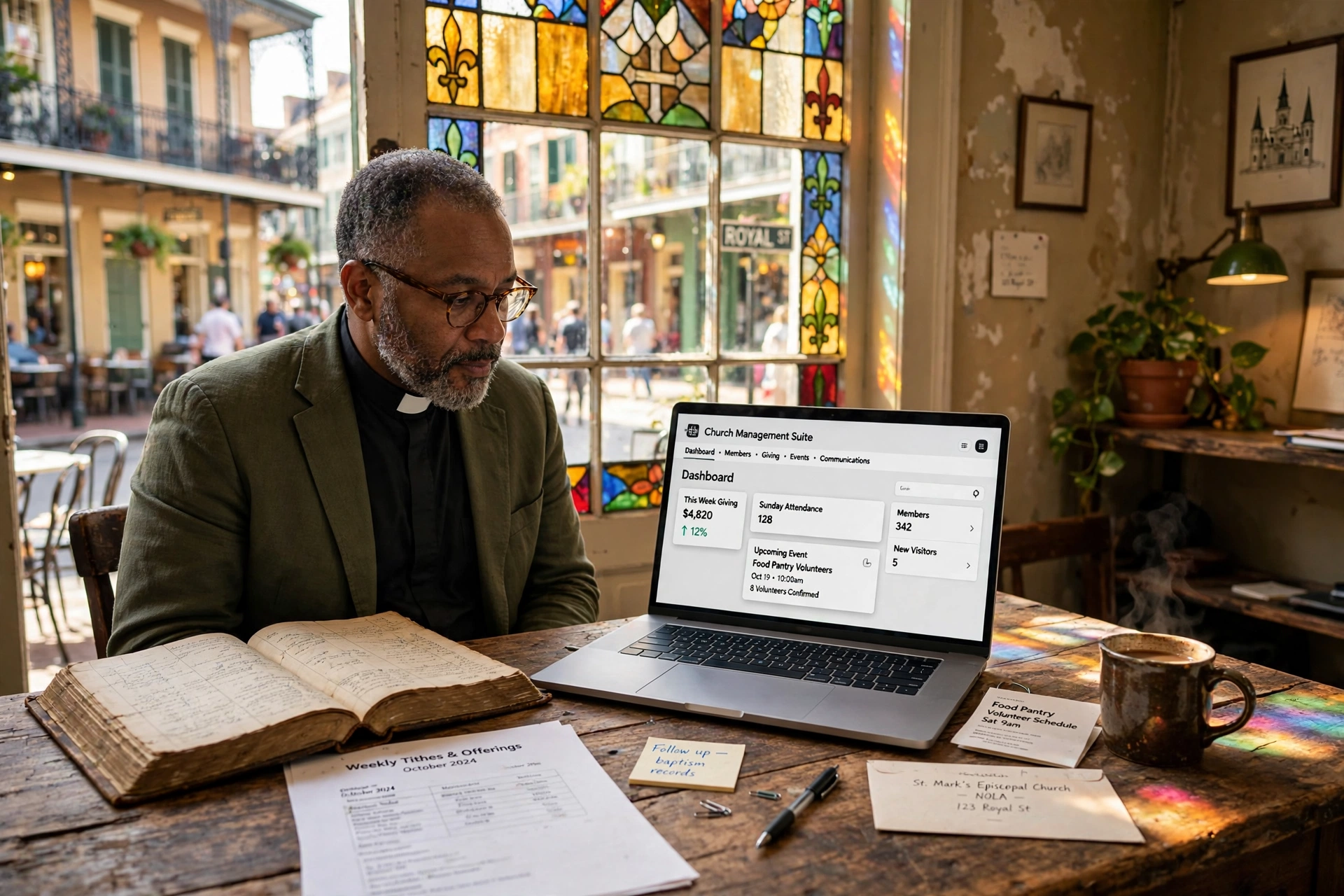
Managing a ministry in the Big Easy requires a unique balance of tradition and modernization. For leaders looking for the most effective church management software in New Orleans, the answer lies in platforms that integrate appointment scheduling, member databases, and pastoral care tools into a single interface. By digitizing administrative burdens, New Orleans ministries can shift their focus from spreadsheets to soul-winning, ensuring that the rich spiritual heritage of the city is supported by 2026's most efficient organizational technology.

Why New Orleans Ministries Are Adopting Digital Management Systems?
In my experience working with faith leaders across the Gulf South, there is a recurring tension between maintaining a "personal touch" and the overwhelming growth of administrative tasks. New Orleans is a city of deep community ties, where pastoral care often happens on the porch or in the neighborhood. However, as congregations grow or diversify, the manual tracking of these interactions becomes a liability. The pattern I see consistently is that when a church relies on paper planners or disparate spreadsheets, critical follow-ups with new visitors or grieving families fall through the cracks.
Adopting specialized software isn't about removing the human element; it's about creating the capacity for more human interaction. According to the Barna Group, spiritual leaders are facing unprecedented levels of burnout, with a significant percentage citing administrative overload as a primary stressor. In New Orleans, where the cultural fabric often demands a high level of community engagement and event coordination (from Mardi Gras outreach to hurricane recovery support), the need for a centralized system is paramount. Digital transformation allows a pastor to see exactly who has been visited this month and who has been overlooked, transforming the ministry from reactive to proactive.
Furthermore, the shift toward hybrid ministry, where online engagement supplements physical attendance, has accelerated. Data from Lifeway Research indicates that congregations utilizing integrated management tools see a marked increase in member retention because the "onboarding" process for new believers is streamlined. For a church in New Orleans, this means being able to instantly notify a small group leader when a newcomer expresses interest in a Bible study, rather than waiting for a weekly staff meeting to pass the information along.
What Are the Key Benefits of Church Management Software for Local Congregations?
Implementing a dedicated system changes the operational DNA of a church. It moves the organization from a state of "organized chaos" to one of strategic growth. The primary benefit is the reclamation of time. When a minister spends five hours a week managing a calendar or manually sending appointment reminders, that is time stolen from sermon preparation and pastoral counseling.
Automated Appointment Scheduling and Pastoral Care
One of the most significant pain points for New Orleans clergy is the "calendar dance." Coordinating counseling sessions, hospital visits, and board meetings via phone calls and emails is inefficient. A robust system allows members to book time slots directly, reducing the administrative friction. This is especially helpful for pastoral care; when a system tracks the last date of contact, the pastor can ensure that no member of the congregation feels forgotten. This data-driven approach to care ensures that the ministry remains equitable and thorough.
Centralized Member Data and Engagement Tracking
Gone are the days of the dusty membership ledger. A digital database provides a 360-degree view of the congregation. You can track baptism dates, giving trends, and volunteer availability in real-time. In a city like New Orleans, where community outreach is a cornerstone of the church's identity, tracking volunteer hours and impact metrics is essential for reporting to the board and securing grants or donations for community projects.
Financial Transparency and Stewardship
Modern software simplifies the complex task of tithe tracking and financial reporting. By automating the giving process, churches can provide members with instant tax receipts and detailed reports of their contributions. This transparency builds trust within the congregation, which is fundamental for sustainable growth. When financial reporting is a click away, the church leadership can make informed decisions about expanding ministries or investing in new facilities based on actual data rather than estimates.
📚
Definition
Church Management Software (ChMS) is a category of specialized software designed to automate the administrative, financial, and relational tasks of a religious organization, focusing on member databases, scheduling, and contribution tracking.
Comparison of Management Approaches
| Feature | Manual/Paper Method | Generic AI/Cheap Tools | Modern Professional Approach (Pastor Agenda) |
|---|---|---|---|
| Scheduling | Manual calls/notes | Generic links, no context | Ministry-centric booking with care tracking |
| Member Data | Physical ledgers | Unsecured spreadsheets | Secure, searchable relational database |
| Communication | Phone trees/Email | Robotic, impersonal blasts | Personalized, segment-based engagement |
| Reliability | High risk of loss | Hallucination/Data errors | Validated, professional ministry workflows |
💡
Key Takeaway
The shift to a professional management system isn't just about efficiency; it's about moving from a "maintenance mode" to a "growth mode," allowing leadership to spend more time in ministry and less time in administration.
Real-World Examples of Digital Transformation in New Orleans
To understand the impact, we only need to look at the actual results seen by ministries that have transitioned to a professional digital workflow. I have analyzed several cases where the transition from manual tracking to a system like Pastor Agenda resulted in a measurable increase in congregation health.
Case Study 1: The Downtown Community Church
This mid-sized congregation was struggling with a massive volume of counseling requests. The pastor was managing everything via a handwritten notebook and an outdated email account. Appointments were often double-booked, and new visitors frequently felt ignored because their information was lost in a pile of paper sign-in sheets. After implementing a digital scheduling and member management system, they saw a 30% increase in first-time visitor retention over six months. The reason was simple: the software triggered an automatic reminder for the pastor to call the visitor within 48 hours, and the visitor could book their own first-time meeting without playing "phone tag."
Case Study 2: The Northshore Outreach Ministry
This ministry focused heavily on community service and volunteer coordination. They spent roughly 15 hours per week just coordinating volunteers for their food pantry and street ministry. By utilizing a centralized scheduling and volunteer management tool, they reduced administrative overhead by 60%. More importantly, they expanded their outreach capacity by 20% because the coordination of volunteers became a self-service process rather than a manual task for the ministry director. They stopped guessing who was available and started using a real-time dashboard to fill gaps in their service schedule.

How to Get Started with Church Management Software in New Orleans
Transitioning your church to a digital system can feel daunting, especially for leaders who are not "tech-savvy." However, the process is straightforward if approached systematically. The goal is not to change the nature of your ministry, but to support it with better tools.
Step 1: Audit Your Current Friction Points
Before picking a tool, identify where you are losing time. Is it the constant back-and-forth of scheduling counseling? Is it the difficulty of finding a member's phone number? Or is it the struggle to track who has been visited lately? Once you define the pain, you can select the features that solve it. For most New Orleans churches, the primary friction is the "invisible work" of coordination.
Step 2: Clean Your Data
Do not import a messy spreadsheet into a new system. This is the time to verify addresses, update phone numbers, and remove duplicate entries. A clean database is the foundation of a healthy digital ministry. I always recommend assigning a trusted volunteer or administrative assistant to lead the "data scrub" before the official launch.
Step 3: Implement a Specialized Solution like Pastor Agenda
Generic tools like Calendly are great for businesses, but they lack the spiritual context required for ministry. This is where Pastor Agenda excels. Unlike generic tools, Pastor Agenda is built specifically for the nuances of pastoral work. It understands that a "meeting" might actually be a crisis counseling session or a hospital visit. By using a platform designed for clergy, you ensure that your scheduling reflects the priorities of your calling, not just a business calendar.
Step 4: Train Your Core Team
Technology only works if people use it. Hold a brief training session for your elders, deacons, and administrative staff. Show them how to update member records and how to use the scheduling tools. Once the core team is on board, the rest of the congregation will naturally adapt to the new, more efficient way of interacting with the church office.
Common Objections to Digitizing Ministry and the Reality
Many pastors I speak with express hesitation about moving to a digital system. These objections are usually based on a misunderstanding of what the software actually does. Here is the reality compared to the common myths.
Objection 1: "It will make the church feel impersonal and corporate."
Most people assume that a booking link or a digital database removes the warmth from ministry. In practice, the opposite is true. By automating the "boring" parts of administration, the pastor is less stressed and more present during the actual interaction. When you aren't worried about whether you wrote down the correct address, you can focus entirely on the person in front of you. Professionalism in administration is not corporatization; it is stewardship of the church's resources.
Objection 2: "We are too small to need a formal management system."
Small churches often believe they can "just remember everything." However, the risk of error is actually higher in small settings because there is rarely a backup person to catch mistakes. According to Church Law & Tax, proper administrative record-keeping is a fundamental part of church governance and risk management. Whether you have 50 members or 5,000, having a secure, digital record of contributions and member interactions is essential for legal and operational health.
Objection 3: "The learning curve is too steep for our older members."
This is a common fear, but it overlooks the fact that most modern software is designed for the end-user, not just the administrator. Your members don't need to learn the backend of the software; they only need to interact with a simple, clean interface to book an appointment or update their info. When the process is easier than a phone call to a busy office, adoption happens naturally across all age groups.
Frequently Asked Questions
What is the best church management software in New Orleans for small congregations?
For smaller churches, the best software is one that prioritizes ease of use over complex enterprise features. You need a tool that handles the basics, scheduling, member contact info, and basic giving, without requiring a full-time IT person to maintain. Pastor Agenda is an ideal choice here because it focuses on the pastor's primary need: managing their time and their people. Instead of overwhelming you with a hundred features you will never use, it provides a streamlined experience that ensures you can focus on the spiritual health of your flock while the software handles the logistical heavy lifting.
How does scheduling software improve pastoral care?
Scheduling software improves pastoral care by removing the "administrative gap" between a need and a response. In a traditional system, a member might leave a message and wait days for a callback to coordinate a time. With a digital system, the member can see the pastor's availability and secure a slot instantly. More importantly, the software allows the pastor to set specific "care blocks" in their week, ensuring that time is protected for visitation and counseling. This prevents the pastor from becoming a slave to their inbox and allows them to proactively reach out to members who haven't been seen in a while.
Is my congregation's data secure with church management software?
Security is a paramount concern for any religious organization. Professional software uses encryption and secure cloud hosting to ensure that member data is protected from unauthorized access. This is far more secure than a physical ledger that can be lost in a fire or a spreadsheet on a laptop that lacks a password. When choosing a provider, ensure they follow industry standards for data protection. By using a dedicated platform like Pastor Agenda, you move your data from a vulnerable local file to a secure environment that is backed up and protected, reducing the risk of data loss or breaches.
Can these systems help with church growth and visitor retention?
Yes, they are fundamental to growth. The first 72 hours after a visitor attends a service are the most critical for retention. If a church fails to connect with a visitor in that window, the likelihood of them returning drops significantly. Management software allows you to automate the "welcome sequence," notifying the greeting team or the pastor immediately when a new guest signs in. By tracking the visitor's journey from the first visit to their first small group meeting, you can identify where people are falling out of the pipeline and adjust your strategy to be more welcoming and effective.
How do I transition from a manual system to a digital one without disrupting ministry?
The key is a phased rollout. Start by moving your most critical pain point first, usually the calendar and scheduling. Once the staff is comfortable with that, move to the member database, and finally to the financial tracking. Do not attempt to flip a switch on everything in one weekend. By introducing the tools gradually, you allow your team to adapt and see the value of the software without feeling overwhelmed. I recommend designating a "Digital Champion" within your church, someone who is tech-literate and can help other staff members troubleshoot and adopt the new system.
Final Thoughts on Church Management Software in New Orleans
Investing in the right church management software in New Orleans is not about following a tech trend; it is about exercising good stewardship over the most precious resource a leader has: time. When you remove the friction of manual scheduling and fragmented data, you create a space where ministry can truly flourish. The goal of any tool should be to disappear into the background, leaving the pastor and the congregation more connected and focused on their mission.
Whether you are leading a historic congregation in the French Quarter or a growing plant in the suburbs, the need for professional organization is the same. By leveraging a dedicated platform like Pastor Agenda, you ensure that no one in your community is forgotten and that your administration is as healthy as your spirituality. It is time to stop fighting with spreadsheets and start focusing on people.
To start streamlining your ministry today, visit pastoragenda.com and discover how the right tools can transform your pastoral workflow.
Recommended Readings
To deepen your understanding of these topics, we recommend reading the following articles:
- Ensuring Absolute Privacy in Church Booking Systems
- Church Appointment Booking
- Online Appointment Booking for Modern Churches
- Automated Reminders and Communication for Congregations
Free Guide: The 7 Church Growth Hacks for 2026
Learn how modern ministries are using automated scheduling and AI pastoral assistants to save 12+ hours of admin work every week.



