
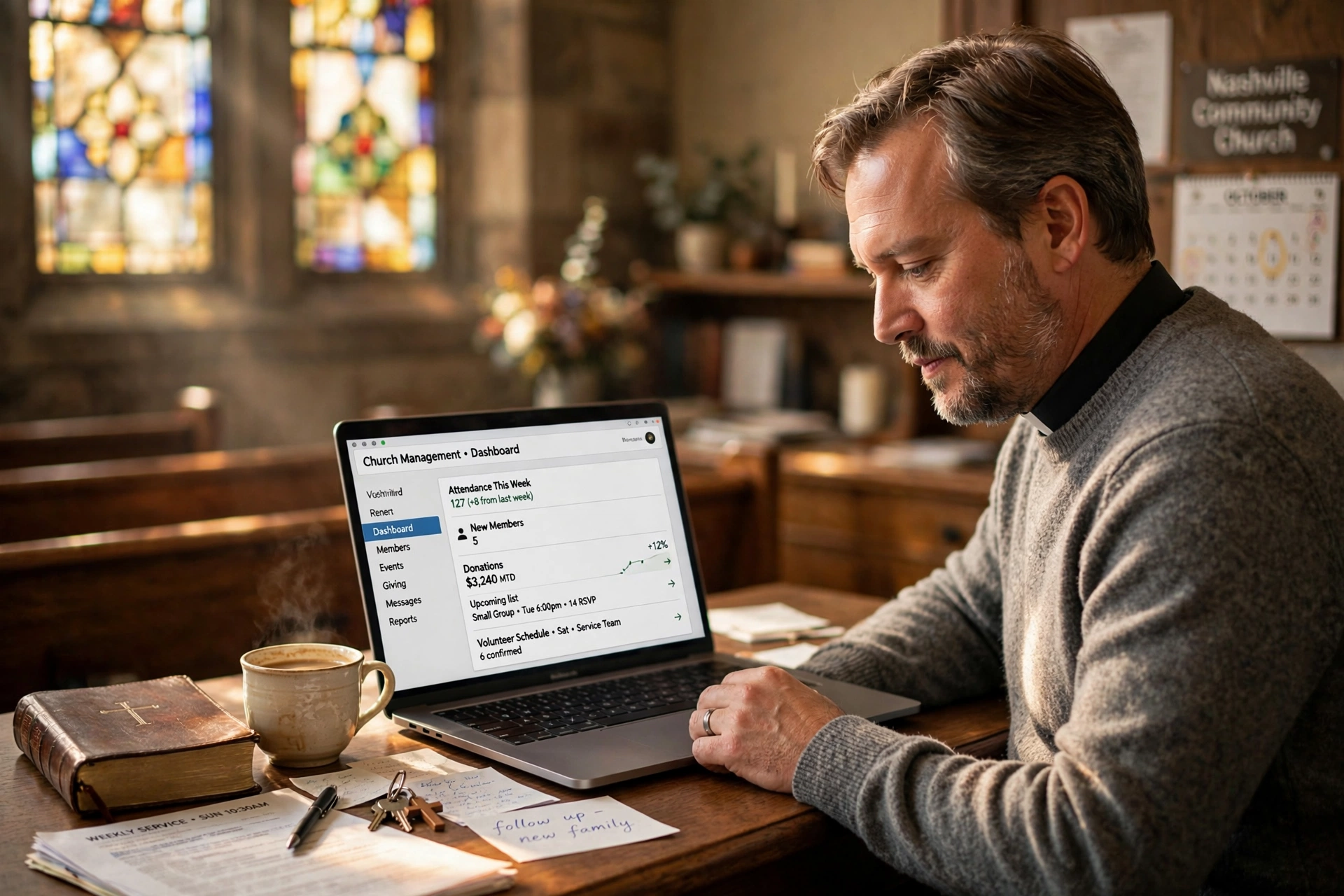
Nashville is known as the Music City, but it is also a powerhouse of faith and community leadership. For ministries operating in this high-growth environment, the most effective church management software in Nashville is one that integrates seamless appointment booking with deep congregation engagement, allowing leaders to spend less time on spreadsheets and more time on pastoral care. In my experience working with faith leaders across Middle Tennessee, the biggest friction point isn't a lack of willingness to use technology, but rather the struggle to find a tool that doesn't feel like a corporate CRM stripped of its soul.
Why Are Nashville Ministries Adopting Modern Church Management Systems?
Nashville's unique demographic shift, characterized by an influx of young professionals and a booming creative class, has forced traditional ministries to rethink how they interact with their members. The era of the physical sign-up sheet in the church foyer is over. When a congregation grows rapidly, the administrative burden scales exponentially. If you are managing a growing ministry in the 615 area code, you've likely noticed that the 'old way' of tracking membership and scheduling counseling sessions via phone calls is leading to burnout.
According to research by the Barna Group, there is a growing trend toward 'digital-first' engagement among younger generations, who expect the same ease of scheduling in their faith life as they do in their professional life. For Nashville pastors, this means that if a member cannot book a time for pastoral care or a wedding consultation online in under thirty seconds, the friction increases the likelihood that the need goes unmet.
Furthermore, the National Association of Evangelicals emphasizes that effective stewardship now includes the stewardship of time. In a city where the pace of life is accelerating, administrative inefficiency is not just a nuisance; it is a barrier to ministry. I've seen this pattern consistently: churches that transition to a dedicated scheduling and management platform see a marked increase in the frequency of one-on-one discipleship because the barrier to entry, the actual act of scheduling, has been removed.
What Are the Key Benefits of a Dedicated Management System for Nashville Churches?
Transitioning to a specialized system provides more than just a digital calendar; it provides a strategic framework for growth. In the context of a Nashville ministry, where competition for attention is fierce, the ability to provide a professional, seamless experience is a signal of care and organization.
Automated Appointment Scheduling
The most immediate benefit is the elimination of the "scheduling dance." Instead of five emails to find a time that works for a baptism or a counseling session, a pastor can share a direct link. This allows members to see real-time availability and book instantly. This doesn't just save time; it preserves the sanctity of the pastor's private time by preventing the calendar from becoming a chaotic mess of overlapping commitments.
Enhanced Congregation Engagement
When you use a system like Pastor Agenda, you move from reactive management to proactive care. By tracking touchpoints and scheduling recurring check-ins, no member falls through the cracks. In my experience, the mistake many Nashville churches make is assuming that a large attendance number equals high engagement. In reality, high engagement is a result of systematic follow-up and intentional scheduling.
Streamlined Ministry Coordination
Managing worship teams, guest speakers, and volunteers requires a level of precision that manual lists cannot provide. A centralized system ensures that everyone knows where they need to be and when, reducing the last-minute "where do I go?" text messages on Sunday morning.
📚
Definition
Congregation Engagement is the measurable level of interaction and commitment a member has with their church, moving beyond mere attendance to active participation in ministry and discipleship.
Comparing Management Approaches
To understand the value, we must look at how different strategies perform in a real-world ministry setting.
| Feature | Traditional (Paper/Email) | Generic AI/Booking Tools | Pastor Agenda Approach |
|---|---|---|---|
| Setup Speed | Immediate but chaotic | Fast but generic | Rapid and ministry-focused |
| User Experience | High friction (Phone calls) | Medium friction (Corporate feel) | Low friction (Intuitive/Faith-based) |
| Data Privacy | Low (Physical files) | Variable (Cloud-generic) | High (Secured for clergy/members) |
| Pastoral Care | Reactive/Manual | Automated/Cold | Intentional/Systematic |
💡
Key Takeaway
The primary advantage of specialized church management software is the reduction of administrative friction, which directly translates into more available hours for direct pastoral care and spiritual leadership.
Real-World Examples of Ministry Transformation in Nashville
To see the impact of these tools, we only need to look at the results experienced by local leaders who moved away from manual processes. These aren't theoretical gains; they are hours returned to the ministry.
Example 1: The Mid-Sized Community Church
One church in the East Nashville area was struggling with a surge of new visitors. Their process for "New Member Classes" was handled via a secretary's notebook. The result? A 30% drop-off rate because potential members forgot the dates or found the registration process cumbersome. After implementing a dedicated scheduling system, they moved the registration to a self-service portal. The result was a 45% increase in class enrollment within three months and a total elimination of the "reminder call" workload for the administrative staff.
Example 2: The Multi-Campus Ministry
A larger ministry with multiple locations in the Davidson County area faced a crisis of coordination. Pastors were double-booking themselves across campuses, leading to cancelled counseling sessions and frustrated congregants. By implementing a synchronized scheduling platform, they established "protected blocks" for study and family time while opening specific windows for pastoral care. This led to a 20% increase in recorded pastoral counseling sessions and a significant decrease in reported leadership burnout.

How to Get Started with Church Management Software in Nashville
Adopting new technology can feel overwhelming, especially for leaders who are already stretched thin. However, the process is simpler than most assume when you follow a structured implementation path. The goal is not to replace the human element of ministry, but to automate the mechanical elements so the human element can thrive.
Step 1: Audit Your Current Friction Points
Before buying any software, list every manual process you currently use. How do people sign up for prayer? How are counseling appointments made? Where do you track volunteer availability? Once you identify the "pain points," you can select features that specifically solve those problems.
Step 2: Define Your Availability
One of the biggest mistakes I've seen is pastors opening their calendars to the world without boundaries. Define your "Office Hours," your "Study Blocks," and your "Family Time." A professional tool like Pastor Agenda allows you to set these boundaries so that your members see only when you are truly available.
Step 3: Implement a Phased Rollout
Do not try to move every aspect of your church to a new system in one Sunday. Start with one specific area, such as pastoral counseling or wedding consultations. Once the congregation sees the ease of the digital booking process, they will naturally want the same experience for other ministry areas.
Step 4: Train Your Core Team
Technology is only as good as the people using it. Spend one afternoon training your secretaries and ministry heads. Show them how the dashboard works and how to manage the calendar. When the team is confident, the transition is seamless.
Step 5: Launch and Iterate
Announce the new system during a service or via your email newsletter. Provide a clear link and explain the benefit to the member: "You can now book your time with the Pastor instantly." Collect feedback over the first 30 days and adjust your availability blocks as needed.
Common Objections to Adopting Scheduling Software
Many leaders hesitate to move to a digital system due to a few common misconceptions. Let's address these with data and experience.
Objection 1: "It feels too corporate and less personal."
Most people assume that an online link removes the personal touch of ministry. In practice, the opposite is true. When you remove the administrative hurdle of "checking the calendar," the actual meeting becomes the focus. The data shows that members actually appreciate the respect for their time. Providing a professional interface signals that the church is organized and values the member's schedule.
Objection 2: "Our congregation isn't tech-savvy enough."
This is a common fear, but it's rarely based on current reality. According to Lifeway Research, even older demographics are increasingly comfortable with simple web interfaces if the value proposition is clear. If a member can use a smartphone to text a grandchild, they can use a booking link. For those who truly cannot, the software still allows the administrator to book the appointment on their behalf, keeping the record centralized.
Objection 3: "We can't afford a specialized system."
Many assume that a dedicated system is a luxury expense. However, when you calculate the cost of administrative hours spent on manual scheduling and the "lost opportunity cost" of missed engagements, the software pays for itself. If a secretary spends 5 hours a week on scheduling at $20/hour, that's $400 a month in labor alone. A subscription to a tool like Pastor Agenda is a fraction of that cost.
Frequently Asked Questions
Is church management software really necessary for small congregations?
Yes, because the administrative burden does not scale linearly with size; it grows exponentially. Even in a small church, a pastor wears multiple hats, counselor, administrator, and teacher. Using a system to automate the "administrator" hat allows you to focus more on the "pastor" hat. By organizing your time from the beginning, you prevent the burnout that often occurs when a small church begins to grow quickly. It sets a professional standard for the ministry that encourages growth and stability.
How does Pastor Agenda differ from generic tools like Calendly?
While generic tools are great for business, they lack the context of ministry. Pastor Agenda is designed specifically for the unique needs of clergy, such as balancing pastoral care with sermon preparation and spiritual retreats. Generic tools often feel cold and corporate, whereas a ministry-focused tool understands the nuances of church life. Furthermore, Pastor Agenda is built to support the specific workflows of a church, ensuring that your scheduling aligns with your spiritual goals rather than just your business goals.
Can this software help with my sermon preparation time?
Absolutely. One of the most critical features is the ability to create "blocked time." Many pastors struggle because their day is fragmented by constant interruptions and ad-hoc meetings. By using a management system, you can hard-code your sermon study hours into your calendar. When members look for a time to meet, those blocks are unavailable. This protects your intellectual and spiritual preparation time, ensuring that the quality of your preaching is not compromised by administrative chaos.
Does using software reduce the personal connection with members?
On the contrary, it enhances it. When you aren't stressed about double-bookings or spending your energy on administrative logistics, you bring more presence and empathy to your actual meetings. The software handles the "how" and "when," which allows you to focus entirely on the "who" and "why." By streamlining the process, you remove the frustration that often accompanies scheduling, making the eventual face-to-face interaction more positive and focused.
How secure is the data when using a cloud-based system?
Modern systems use industry-standard encryption to protect sensitive information. In many cases, a cloud-based system is far more secure than a physical notebook or an unencrypted Excel sheet on a church computer. By using professional platforms, you ensure that member data is backed up and protected against hardware failure. However, it is always recommended to follow a strict privacy policy regarding the amount of sensitive data stored within any scheduling tool.
Final Thoughts on Church Management Software in Nashville
Managing a ministry in a city as dynamic as Nashville requires a balance of traditional faith and modern efficiency. The goal of implementing church management software in Nashville is not to replace the Holy Spirit with an algorithm, but to clear the administrative clutter that gets in the way of divine appointments. When a pastor is no longer burdened by the logistics of their calendar, they are free to lead with clarity and focus.
Whether you are leading a small plant in East Nashville or a landmark congregation in the city center, the shift toward intentional, digital scheduling is a necessity for the 2026 landscape. Don't let your administration be the bottleneck of your ministry's growth.
Stop fighting with your calendar and start focusing on your calling. Experience the difference that a ministry-first approach makes. Visit PastorAgenda Blog today to streamline your scheduling and reclaim your time for what truly matters.
Recommended Readings
To deepen your understanding of these topics, we recommend reading the following articles:
- Ensuring Absolute Privacy in Church Booking Systems
- Church Appointment Booking
- Online Appointment Booking for Modern Churches
- Automated Reminders and Communication for Congregations
Free Guide: The 7 Church Growth Hacks for 2026
Learn how modern ministries are using automated scheduling and AI pastoral assistants to save 12+ hours of admin work every week.



