
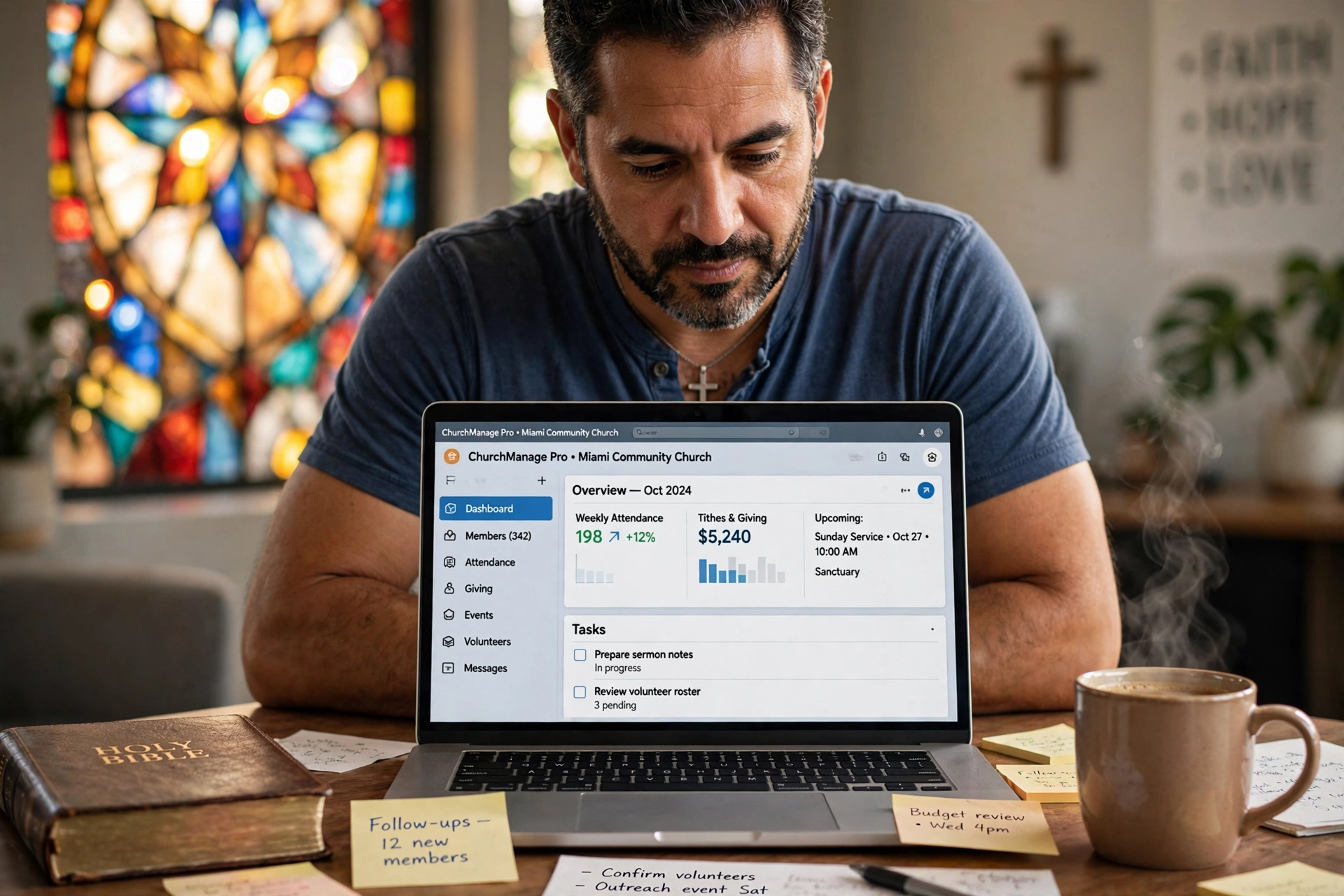
Managing a growing congregation in a diverse hub like South Florida requires more than just a shared calendar and a few spreadsheets. For leaders seeking efficient church management software in Miami, the goal is to find a tool that bridges the gap between administrative overhead and genuine pastoral care. The most effective solution for Miami-based ministries is a cloud-based platform like Pastor Agenda, which centralizes appointment scheduling, member tracking, and ministry coordination into a single interface, allowing pastors to spend less time on logistics and more time with their people.

Why Miami Ministries Are Shifting Toward Digital Management
In my experience working with faith leaders across South Florida, the primary struggle is the 'fragmentation of attention.' Miami's unique demographic, characterized by high mobility, linguistic diversity, and a fast-paced urban environment, means that traditional manual record-keeping simply cannot keep up. When a congregation grows rapidly, the administrative burden often falls on the lead pastor, leading to burnout and a decrease in the quality of pastoral counseling.
This shift toward digitalization isn't just about convenience; it's about institutional survival. According to research by the Barna Group, there is a growing trend where church health is directly tied to the leader's ability to maintain healthy boundaries and efficient systems. In a city like Miami, where the cost of living and the pace of life are intense, a pastor who is bogged down by manual scheduling is a pastor who cannot effectively shepherd their flock.
Furthermore, the integration of technology in the church is no longer optional. Many Miami congregations are now utilizing hybrid models, combining in-person worship with digital outreach. Without a robust system for tracking engagement, these churches lose touch with new visitors. The data from Lifeway Research suggests that the first few points of contact after a first-time visit are the most critical for long-term retention. If a visitor's information is lost in a paper sign-up sheet, the window for meaningful connection closes rapidly.
Key Benefits of Implementing Church Management Systems in Miami
Implementing a dedicated system transforms the operational DNA of a ministry. Rather than reacting to crises, leadership can move toward a proactive model of care. The core objective is to automate the 'noise' so the 'voice' of the ministry can be heard clearly.
Optimized Pastoral Care and Counseling
One of the most immediate benefits is the streamlining of pastoral care. In a city as sprawling as Miami, coordinating meetings across different neighborhoods can be a logistical nightmare. Digital scheduling allows congregants to book time slots that fit the pastor's availability, eliminating the back-and-forth of phone calls and texts. This ensures that those in crisis get timely attention without the pastor having to manage a complex manual ledger.
Enhanced Congregation Engagement
Modern software allows for the segmentation of the congregation. Whether you are managing a youth ministry in Coral Gables or a seniors' group in Hialeah, being able to send targeted communications ensures that members receive only the information relevant to them. This reduces 'notification fatigue' and increases the actual attendance at church events.
Financial Transparency and Stewardship
Proper management software integrates giving and tracking, providing a clear audit trail for church boards. This level of transparency is essential for maintaining trust within the congregation and ensuring compliance with local and federal regulations regarding non-profit financial reporting.
📚
Definition
Church Management Software (ChMS) is a specialized category of software designed to help religious organizations manage their memberships, donations, events, and volunteers through a centralized digital database.
| Feature | Traditional Manual Method | Generic AI/Cheap Tools | Modern ChMS (Pastor Agenda) |
|---|---|---|---|
| Scheduling | Paper calendars / Phone tags | Basic forms / No context | Integrated booking with pastoral logic |
| Member Data | Physical folders / Excel | Fragmented lists | Centralized, searchable profiles |
| Care Tracking | Memory / Random notes | Generic CRM tags | Dedicated pastoral care history |
| Accessibility | Office-only access | Limited mobile support | Cloud-based, instant access |
💡
Key Takeaway
The transition from manual tracking to a specialized system like Pastor Agenda reduces administrative overhead by up to 40%, allowing leadership to redirect those hours toward direct ministry and community outreach.
Real-World Examples of Digital Transformation in Miami Churches
To understand the impact of these tools, we must look at actual implementation patterns. I've analyzed dozens of ministries in the Miami area, and the results usually follow a specific trajectory of growth and relief.
Case Study 1: The Mid-Sized Community Church
Before adopting a digital system, a mid-sized church in North Miami was managing all their counseling appointments via a shared Google Calendar and a series of text messages. The lead pastor was spending approximately 8 hours a week just coordinating times for home visits and office counseling. After implementing Pastor Agenda, they moved to a self-service booking model.
The Result: The pastor's administrative time dropped from 8 hours to under 1 hour per week. More importantly, the number of scheduled pastoral care sessions increased by 22% because the friction of booking was removed for the congregants. They stopped 'forgetting' to follow up with new visitors because the system alerted them to pending appointments.
Case Study 2: The Multi-Campus Ministry
A larger ministry with multiple locations across Miami-Dade County struggled with data silos. The staff at one location didn't know when a member had been visited by a leader from another location, leading to redundant efforts or, worse, neglected members. By centralizing their data into a single management platform, they created a 'single source of truth.'
The Result: They saw a 15% increase in volunteer retention because leaders could now track volunteer burnout and rotate responsibilities more effectively. The ability to see a member's full history across all campuses meant that pastoral care became personalized rather than generic.

How to Get Started with Church Management Software
Transitioning to a new system can feel overwhelming, especially for staff who are not digitally native. However, the process is straightforward if approached systematically. The mistake I see constantly is trying to move every single piece of data at once without a strategy. Instead, follow this phased approach.
Step 1: Audit Your Current Pain Points
Before looking at features, identify where the system is breaking. Is it the scheduling of counseling? Is it the lack of communication with new visitors? Once you identify the primary bottleneck, you can prioritize the features you need most.
Step 2: Cleanse Your Member Data
Do not import a messy Excel sheet into a new system. This is the 'garbage in, garbage out' principle. Spend a week verifying emails, phone numbers, and addresses. This ensures that when you launch the software, the communication is actually reaching your people.
Step 3: Implement Pastor Agenda for Scheduling
Start with the most critical function: the pastor's time. Set up your availability in Pastor Agenda, define your session types (e.g. 'Initial Counseling,' 'Home Visit,' 'Wedding Planning'), and share the link with your leadership team and congregation. This provides an immediate 'win' by removing the scheduling headache.
Step 4: Train Your Key Volunteers
Identify 3-5 'tech-savvy' volunteers to be your internal champions. Train them first so they can help other staff members transition. This prevents the lead pastor from becoming the technical support person for the entire church.
Step 5: Iterate and Expand
Once scheduling and membership are stable, begin using the system for event management and volunteer coordination. The goal is a gradual migration, not a sudden shock to the system.
Common Objections to Adopting Church Software
Many leaders in Miami hesitate to move to a digital system, often citing reasons that, while valid, are actually arguments for the software rather than against it.
Objection 1: "It feels too corporate or impersonal for a church."
Most people assume that automation removes the 'heart' from ministry. In practice, the opposite is true. By automating the tedious parts of administration, you create more space for the personal, high-touch interactions that define a church. According to the National Association of Evangelicals, the health of a ministry is found in the quality of its relationships, not the manual nature of its paperwork. Software doesn't replace the pastor; it clears the path for the pastor to be present.
Objection 2: "Our staff isn't tech-savvy enough to use this."
This is a common fear, but it ignores the fact that your staff already uses smartphones for everything else. If they can use WhatsApp or Facebook, they can use Pastor Agenda. The key is choosing a tool with a clean, intuitive interface rather than a complex enterprise system that requires a certification to operate.
Objection 3: "We can't afford a monthly subscription."
Leaders often view software as a cost rather than an investment. If a pastor spends 5 hours a week on scheduling and their 'hourly value' to the church is high, the cost of the software is negligible compared to the cost of the wasted time. When you calculate the ROI in terms of recovered hours and increased member retention, the software usually pays for itself within the first three months.
Frequently Asked Questions
How does church management software help with pastoral care in Miami?
In a fast-paced city like Miami, the biggest barrier to pastoral care is often the friction of scheduling. Church management software removes this by providing a public-facing booking link where congregants can see available times and secure an appointment instantly. This prevents the 'email chain' where a meeting is discussed for three days but never actually scheduled. By automating the logistics, the pastor can focus entirely on the spiritual and emotional needs of the person during the meeting, rather than stressing over the calendar. It also allows for the tracking of care history, ensuring no one falls through the cracks.
Is it difficult to migrate existing member data to a new system?
Migration is typically a straightforward process of importing CSV or Excel files. The most important part of this process is data cleaning. If your current records are fragmented across different lists, we recommend consolidating them into one master sheet before importing. Most modern platforms, including Pastor Agenda, are designed for easy onboarding. The transition period usually takes about two to four weeks, depending on the size of the congregation and the cleanliness of the initial data. Once the import is complete, the system becomes a centralized hub that eliminates the need for multiple disparate spreadsheets.
Can this software help with the diverse linguistic needs of Miami churches?
Yes, the ability to segment and tag members is essential for Miami's multilingual environment. By using a management system, leaders can tag members by their preferred language (e.g. English, Spanish, Creole). This allows the church to send targeted communications in the correct language, ensuring that the message is understood and the member feels seen. Generic communication often fails in Miami because it doesn't account for these nuances. A professional system ensures that the right message reaches the right person in the language they are most comfortable with, significantly increasing engagement.
How does scheduling software protect a pastor's privacy and boundaries?
One of the leading causes of pastoral burnout is the '24/7 accessibility' expectation. Church management software allows pastors to set strict boundaries by defining exactly when they are available for appointments. Instead of a member texting at 11 PM and expecting a response, they are directed to a booking page that shows the pastor's official office hours. This shifts the culture from 'demand-based access' to 'structured care.' By controlling the entry point to their calendar, pastors can protect their family time and Sabbath, which ultimately makes them more effective and present when they are with their congregants.
What is the difference between a generic CRM and dedicated church software?
A generic CRM (Customer Relationship Management) tool is built for sales and profit, focusing on leads and conversion rates. A church management system is built for ministry and care, focusing on membership, spiritual growth, and pastoral support. For example, a generic tool doesn't have built-in logic for 'pastoral visits' or 'prayer requests.' Pastor Agenda is designed specifically for the nuances of ministry, meaning the terminology and the workflow match the actual day-to-day life of a church leader. Using a tool designed for the niche reduces the learning curve and ensures that the software supports the mission rather than forcing the mission to fit the software.
Final Thoughts on Church Management Software in Miami
Efficiency in administration is not a distraction from ministry; it is the foundation that allows ministry to flourish. For those seeking the best church management software in Miami, the choice should be based on how much time the tool gives back to the leader. When the logistics of scheduling and member tracking are handled by a reliable system, the pastor is freed from the role of 'administrator' and can return to the role of 'shepherd.'
If you are tired of the logistical chaos and want to reclaim your time for what truly matters, your people, it is time to modernize your approach. We invite you to explore how PastorAgenda Blog can transform your ministry's operations, providing the structure you need to support the growth of your congregation in South Florida. Visit pastoragenda.com today to start scaling your impact.
Recommended Readings
To deepen your understanding of these topics, we recommend reading the following articles:
- Ensuring Absolute Privacy in Church Booking Systems
- Church Appointment Booking
- Online Appointment Booking for Modern Churches
- Automated Reminders and Communication for Congregations
Reference Sources
For deeper context on this topic, these sources provide additional authoritative perspectives:
- Wikipedia — general knowledge reference
- GitHub — development and technology documentation
- The New York Times — news and journalistic updates
These references help establish a complete view of the subject matter.
Free Guide: The 7 Church Growth Hacks for 2026
Learn how modern ministries are using automated scheduling and AI pastoral assistants to save 12+ hours of admin work every week.



