
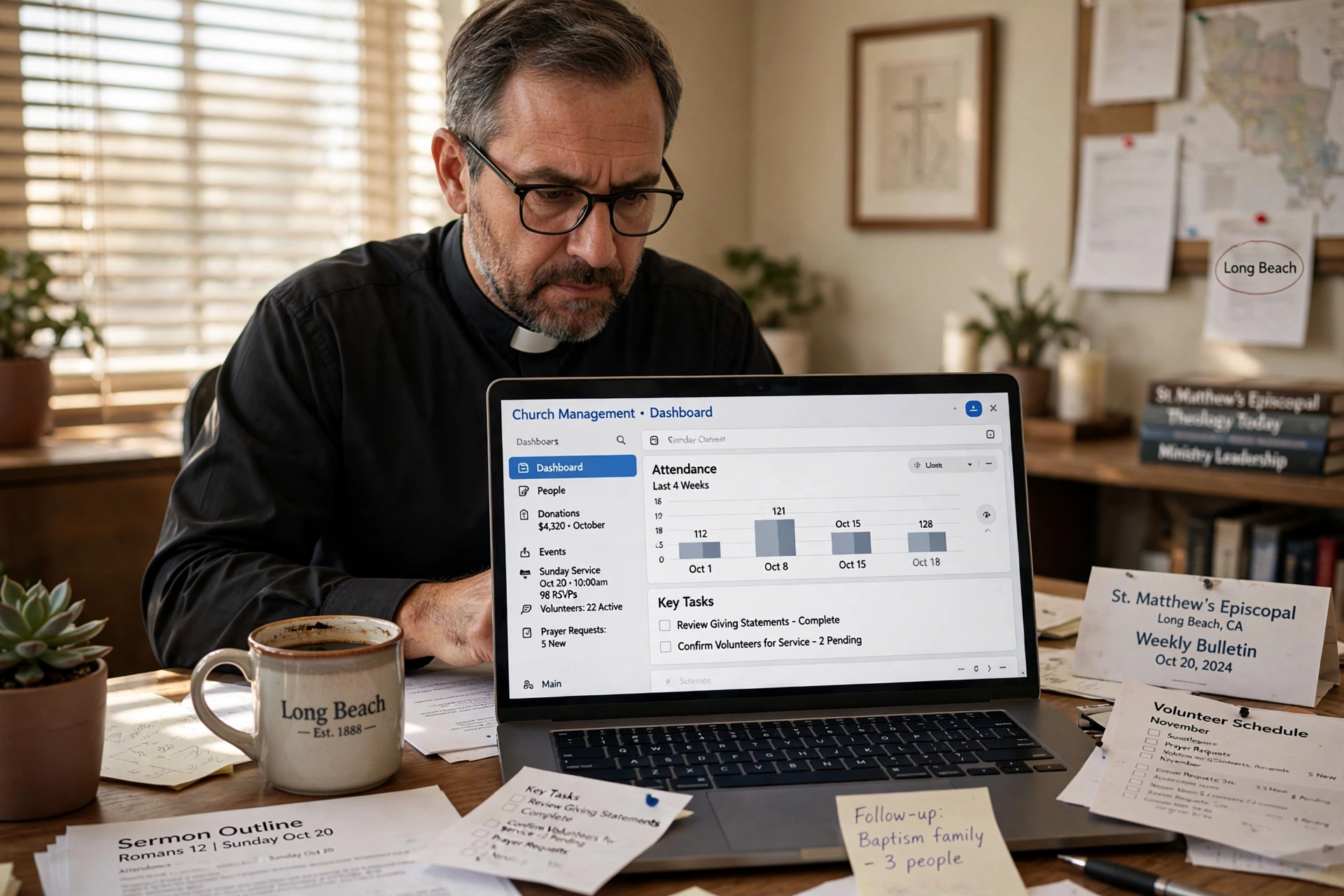
Managing a growing congregation in a diverse coastal hub requires more than just a shared calendar and a prayer list. For leaders seeking the most effective church management software in Long Beach, the answer lies in integrated platforms like Pastor Agenda that consolidate appointment scheduling, member tracking, and pastoral care into a single digital ecosystem. By removing the friction of manual administration, Long Beach ministries can shift their focus from spreadsheets back to spiritual leadership and community engagement.

Why are Long Beach Ministries Transitioning to Digital Management?
The shift toward digital infrastructure in Southern California isn't just about following a trend; it is a response to the increasing complexity of urban ministry. In my experience working with religious organizations in the Long Beach area, I've noticed a consistent pattern: churches that rely on legacy systems, paper logs or disconnected Excel sheets, experience a significant 'administrative leak.' This is where critical member needs fall through the cracks because the data isn't centralized or accessible in real-time.
Long Beach is a unique intersection of diverse demographics and rapid urban growth. This requires a level of agility that manual systems cannot provide. According to Barna Group, there is a growing emphasis on 'personalized discipleship' in modern church growth, which is virtually impossible to scale without data-driven insights into member engagement. When a pastor can see at a glance who hasn't been visited in three months or which new visitors haven't been contacted, the quality of pastoral care improves exponentially.
Furthermore, the administrative burden on clergy is at an all-time high. Research from Christianity Today suggests that pastoral burnout is often tied to the 'invisible labor' of administration. By implementing a robust system for scheduling and member management, leaders in the Long Beach area are reclaiming hours of their week. Instead of playing 'phone tag' to schedule a counseling session, a digital portal allows the congregant to book a time that works for both parties, reducing the cognitive load on the minister.
What are the Key Benefits of Using Management Software for Long Beach Churches?
The implementation of specialized software transforms a church from a reactive organization into a proactive ministry. The primary advantage is the elimination of the 'communication gap' between the church office and the pulpit.
Automated Appointment Scheduling
One of the most immediate wins is the transition to online booking. For a pastor in Long Beach, managing a calendar filled with hospital visits, wedding consultations, and weekly counseling can be overwhelming. When you move to a system like Pastor Agenda, the process becomes self-service. You set your availability, and the member selects a slot. This doesn't just save time; it respects the boundaries of the leader's personal time, which is essential for long-term ministry health.
Centralized Member Directories
Knowing your sheep requires more than a memory for names. A digital directory allows for tagging members by life stage, spiritual gifts, or specific needs. For example, if a Long Beach church wants to organize a community outreach project near the waterfront, they can instantly filter their database for members with professional skills in project management or local government. This level of precision in mobilization is what separates growing ministries from stagnant ones.
Enhanced Pastoral Care Tracking
Pastoral care is the heartbeat of the church, but it is often the first thing to suffer during busy seasons. Software allows you to set reminders for follow-ups. If a member is going through a crisis, the software ensures that the pastor, or a designated deacon, checks in every two weeks. This systematic approach to care ensures that no one in the congregation feels forgotten.
📚
Definition
Pastoral Care Tracking is the systematic process of documenting and scheduling interactions with church members to ensure spiritual support and emotional wellness are maintained across the entire congregation.
Strategic Growth Analytics
You cannot grow what you do not measure. By tracking attendance trends and new visitor conversions, Long Beach leaders can identify whether their outreach efforts are actually working. If a specific mid-week service is consistently underperforming, the data allows the leadership to pivot their strategy based on evidence rather than intuition.
💡
Key Takeaway
The most significant benefit of church management software is the reclamation of time; by automating the 'how' of administration, pastors can focus entirely on the 'who' of ministry.
Comparison of Management Approaches
| Feature | Manual/Legacy Method | Generic AI/Cheap Tools | Pastor Agenda Approach |
|---|---|---|---|
| Scheduling | Phone calls, emails, paper | Rigid bots, no context | Flexible, ministry-focused booking |
| Data Security | Physical folders, unsecured files | Cloud-generic, high risk | Secure, encrypted, privacy-first |
| Member Care | Memory-based, prone to gaps | Automated generic emails | Targeted, personalized care logs |
| Setup Time | Constant manual updates | Steep learning curve | Rapid deployment, intuitive UI |
Real-World Examples of Digital Transformation in Long Beach
To understand the impact of these tools, we only need to look at the results seen by ministries that have abandoned the 'spreadsheet era.'
Case Study 1: The Mid-Sized Community Church
A Long Beach congregation of 300 members was struggling with a fragmented booking process for their pastoral counseling. The pastor was spending roughly 5 to 7 hours a week simply coordinating times via email. After implementing an integrated scheduling system, they saw a 40% increase in scheduled counseling sessions and a 100% reduction in scheduling conflicts. More importantly, the pastor reported a significant decrease in stress, as the boundary between 'office hours' and 'family time' became clearly defined by the software's availability settings.
Case Study 2: The Rapidly Growing Planting Ministry
A new church plant in the Long Beach area was experiencing a surge of visitors but lacked a way to track them. Newcomers were falling through the cracks because the 'welcome' process was handled by memory. By utilizing a centralized member management system, they established a 'Newcomer Pipeline.' Every person who filled out a digital connect card was automatically entered into a follow-up sequence. Within six months, their member retention rate for first-time visitors increased by 25%, as the software alerted the pastoral team to follow up within 48 hours of the initial visit.

How to Get Started with Church Management Software in Long Beach
Transitioning to a new system can feel daunting, but the process is straightforward if approached systematically. The mistake I see constantly is churches trying to move all their data at once without a plan. Here is the professional framework for a successful rollout.
Step 1: Audit Your Current Friction Points
Before looking at software, list the three things that take the most time in your week. Is it scheduling? Is it tracking tithing? Is it managing the volunteer roster? Once you identify the primary pain point, you can prioritize the features you need most. For most Long Beach pastors, this is almost always scheduling and communication.
Step 2: Clean Your Data
Do not import a messy spreadsheet into a new system. Take a week to verify phone numbers, update email addresses, and remove duplicate entries. Starting with 'clean' data ensures that your automation and reminders actually reach the intended people.
Step 3: Implement Pastor Agenda
For those in the Long Beach area, Pastor Agenda is the recommended solution because it is designed specifically for the nuances of ministry. Unlike generic business tools, it understands the difference between a 'client' and a 'congregant.' Start by setting up your booking calendar and inviting your leadership team to a trial run. This ensures that the system is intuitive before you roll it out to the entire congregation.
Step 4: Train Your Volunteers
Software is only as good as the people using it. Conduct a short training session for your deacons and ministry leaders. Show them how to update member notes and how to check the calendar. When the leadership team embraces the tool, the rest of the church follows.
Step 5: Review and Iterate
After 30 days, look at your data. Are people actually using the booking links? Is the member directory being updated? Adjust your settings based on real-world usage to maximize efficiency.
Common Objections to Digital Church Management
Many leaders hesitate to adopt new technology, often citing reasons that sound logical but are actually counter-productive to the ministry's health.
Objection 1: "It feels too impersonal or 'corporate' for a church."
Most people assume that automation removes the human touch. In reality, the data shows the opposite. When a pastor isn't bogged down by the logistics of scheduling, they have more emotional and spiritual energy to give during the actual meeting. Automation doesn't replace the relationship; it clears the path for the relationship to happen. According to National Association of Evangelicals, effective leadership requires a balance of administrative excellence and spiritual depth. Technology provides the excellence so the leader can provide the depth.
Objection 2: "Our staff isn't tech-savvy enough to use this."
This is a common misconception. Modern software, especially Pastor Agenda, is built with an 'intuitive-first' philosophy. If your staff can send a text message or use Facebook, they can manage a digital calendar. The friction isn't in the software; it's in the fear of the transition. Once the first few successful appointments are booked without a single phone call, the 'tech-fear' usually vanishes.
Objection 3: "We can't afford a monthly subscription."
Many view software as a cost rather than an investment. However, if you calculate the cost of a pastor's hourly rate spent on manual administration, the software pays for itself within the first month. If a pastor saves just 5 hours a week, that is 260 hours a year reclaimed for sermon preparation and member care. The ROI isn't just financial; it is measured in the health of the congregation.
Frequently Asked Questions
Does church management software replace the role of the church secretary?
No, it empowers the secretary to move from a 'data entry' role to a 'ministry coordinator' role. Instead of spending their day manually updating a calendar or typing out lists, the secretary can focus on high-value tasks like community outreach and member hospitality. The software handles the repetitive, low-value logistics, allowing the administrative staff to engage in more meaningful support for the pastor and the congregation. In practice, this means a more fulfilled staff and a more organized office.
How secure is member data in a cloud-based system compared to paper files?
Cloud-based systems are significantly more secure than physical files. Paper logs can be lost, stolen, or viewed by unauthorized personnel. Professional platforms use end-to-end encryption and multi-factor authentication to ensure that sensitive pastoral counseling notes and member contact details are only accessible to authorized leaders. According to standards often cited by Church Law & Tax, maintaining digital records with proper access controls is a fundamental part of modern ecclesiastical governance and risk management.
Can this software help with the diverse needs of a Long Beach congregation?
Yes, specifically through the use of tagging and segmentation. Long Beach ministries often serve people from vastly different socio-economic and cultural backgrounds. A management system allows you to categorize needs, such as language preferences, age-specific ministries, or specific pastoral needs, ensuring that your communication is relevant. For example, you can send a targeted notification only to your Spanish-speaking members about a specific event, rather than flooding the entire congregation with irrelevant emails.
Is it difficult to migrate data from an old system or spreadsheet?
While there is always a learning curve, the process is streamlined through CSV imports. Most modern software allows you to upload your existing Excel or Google Sheets data directly into the system. The most important part of this process is 'data cleaning', removing old entries and correcting typos, before the import. Once the data is in, the transition is typically seamless, and most platforms provide onboarding support to ensure the migration happens without loss of information.
Will a scheduling tool make members feel like they are just a 'number' in a system?
Quite the opposite. Members generally appreciate the transparency and efficiency of online booking. It eliminates the anxiety of wondering if a pastor received their message or the frustration of multiple missed calls. When a member can see a pastor's availability and book a slot instantly, it signals that the church values their time and is organized in its care. The software is the 'bridge' that leads to the personal interaction, not a barrier that replaces it.
Final Thoughts on Church Management Software in Long Beach
The spiritual mission of a church is timeless, but the methods of administration must evolve. Relying on outdated manual processes in a city as dynamic as Long Beach is a recipe for burnout and missed opportunities. Whether you are a small planting ministry or an established landmark church, the integration of a system like Pastor Agenda allows you to scale your care without sacrificing the personal touch that defines a faith community.
By automating your scheduling and centralizing your member data, you aren't 'corporatizing' your church; you are stewardship-ing your time. The result is a leadership team that is rested, a staff that is efficient, and a congregation that feels seen and supported. It is time to move beyond the spreadsheet and embrace a tool designed for the unique demands of the modern ministry.
Ready to reclaim your time and focus on what truly matters? Explore how PastorAgenda Blog can transform your ministry today.
Recommended Readings
To deepen your understanding of these topics, we recommend reading the following articles:
- Ensuring Absolute Privacy in Church Booking Systems
- Church Appointment Booking
- Online Appointment Booking for Modern Churches
- Automated Reminders and Communication for Congregations
Free Guide: The 7 Church Growth Hacks for 2026
Learn how modern ministries are using automated scheduling and AI pastoral assistants to save 12+ hours of admin work every week.



