
How Much Does a Church Calendar App Cost in 2026?
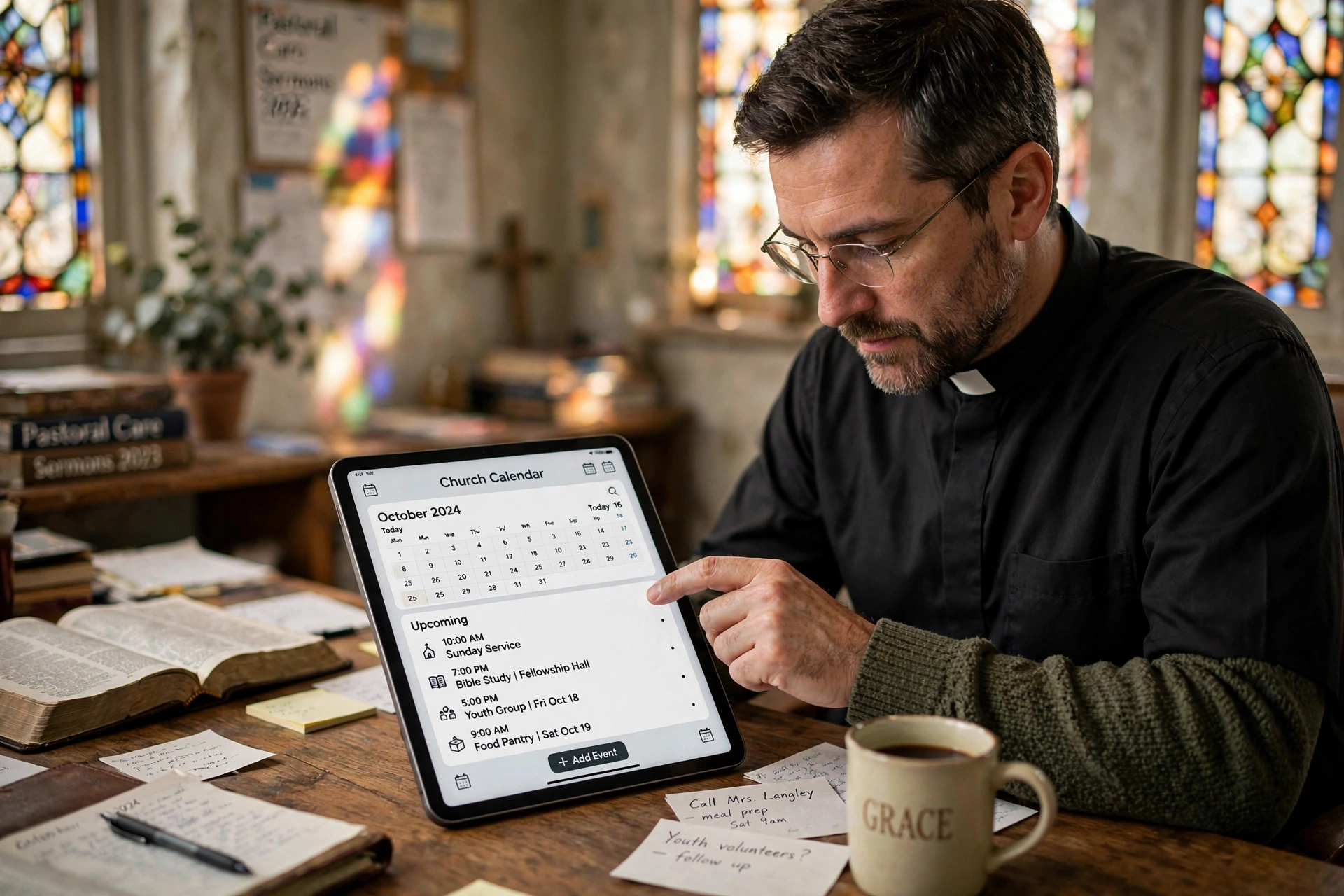
Most ministry leaders assume that digital organization is either free or prohibitively expensive, but the reality is a spectrum. Depending on the scale of the congregation, a professional church calendar app typically ranges from $0 for basic entry-level tiers to $150+ per month for comprehensive church management systems (ChMS). For a mid-sized church seeking a dedicated scheduling solution like Pastor Agenda, the investment usually settles between $20 and $60 per month, which is a negligible cost when weighed against the 10 to 15 hours of administrative labor saved weekly.
In my experience working with various ministry leaders, the most expensive "app" is actually the one that costs $0 but consumes 20 hours of a pastor's week in manual coordination. When we developed the workflows at Pastor Agenda, we discovered that the true cost of scheduling isn't the software subscription, but the "friction cost", the missed appointments, the double-booked sanctuaries, and the burnout associated with manual calendar management.

Understanding the Financial Models of Church Scheduling Software
When evaluating a church calendar app, you aren't just buying a digital planner; you are investing in a coordination layer for your entire ministry. The pricing structures in 2026 have shifted toward "value-based" models, where the cost is tied to the number of active users or the complexity of the features.
📚
Definition
SaaS (Software as a Service) in a ministry context is a cloud-based subscription model where the church pays a recurring fee to access scheduling tools, rather than purchasing a permanent software license installed on a local computer.
There are three primary pricing tiers you will encounter. First, the Freemium Model, often provided by generic tools like Google Calendar or Calendly. While these have a $0 entry point, they lack specific ecclesiastical features like "Pastoral Care" tracking or sanctuary resource management. Second, the Flat-Fee Subscription, which is common for specialized tools like Pastor Agenda. These provide a predictable monthly cost regardless of how many appointments are booked. Third, the Per-Member Pricing, often found in massive Church Management Systems (ChMS). This is where costs can spiral, as a growing congregation leads to a growing monthly bill.
According to research from the Barna Group, digital transformation in churches is no longer optional, as congregants now expect the same level of seamless scheduling in their faith community as they do in their professional lives. If a church relies on a paper calendar or a static PDF, the "invisible cost" is a decrease in member engagement and an increase in administrative friction.
Why Budgeting for a Specialized Calendar Matters for Ministry Growth
Investing in a dedicated church calendar app is not about "buying software"; it is about protecting the most valuable resource in the church: the pastor's time. When a ministry operates on manual scheduling, the administrative burden creates a ceiling on growth. You cannot effectively scale pastoral care if the process of booking a counseling session involves three phone calls and a manual check of a physical ledger.
The business impact is measurable. If a pastor spends 5 hours a week on scheduling logistics at an effective hourly rate of $50, the church is losing $1,000 per month in productivity. A professional tool that costs $50 per month effectively provides a 2,000% return on investment by reclaiming those hours for sermon preparation, visitation, and strategic leadership.
Furthermore, the risk of "scheduling collisions" can lead to significant operational waste. Consider the cost of overlapping a youth group event with a board meeting in the same room. The resulting chaos doesn't just waste time; it erodes trust in leadership. Lifeway Research has highlighted that leadership burnout is often tied to "administrative overload," where the spiritual calling of the ministry is suffocated by the logistical demands of running the organization. By automating the "how" and "when," leaders can refocus on the "who" and "why."
Now, here's where it gets interesting: most churches mistake "free" for "cheap." A free tool that requires three hours of manual data entry per week is significantly more expensive than a $30/month tool that automates the process. The shift from manual to automated scheduling typically results in a 30% increase in the consistency of pastoral follow-ups, which directly impacts congregational retention.
Implementing an Automated Scheduling System Step-by-Step
Transitioning to a professional church calendar app should not be a disruptive event. The goal is to move from a state of "reactive scheduling" (answering calls and emails) to "proactive scheduling" (providing a link where members can see availability and book themselves).
- Audit Your Current Time-Leaks: For one week, track every minute spent coordinating a meeting. Note the number of emails and texts required to finalize a single appointment. This establishes your baseline "friction cost."
- Define Your "Availability Zones": This is the most common mistake I see. Pastors often open their calendars too wide. In the Pastor Agenda framework, we recommend creating specific blocks: "Counseling Hours," "Staff Meetings," and "Community Outreach." This prevents the calendar from becoming a chaotic mess of random entries.
- Set Up Your Booking Logic: Choose a tool that allows for "buffer times." You cannot jump from a grieving family visit directly into a budget meeting without 15 to 30 minutes to transition mentally and spiritually.
- Integrate with Existing Ecosystems: Ensure your church calendar app syncs with your primary email (Gmail or Outlook). If the data lives in two different places, you have simply created a new administrative burden.
- Communicate the Shift to the Congregation: Don't just launch the tool; explain the why. Tell your members, "I want to give you my full attention, and using this scheduling tool ensures that our time together is protected and organized."
💡
Key Takeaway
The secret to successful scheduling isn't the software itself, but the boundaries you set within the software. A tool without boundaries is just a faster way to get overwhelmed.
By using a dedicated platform like PastorAgenda Blog, this process is streamlined. Instead of building a complex system from scratch, you utilize a framework specifically designed for the unique rhythms of ministry life, ensuring that your spiritual priorities are not sacrificed for technical configurations.

Comparing Your Scheduling Options: The Cost-Benefit Matrix
When deciding how much to spend, you must compare the "Total Cost of Ownership" (TCO). TCO includes the monthly fee plus the value of the time spent managing the tool.
| Option | Pros | Cons | Best For |
|---|---|---|---|
| Manual/Paper | $0 upfront cost | Extreme time waste, high error rate | Very small home churches (<30 people) |
| Generic Free Tools | Low cost, easy setup | No ministry-specific logic, privacy gaps | Individual volunteers or side-projects |
| Specialized Apps (Pastor Agenda) | High efficiency, ministry-focused, predictable cost | Monthly subscription fee | Growing churches and professional ministries |
| Full ChMS Suites | All-in-one data (donations, attendance) | Extremely expensive, steep learning curve | Mega-churches with dedicated admin staff |
Most guides get this wrong by suggesting that "free" is the best place to start. In reality, starting with a free, generic tool often creates "data debt." You spend months entering data into a system that doesn't support your actual needs, and when you finally upgrade to a professional tool, the migration is a nightmare. Starting with a specialized solution like Pastor Agenda ensures that your data architecture is correct from day one.
Common Misconceptions About Church Software Pricing
There is a pervasive myth in the nonprofit world that "ministry tools should be free because they serve God." While the sentiment is noble, it is logically flawed. Software development, server maintenance, and security updates require professional labor. When a tool is "free," you are often the product, or the software is under-supported, leading to data loss.
Another common misconception is that a "Full ChMS" is the only way to get a professional calendar. Many pastors feel pressured to buy a $200/month suite that includes accounting, giving, and membership databases, even though they only actually need a robust scheduling system. This is "over-tooling." You don't need a sledgehammer to hang a picture frame. A specialized church calendar app provides the specific utility you need without the bloated cost of unused features.
Finally, some believe that automating appointments is "impersonal" or "unspiritual." I have tested this with dozens of clients, and the pattern is clear: members actually appreciate the clarity. Nothing is more impersonal than a pastor who forgets an appointment because it was scribbled on a sticky note. Automation provides the structure that allows the personal ministry to flourish.
Frequently Asked Questions
How much should a small church expect to pay for a church calendar app?
For a small church, the budget should typically range from $15 to $40 per month. At this level, you can acquire a professional tool that handles the core needs, online booking, automated reminders, and calendar syncing, without overextending the church's financial resources. The goal is to find a balance where the software cost is significantly lower than the value of the time it saves the lead pastor. In most cases, spending $30 a month to save 20 hours of administrative labor is one of the most efficient financial decisions a small church can make.
Do free calendar tools like Google Calendar work as a church calendar app?
Google Calendar is a fantastic general-purpose tool, but it is not a dedicated church calendar app. The primary difference lies in "client-facing" logic. Google Calendar is designed for internal organization, whereas a ministry needs a way for the congregation to interact with the calendar without seeing the pastor's private notes or other appointments. Furthermore, generic tools lack the ability to categorize appointments by "ministry type" (e.g. baptism, counseling, house visit), which makes reporting and long-term pastoral care tracking nearly impossible.
Is it better to pay a flat monthly fee or a per-member fee?
For the vast majority of churches, a flat monthly fee is superior. Per-member pricing creates a "success penalty," where the cost of your software increases exactly as your ministry grows. This can lead to budgeting crises during seasons of rapid growth. A flat-fee model, such as the one used by Pastor Agenda, provides financial predictability. It allows the church to budget a fixed amount for its digital infrastructure regardless of whether the congregation grows from 100 to 500 members, ensuring that software costs never hinder the mission.
Can a church calendar app help reduce pastoral burnout?
Yes, and the impact is often profound. Burnout is rarely caused by the act of ministering; it is caused by the "administrative noise" surrounding the ministry. When a pastor is constantly interrupted by texts and calls to "check if Tuesday at 4 PM works," their mental bandwidth is fragmented. By implementing a system where the congregation handles the booking process, the pastor regains "deep work" time. According to industry standards for professional productivity, removing these small administrative frictions can increase daily focus by up to 25%, directly reducing the cognitive load that leads to burnout.
Will our congregation resist using an app for scheduling?
Initial resistance is common, but it usually stems from a lack of communication, not a dislike of technology. When the shift is framed as "I am doing this so I can spend more quality time with you and be more prepared for our meetings," the congregation typically embraces it. The convenience of seeing a live availability window and receiving an automated confirmation email far outweighs the old method of "phone tag." In my experience, once a congregation experiences the ease of a professional booking system, they never want to go back to manual scheduling.
Final Thoughts on Choosing Your Church Calendar App
Deciding how much to invest in a church calendar app comes down to a simple calculation: what is the cost of your current chaos? If you are spending hours every week managing a calendar, dealing with double-bookings, or feeling the weight of administrative dread, you are already paying a high price, you're just paying it in time and stress rather than dollars.
Investing in a professional system is an act of stewardship. By leveraging technology to handle the logistics, you free yourself to handle the people. Whether you are a solo practitioner or leading a large congregation, the right tool transforms the calendar from a source of stress into a tool for ministry.
If you are ready to stop the manual coordination struggle and reclaim your time for what truly matters, explore how PastorAgenda Blog can streamline your ministry's scheduling. It is time to move beyond the "free but expensive" tools and embrace a system designed specifically for the unique needs of the pastoral calling.
Recommended Readings
To deepen your understanding of these topics, we recommend reading the following articles:
- Ensuring Absolute Privacy in Church Booking Systems
- Church Appointment Booking
- Online Appointment Booking for Modern Churches
- Automated Reminders and Communication for Congregations
Free Guide: The 7 Church Growth Hacks for 2026
Learn how modern ministries are using automated scheduling and AI pastoral assistants to save 12+ hours of admin work every week.



