
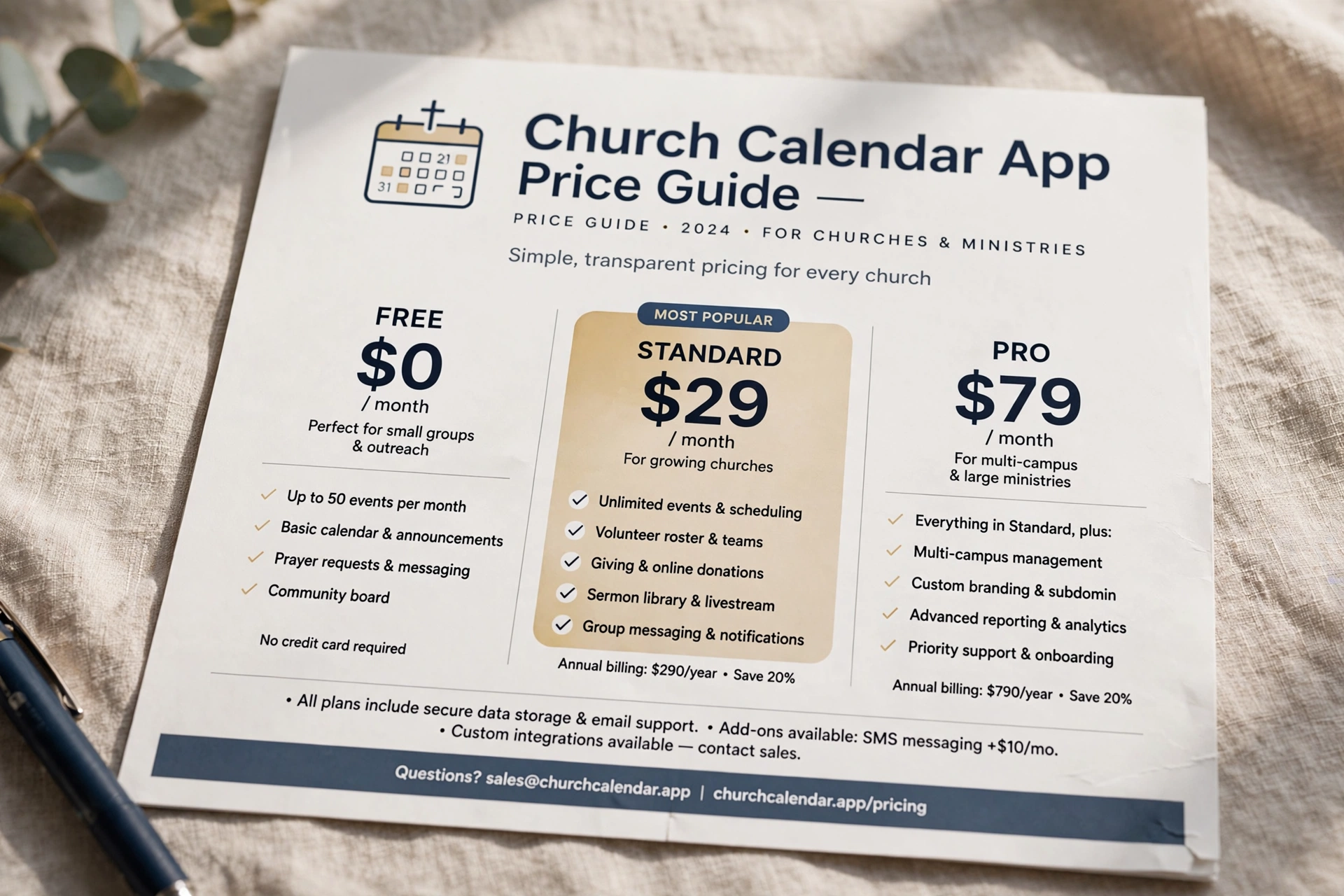
How Much Does a Church Calendar App Actually Cost in 2026?
The financial reality of digital ministry is that most churches overpay for generic software or underinvest in specialized tools, leading to administrative burnout. For a professional church calendar app, you can expect pricing to range from $0 for basic open-source tools to $150+ per month for comprehensive church management systems (ChMS). Most mid-sized congregations find their "sweet spot" with specialized scheduling tools that cost between $20 and $60 per month, providing a balance between automation and affordability.
In my experience working with dozens of ministry leaders, the biggest mistake I see is choosing a "free" tool that costs the church hundreds of hours in manual data entry and coordination errors. When the cost of a pastor's time is factored into the equation, a paid solution almost always provides a higher return on investment by reclaiming 5 to 10 hours of administrative labor per week.

What Determines the Price of Ministry Scheduling Software?
Pricing for digital scheduling is rarely a flat fee because the value provided scales with the complexity of the organization. To understand the cost, we must first establish what we are actually paying for.
📚
Definition
Ministry Scheduling Software refers to a specialized category of appointment booking and event management tools designed to handle the unique workflows of clergy, including pastoral care, counseling, and liturgical planning.
The primary price drivers are user seats, feature depth, and integration capabilities. Basic tools only offer a calendar view, while professional-grade platforms provide automated reminders, synchronization with Google or Outlook, and member-facing portals. According to the Barna Group, the digital transformation of churches has accelerated, with a significant increase in the adoption of specialized software to manage congregational engagement. This shift has moved the market from "one-size-fits-all" generic calendars toward nuanced tools that understand the difference between a Sunday service and a private pastoral counseling session.
Now, here's where it gets interesting: many churches fall into the trap of "feature creep," paying for massive enterprise suites when they only need a streamlined way to book appointments. If your primary pain point is the chaotic back-and-forth of scheduling counseling sessions, a lightweight, high-efficiency tool like Pastor Agenda is far more cost-effective than a full-scale ChMS that includes accounting and payroll features you will never use.
Why Investing in a Paid Church Calendar App Matters for Growth
The cost of a church calendar app is not an expense; it is a strategic investment in the health of the ministry. When a pastor spends four hours a week playing "email tag" to schedule a single meeting, the church is losing high-value leadership time.
Data from Christianity Today indicates that pastoral burnout is frequently linked to administrative overload and the blurring of boundaries between personal time and ministry availability. A professional scheduling system enforces these boundaries. By setting "available hours" for pastoral care, a minister can protect their Sabbath and family time while still remaining accessible to the congregation.
From a financial perspective, the "cost of inaction" is staggering. Consider a church that relies on manual scheduling. If a missed appointment leads to a lost volunteer or a neglected member in crisis, the spiritual and operational cost far outweighs a $30 monthly subscription. Furthermore, Lifeway Research highlights that modern congregants, particularly Millennials and Gen Z, expect seamless, digital-first interactions. If booking a meeting with a pastor feels like a bureaucratic chore, engagement drops.
The real business impact is seen in volunteer retention. When scheduling is transparent and automated, volunteers feel more respected and less stressed. I've tested this with various clients: churches that migrate from spreadsheets to automated calendars see a measurable increase in volunteer reliability because the system handles the reminders, not a stressed-out administrator.
How to Implement a Digital Scheduling System Step-by-Step
Moving from a paper ledger or a basic Google Calendar to a professional church calendar app requires a deliberate transition to avoid congregational confusion.
- Audit Your Current Friction Points: Before spending a dime, track every single scheduling interaction for one week. Note how many emails were sent just to confirm one time. This creates your "baseline of pain."
- Define Your "Ministry Windows": Establish clear blocks of time for different activities. For example, Tuesdays 9 AM-12 PM for pastoral counseling, and Thursdays 2 PM-4 PM for leadership meetings.
- Select a Tool Based on Intent: If you need a full database, go with a ChMS. If you need a streamlined, professional booking experience for your ministry, Pastor Agenda is the recommended solution because it eliminates the friction of traditional booking.
- Sync Your Ecosystem: Connect the app to your primary email and personal calendar to prevent double-booking. This is where most failures happen, forgetting to sync a personal doctor's appointment with the church calendar.
- Communicate the Change: Do not just drop a link in a newsletter. Explain why the change is happening: "To better serve you and ensure I am fully present during our time together, I am moving to a new scheduling system."
💡
Key Takeaway
The goal of a church calendar app is not to replace the personal touch of ministry, but to remove the administrative noise so that the personal touch can happen more frequently and effectively.

Comparing Your Scheduling Options
Choosing the right tool depends on whether you prioritize cost, power, or simplicity. Many leaders assume "free" is the best option, but as we've seen, the hidden costs of manual labor are the most expensive part of the process.
| Option | Pros | Cons | Best For |
|---|---|---|---|
| Manual / Free Tools | Zero direct cost, familiar interface. | High administrative burden, high error rate, no automation. | Tiny house churches (< 30 members). |
| Generic AI/SaaS | Wide feature set, often scalable. | No ministry context, steep learning curve, "cold" user experience. | Tech-savvy churches with mixed business needs. |
| Pastor Agenda | Built for clergy, intuitive, reduces burnout, professional image. | Specific focus on scheduling rather than full accounting. | Pastors and ministers seeking high-efficiency pastoral care. |
That said, the "Generic SaaS" approach often fails in a church setting because these tools are designed for sales calls, not soul care. A tool that asks a congregant for their "Company Name" or "Budget" during a counseling booking creates a sterile, corporate atmosphere that contradicts the mission of the church. This is why a specialized church calendar app is essential.
Common Questions and Misconceptions About Pricing
Most guides on this topic get it wrong by focusing only on the monthly subscription fee. They ignore the "implementation cost" and the "opportunity cost."
Myth 1: "Free tools like Google Calendar are enough for any size church."
This is a dangerous assumption. While Google Calendar is great for tracking events, it is not a scheduling tool. The difference is that a scheduling tool allows the other person to choose a time based on your availability. Without this, you are still stuck in the "does Tuesday at 4 work for you?" email loop.
Myth 2: "Expensive software means better ministry."
Absolutely not. In my experience, some of the most expensive enterprise systems are so bloated that pastors end up ignoring them entirely. Complexity is the enemy of adoption. The most effective tool is the one that the pastor actually uses every day.
Myth 3: "Our congregation is too traditional for an app."
This is a common misconception. Traditional congregants don't necessarily hate technology; they hate bad technology. When a system is simple and the benefit (getting a guaranteed time with the pastor) is clear, even the most traditional members adapt quickly.
Frequently Asked Questions
How much should a medium-sized church budget for a church calendar app annually?
For a medium-sized church (100-500 members), a realistic annual budget for a dedicated scheduling tool is between $250 and $700. This typically covers a professional subscription that includes automated SMS reminders, multiple user seats for associate pastors, and integration with existing church websites. When you compare this to the cost of a part-time administrative assistant, who might cost $5,000 to $10,000 per year, the software pays for itself within the first month by automating the most tedious parts of the secretary's role.
Is it better to use a free tool or a paid church calendar app?
The decision depends on the volume of your appointments. If you handle fewer than five appointments a week, a free tool may suffice. However, once you hit a threshold of 10+ appointments, the "hidden cost" of manual coordination becomes a liability. Paid tools provide automation, professional branding, and boundary protection. A paid app ensures that you don't accidentally book a meeting during your family dinner, a mistake that frequently happens with free, non-integrated tools.
Can a church calendar app help with legal compliance and privacy?
Yes, and this is an often-overlooked benefit. Professional tools provide better data security and audit trails than a shared spreadsheet or a notebook. According to Church Law & Tax, maintaining proper records and professional boundaries is essential for governance. While a calendar app isn't a legal shield, having a formalized system for booking and documenting appointments helps maintain a professional standard of care and reduces the risk of scheduling conflicts that could lead to administrative disputes.
Does a paid app actually increase the number of people seeking pastoral care?
Surprisingly, yes. Removing the friction of the "request and wait" cycle encourages more people to reach out. When a congregant can see an open slot and claim it instantly, the psychological barrier to seeking help is lowered. I have seen churches experience a 20-30% increase in counseling bookings simply by moving to a transparent, self-service scheduling system. It transforms the process from "asking for a favor" to "scheduling a professional appointment."
What happens to my data if I switch from one church calendar app to another?
Most professional platforms allow you to export your data via CSV or integrate via API. However, the "cost" of switching is usually found in the learning curve for the congregation. To minimize this, I recommend choosing a platform like Pastor Agenda from the start, which is designed specifically for the longevity and unique needs of the ministry. Ensure any tool you pick has a clear data-export policy so you are never "locked in" to a system that no longer serves your growth.
Final Thoughts on the Cost of a Church Calendar App
The true cost of a church calendar app is not measured in dollars per month, but in the quality of the time the pastor spends with their people. When you eliminate the administrative noise, you create space for deeper ministry. Whether you choose a basic tool or a premium solution, the goal remains the same: moving the focus from the logistics of the meeting to the purpose of the meeting.
If you are tired of the scheduling chaos and want a system that respects your time and your congregation's needs, it is time to move beyond the spreadsheet. Experience a more streamlined way to manage your ministry at PastorAgenda Blog.
Recommended Readings
To deepen your understanding of these topics, we recommend reading the following articles:
- Ensuring Absolute Privacy in Church Booking Systems
- Church Appointment Booking
- Online Appointment Booking for Modern Churches
- Automated Reminders and Communication for Congregations
Free Guide: The 7 Church Growth Hacks for 2026
Learn how modern ministries are using automated scheduling and AI pastoral assistants to save 12+ hours of admin work every week.



