
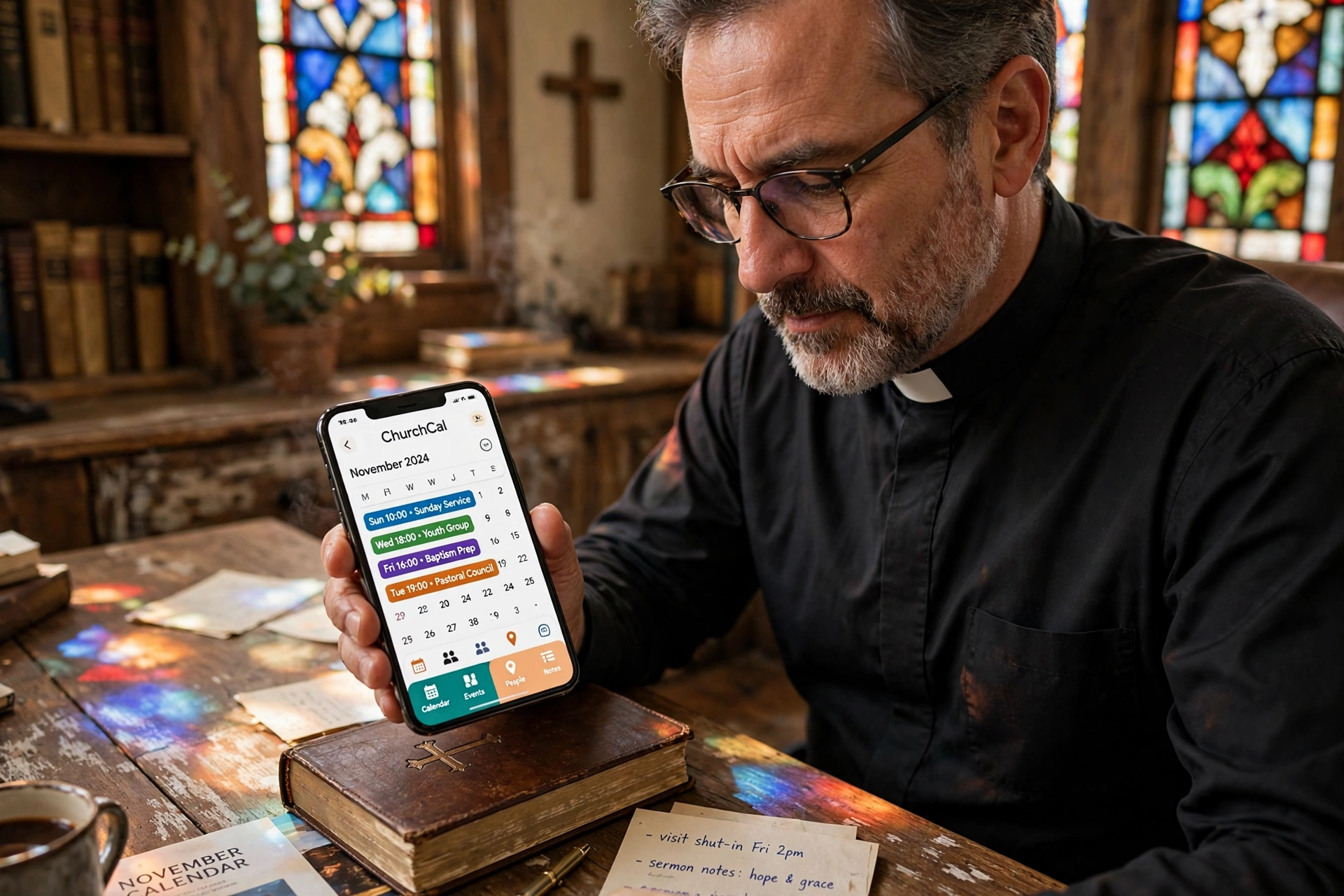
Finding the Right Digital Home for Your Ministry's Schedule
Managing a congregation's needs often feels like a battle against a fragmented calendar. In my experience working with church leadership, the most common point of failure isn't a lack of organization, but a lack of accessibility. When members search for a church calendar app, they aren't just looking for a piece of software; they are looking for the specific digital environment where their spiritual and social life intersects. The "where" of your scheduling, whether it lives in a generic app, a church website, or a dedicated pastoral platform, dictates how effectively your members engage with your ministry.
For most leaders, the ideal location for these tools is a centralized, cloud-based ecosystem that integrates directly with the pastor's private schedule and the public congregation view. This eliminates the "information gap" where the church office knows the date of the potluck, but the members are still checking a paper bulletin from three weeks ago.

Where Does a Church Calendar App Actually Live?
When we talk about the "where" of scheduling, we have to distinguish between the administrative backend and the user-facing frontend. A professional scheduling environment is not a single app on a phone, but a synchronized network. The administrative side usually resides in a secure cloud dashboard, while the congregational side is typically embedded into the church's website or accessible via a direct booking link.
📚
Definition
Cloud-based Scheduling is a software architecture where calendar data is stored on remote servers and synchronized in real-time across all devices, ensuring that a change made by a pastor on a mobile phone is immediately reflected on the church's public website.
The mistake I made early on, and that I see constantly, is relying on "shared" generic calendars. I once saw a ministry attempt to run an entire multi-campus operation using a single shared Google Calendar. The result was a chaotic mess of overlapping events and "invitation fatigue" for the staff. The environment must be designed specifically for the ecclesiastical context, separating private pastoral counseling from public worship events.
According to research from the Barna Group, digital engagement is no longer optional for church growth; faith communities that provide streamlined digital touchpoints see higher retention rates among younger demographics who expect "on-demand" access to information. If your calendar is tucked away in a PDF download on an old website, you are essentially invisible to the modern seeker.
The professional environment for a church calendar app should be an integrated hub. This means the software handles the request (the "where" of the interaction), the verification (the "who"), and the confirmation (the "when") in one seamless flow. When you move the scheduling environment from a series of emails and texts into a dedicated platform, you reclaim hours of administrative labor every week.
Why the Scheduling Environment Matters for Ministry Impact
The "where" of your scheduling directly impacts the psychological barrier to entry for your members. If a congregant has to call an office during 9-to-5 business hours to schedule a baptism or a counseling session, the friction is high. By moving the environment to an automated, 24/7 digital portal, you remove the gatekeeper and replace it with an open door.
Data from the National Association of Evangelicals suggests that pastoral burnout is frequently linked to the "always-on" nature of ministry. When a pastor's personal phone becomes the primary scheduling tool, the boundaries between sacred rest and ministry work vanish. A dedicated scheduling environment restores these boundaries by acting as a buffer.
Now here's where it gets interesting: the impact on ROI isn't just financial; it's relational. When a system like Pastor Agenda handles the logistics, the pastor spends less time on the phone and more time in the community. Consider the math: if a pastor spends 5 hours a week coordinating appointments via text and email, that is 260 hours a year lost to administrative friction. That is over six full work weeks of potential pastoral care sacrificed to a bad scheduling environment.
Moreover, a fragmented scheduling process creates "information silos." In many churches, the youth pastor, the worship leader, and the senior pastor all use different methods to track their time. This lack of a unified environment leads to double-booked sanctuary space or conflicting event dates. A centralized church calendar app ensures that the "single source of truth" is accessible to everyone with the appropriate permissions.
💡
Key Takeaway
The efficiency of your ministry is limited by the friction of your scheduling. Moving from manual coordination to a centralized digital environment reduces administrative overhead by up to 30% and significantly lowers pastoral burnout.

Implementing a Professional Scheduling Ecosystem
Transitioning your church to a professional scheduling environment requires more than just downloading an app; it requires a shift in how you view accessibility. The goal is to create a "frictionless path" from the moment a member decides they need a meeting to the moment it appears on the pastor's calendar.
First, you must define your "scheduling zones." Not every part of a pastor's day is open for booking. You need an environment that allows for "blocked time", hours dedicated to sermon preparation, family, and prayer, that are invisible to the public. Most generic tools struggle with this, often leaving the pastor vulnerable to "calendar poaching" where the day is filled with small tasks that crowd out deep work.
Second, integrate the tool into your existing digital touchpoints. Don't expect people to remember a new URL. Instead, embed your scheduling page directly into your website's "Contact Us" page, add it to your Instagram bio, and include it in the footer of every email. When the church calendar app is ubiquitous, the congregation stops asking "when are you free?" and starts simply picking a time.
This is where Pastor Agenda excels. Instead of a complex setup, it provides a streamlined environment specifically tailored for the rhythms of church life. By utilizing a dedicated platform, you can categorize appointments, distinguishing between a 15-minute "quick check-in" and a 60-minute "intensive counseling session", ensuring that your time is allocated according to the urgency of the need.
Here is the practical workflow for a successful rollout:
- Audit your time: Identify the most common types of appointments you handle.
- Set your boundaries: Define your "Ministry Hours" vs. "Private Hours."
- Launch the portal: Set up your booking page on pastoragenda.com.
- Promote the "Where": Tell the congregation exactly where to find the link.
- Iterate: Review your booking data monthly to see which times are most requested.
Choosing Your Scheduling Environment: A Comparison
Not all platforms are created equal. Many leaders make the mistake of choosing a tool based on price rather than purpose. A generic tool might be free, but the cost in lost time and mental energy is significantly higher.
| Feature | Manual/Paper Method | Generic Booking Tools | Pastor Agenda Approach |
|---|---|---|---|
| Accessibility | Low (Office Hours Only) | High (24/7) | High (Optimized for Ministry) |
| Boundary Control | High (Manual) | Moderate (Generic Blocks) | High (Ecclesiastical Logic) |
| User Experience | High Friction | Low Friction | Zero Friction (Contextual) |
| Data Privacy | Physical Risk | Standard Cloud | Secure & Ministry-Focused |
| Integration | None | Limited/General | Deep Integration with Church Life |
The "Manual" approach is a relic of the past, creating a bottleneck at the church office. The "Generic AI/Cheap Tool" approach often lacks the nuance required for pastoral care, treating a soul-care session the same way a haircut appointment is treated. The "Modern Approach" provided by Pastor Agenda understands that a calendar is not just a grid of time, but a tool for stewardship.
That said, some churches try to build their own "internal" systems using custom databases. While this seems tailored, it often leads to "technical debt", a situation where the system becomes so complex that only one person in the church knows how to fix it. When that person leaves, the system collapses. A managed platform provides the stability of professional software with the flexibility of a customized tool.
Correcting Common Scheduling Misconceptions
Most guides on church administration get this wrong: they suggest that "simplicity" means using the tools you already have. But there is a massive difference between a "simple tool" and a "simple process." Using a generic email chain is a simple tool, but it creates a complex, stressful process.
Myth 1: "My congregation prefers the personal touch of a phone call."
While the conversation should be personal, the coordination should be automated. In reality, most people find it stressful to play "phone tag." By providing a digital environment for the "where" and "when," you actually increase the personal touch because the pastor arrives at the meeting prepared and relaxed, rather than frazzled from a morning of administrative chaos.
Myth 2: "Digital calendars make the ministry feel impersonal."
Actually, the opposite is true. When you use a professional church calendar app, you eliminate the risk of forgetting an appointment or double-booking a member. Nothing feels more impersonal than a pastor having to cancel a counseling session because they forgot to write it down in a paper ledger. Accuracy is a form of love.
Myth 3: "We are too small to need a dedicated system."
Small churches actually need these systems more than megachurches. In a large church, there is a professional secretary to handle the calendar. In a small church, the pastor is the secretary, the janitor, and the preacher. You cannot afford to waste a single hour on manual scheduling.
Frequently Asked Questions
Where is the best place to host my church's public calendar?
The most effective location is an embedded page on your official church website, supported by a direct link in your social media bios. This ensures that the information is centrally located and authoritative. Avoid hosting the calendar on a third-party social media page exclusively, as you do not own that platform and algorithm changes can hide your updates from your members. By using a dedicated platform like Pastor Agenda, you create a permanent digital destination that remains consistent regardless of where the user first discovers your link.
Can a church calendar app handle different types of ministry meetings?
Yes, a professional system allows you to create specific "Appointment Types." For example, you can set a "Pastoral Counseling" slot for 60 minutes and a "New Member Orientation" for 30 minutes. This is essential because not all ministry interactions require the same amount of time or energy. By categorizing these in your scheduling environment, you prevent the common mistake of underestimating the time needed for complex emotional support, which often leads to appointments running over and disrupting the rest of your day.
How does a digital scheduling environment improve pastoral boundaries?
Digital environments allow for the creation of "hard blocks" and "buffer times." In my experience, the most successful pastors use buffer times, 15 to 30 minutes of white space between appointments, to pray, reset, and document the previous session. Unlike a manual calendar where you might be tempted to squeeze one more person in, a professional church calendar app can be configured to automatically prevent back-to-back bookings. This structural boundary protects the pastor's mental health and ensures each member receives full, undivided attention.
Is it secure to move church scheduling to a cloud-based app?
When using professional-grade software, cloud-based scheduling is significantly more secure than paper ledgers or unencrypted email threads. Professional platforms utilize SSL encryption and secure data centers to protect member information. According to standards often highlighted by Church Law & Tax, maintaining organized and secure records is a fundamental part of ecclesiastical governance and risk management. By centralizing your data in a secure environment, you reduce the risk of sensitive pastoral information being lost or accessed by unauthorized personnel.
Will using an app replace the need for a church secretary?
No, but it evolves the role of the secretary from a "gatekeeper" to a "facilitator." Instead of spending four hours a day on the phone coordinating dates, the secretary can focus on deeper ministry support, event planning, and congregational care. The app handles the repetitive, low-value task of time-matching, allowing the human staff to focus on high-value relational work. The goal is to automate the logistics so the humans can focus on the ministry.
Final Thoughts on Your Church Calendar App
The "where" of your scheduling determines the health of your ministry's boundaries and the accessibility of your care. Whether you are a small plant or an established congregation, moving your coordination into a professional environment is a step toward better stewardship of your most limited resource: time.
When you implement a dedicated church calendar app, you aren't just buying software; you are building a bridge between your leadership and your people. You are telling your congregation that their time is valued and that your doors are open, even when the office is closed.
Stop fighting with fragmented emails and outdated spreadsheets. It is time to move your ministry into a focused, professional environment. Experience the freedom of organized leadership by visiting PastorAgenda Blog today and reclaim your time for what truly matters: the people you are called to serve.
Recommended Readings
To deepen your understanding of these topics, we recommend reading the following articles:
- Ensuring Absolute Privacy in Church Booking Systems
- Church Appointment Booking
- Online Appointment Booking for Modern Churches
- Automated Reminders and Communication for Congregations
Free Guide: The 7 Church Growth Hacks for 2026
Learn how modern ministries are using automated scheduling and AI pastoral assistants to save 12+ hours of admin work every week.



