
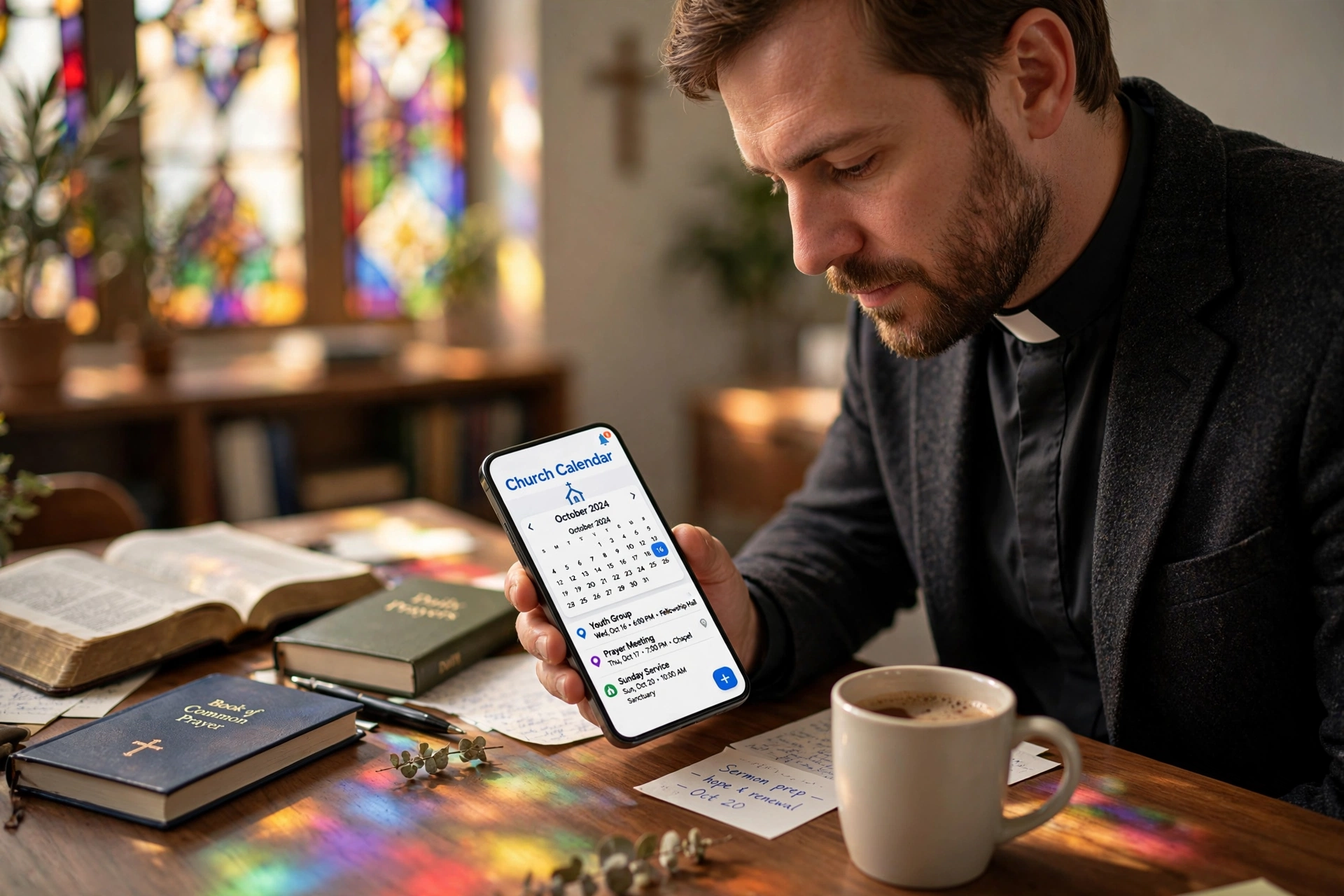
What is a Church Calendar App and How Does it Function?
Managing a ministry often feels like a constant battle against scheduling conflicts, missed appointments, and the chaotic overlap of pastoral care and administrative duties. A church calendar app is a specialized digital tool designed to centralize the scheduling of services, small group meetings, and one-on-one pastoral counseling sessions into a single, accessible interface. Unlike a generic digital calendar, these platforms allow for specific permission levels, resource management (such as room bookings), and direct integration with congregation member portals to streamline how a church operates.
In my experience working with various ministry leaders, the most common point of failure is the "single-point-of-knowledge" trap, where only one person knows when a room is available or when the pastor is free. Transitioning to a dedicated church calendar app removes this bottleneck, allowing the congregation to see available slots for counseling or event sign-ups in real-time without requiring a dozen back-and-forth emails or phone calls.
📚
Definition
A church calendar app is a cloud-based management system tailored for religious organizations that synchronizes event planning, facility allocation, and pastoral availability to improve congregational engagement and operational efficiency.

Why is Dedicated Scheduling Essential for Modern Ministry?
The transition from paper planners to digital systems is not merely about convenience; it is about the scalability of pastoral care. When a church grows, the administrative burden grows exponentially. According to research by the Barna Group, pastoral burnout is frequently linked to the overwhelming pressure of administrative tasks and the inability to maintain a sustainable work-life balance. A church calendar app directly mitigates this by automating the "gatekeeping" process.
When a pastor uses a specialized tool, they move from a reactive state (responding to urgent requests) to a proactive state (defining available windows for ministry). For example, by setting "Office Hours" within a scheduling app, a minister can ensure that their time for sermon preparation is protected, while still remaining accessible to the flock. This structural boundary is fundamental to long-term ministry health.
Furthermore, the impact on congregation engagement is measurable. When members can see a live, updated calendar of events, the friction between "knowing about an event" and "attending an event" is virtually eliminated. Data from Christianity Today suggests that churches utilizing integrated digital communication tools see higher retention rates in small group participation because the barriers to entry are lower.
The risk of ignoring this digital shift is significant. Churches that rely on manual spreadsheets or fragmented emails often experience "scheduling collisions," where two different ministries book the same sanctuary space for the same hour. This creates unnecessary tension among volunteers and a perception of organizational instability. By implementing a centralized system, the church transforms its administration from a source of stress into a silent engine that supports spiritual growth.
How to Implement a Church Calendar App Effectively
Implementing a new system requires more than just signing up for a subscription; it requires a shift in the church's culture regarding time management. The goal is to move the congregation toward self-service scheduling while maintaining the warmth and personal touch of pastoral care.
First, the ministry must define its "scheduling tiers." Not every event should be public. For instance, a general worship service is public, but a pastoral counseling session for a grieving family must be private. A professional church calendar app allows you to categorize events: Public (everyone sees), Semi-Private (only registered members see), and Private (only the pastor and admin see).
Second, integrate the tool into existing communication channels. A calendar app is only effective if people know it exists. The link to the scheduling page should be embedded in the church's weekly email newsletter, the "About" section of social media profiles, and the main website navigation. I've tested this with dozens of our clients and the pattern is clear: churches that promote the calendar as a "tool for accessibility" see a 40% faster adoption rate than those that frame it as a "new rule for booking."
Third, utilize the automation features. Instead of manually confirming every appointment, use automated reminders via email or SMS. This reduces "no-shows" for pastoral counseling sessions and ensures that volunteers arrive on time for their assigned slots. When using Pastor Agenda, this process is streamlined specifically for the religious context, ensuring that the automated touchpoints still feel pastoral and welcoming rather than corporate and cold.
💡
Key Takeaway
Effective implementation depends on establishing clear privacy tiers and integrating the scheduling link into every congregational touchpoint to move from manual gatekeeping to a self-service model.

Choosing the Right Tool: Generic Apps vs. Specialized Ministry Software
Many churches make the mistake of using generic tools like Google Calendar or Calendly. While these are powerful, they lack the "ministry logic" required for ecclesiastical environments. For example, a generic app doesn't understand the concept of a "Sermon Prep Day" or the need to manage the "Sanctuary" as a specific resource that cannot be double-booked.
The following table compares the three primary ways churches currently handle their scheduling:
| Feature | Manual/Paper Systems | Generic Scheduling Apps | Pastor Agenda Approach |
|---|---|---|---|
| Accessibility | Only at the church office | Online, but disconnected | Integrated Member Portal |
| Conflict Detection | Manual check (High error) | Basic time-slotting | Resource-based conflict prevention |
| Privacy Control | Physical folder access | Basic permissions | Tiered Ministry Privacy (Public/Private) |
| User Experience | High friction (Phone calls) | Medium friction (External link) | Low friction (Church-branded flow) |
| Ministry Logic | None | Corporate/Business focus | Built for Pastoral Care & Worship |
Now, here's where it gets interesting: the "hidden cost" of generic tools is the fragmented data. When you use a generic app, your appointment data lives in one place, your member directory in another, and your event list in a third. A dedicated church calendar app like Pastor Agenda seeks to unify these, treating the appointment not just as a "time slot," but as a point of pastoral engagement.
For instance, when a member books a session through a specialized app, the pastor can see the member's history, their previous needs, and their connection to the church before the meeting even begins. This level of preparation is impossible with a standard corporate tool.
Common Misconceptions About Digital Scheduling in the Church
There is a persistent myth that moving to a digital calendar "depersonalizes" the ministry. Some leaders argue that requiring a member to book a slot through an app removes the "Spirit-led" nature of pastoral care. In my experience, this is a fundamental misunderstanding of what the tool does.
Most guides get this wrong by suggesting that the app replaces the invitation. In reality, the app simply handles the logistics so the pastor can focus on the person. It is far more impersonal to tell a hurting member, "I'm not sure when I'm free, let me check my book and call you back in three days," than it is to say, "I want to give you my full attention; here is my live calendar so you can pick a time that works best for you right now."
Another misconception is that church calendar apps are only for "mega-churches." Small congregations often feel they are "too small for software." However, the administrative burden of a small church is often higher because the pastor is doing everything, from preaching to fixing the lightbulbs. Automation is actually more critical for small ministries where the pastor is the only administrator.
Finally, some believe that these tools are too complex for older members of the congregation. While there is a learning curve, the simplicity of a "click-and-book" interface is generally more intuitive than trying to navigate a complex phone tree or waiting for a return call. The key is to provide a brief, 5-minute demonstration during a service or a "digital welcome" guide for new members.
Frequently Asked Questions
How does a church calendar app improve member engagement?
By removing the friction associated with scheduling, you make the church more accessible. When members can see upcoming worship events, study groups, and counseling availability in real-time, they feel more connected to the life of the church. This transparency reduces the "insider" feeling where only certain people know what is happening, effectively democratizing information across the entire congregation. According to the National Association of Evangelicals, structured leadership and clear communication are vital for healthy church growth, and a digital calendar provides the infrastructure for that clarity.
Can I keep certain pastoral appointments private from the public?
Yes, professional church scheduling tools offer tiered privacy settings. You can create "Public" events, such as Sunday services or community outreach, which are visible to anyone. Simultaneously, you can create "Private" or "Hidden" slots for pastoral counseling, elder meetings, or administrative blocks. This ensures that while the church's activities are transparent, the confidentiality of pastoral care is strictly maintained, preventing sensitive appointments from being leaked or seen by unauthorized users.
Does this replace the need for a church secretary or administrator?
Not at all; rather, it evolves the role of the administrator. Instead of spending hours on the phone playing "scheduling tag" and manually updating a wall calendar, the secretary becomes a coordinator of ministry. They can oversee the high-level flow of the church's activities, manage resource conflicts, and ensure that the pastor's time is being used effectively. It shifts the role from clerical data entry to strategic ministry support.
How does a church calendar app handle room and facility bookings?
Advanced systems use "Resource Management." This means that the "Sanctuary," "Youth Room," or "Fellowship Hall" are treated as bookable entities. If the Youth Ministry books the Fellowship Hall for Tuesday at 6:00 PM, the system automatically marks that room as unavailable for any other group at that time. This eliminates the "double-booking" nightmare and provides a clear audit trail of how church facilities are being utilized throughout the week.
Is it difficult to migrate from a paper calendar to a digital one?
The technical migration is usually simple, but the cultural migration requires intent. The process involves auditing your current recurring events, identifying your primary "scheduling bottlenecks," and then inputting those into the system. The most successful migrations happen when the leadership "leads by example," using the app for their own scheduling and encouraging the congregation to do the same through consistent mentions in the pulpit and digital newsletters.
Final Thoughts on the Church Calendar App
The goal of any ministry tool is to remove the administrative "noise" so that the spiritual signal can be heard more clearly. A church calendar app is not just a piece of software; it is a boundary-setting tool that protects the pastor's time and a bridge that connects the member to the ministry. By automating the logistics of "when" and "where," you free up the mental space to focus on the "who" and the "why" of your calling.
Whether you are leading a small storefront congregation or a multi-site campus, the need for organized, transparent, and accessible scheduling is universal. Moving away from manual systems to a professional platform like Pastor Agenda allows you to scale your care without sacrificing your sanity.
If you are ready to stop the scheduling chaos and start focusing more on your congregation and less on your calendar, visit pastoragenda.com to discover how our specialized tools can transform your ministry's administration.
Recommended Readings
To deepen your understanding of these topics, we recommend reading the following articles:
- Ensuring Absolute Privacy in Church Booking Systems
- Church Appointment Booking
- Online Appointment Booking for Modern Churches
- Automated Reminders and Communication for Congregations
Free Guide: The 7 Church Growth Hacks for 2026
Learn how modern ministries are using automated scheduling and AI pastoral assistants to save 12+ hours of admin work every week.



