
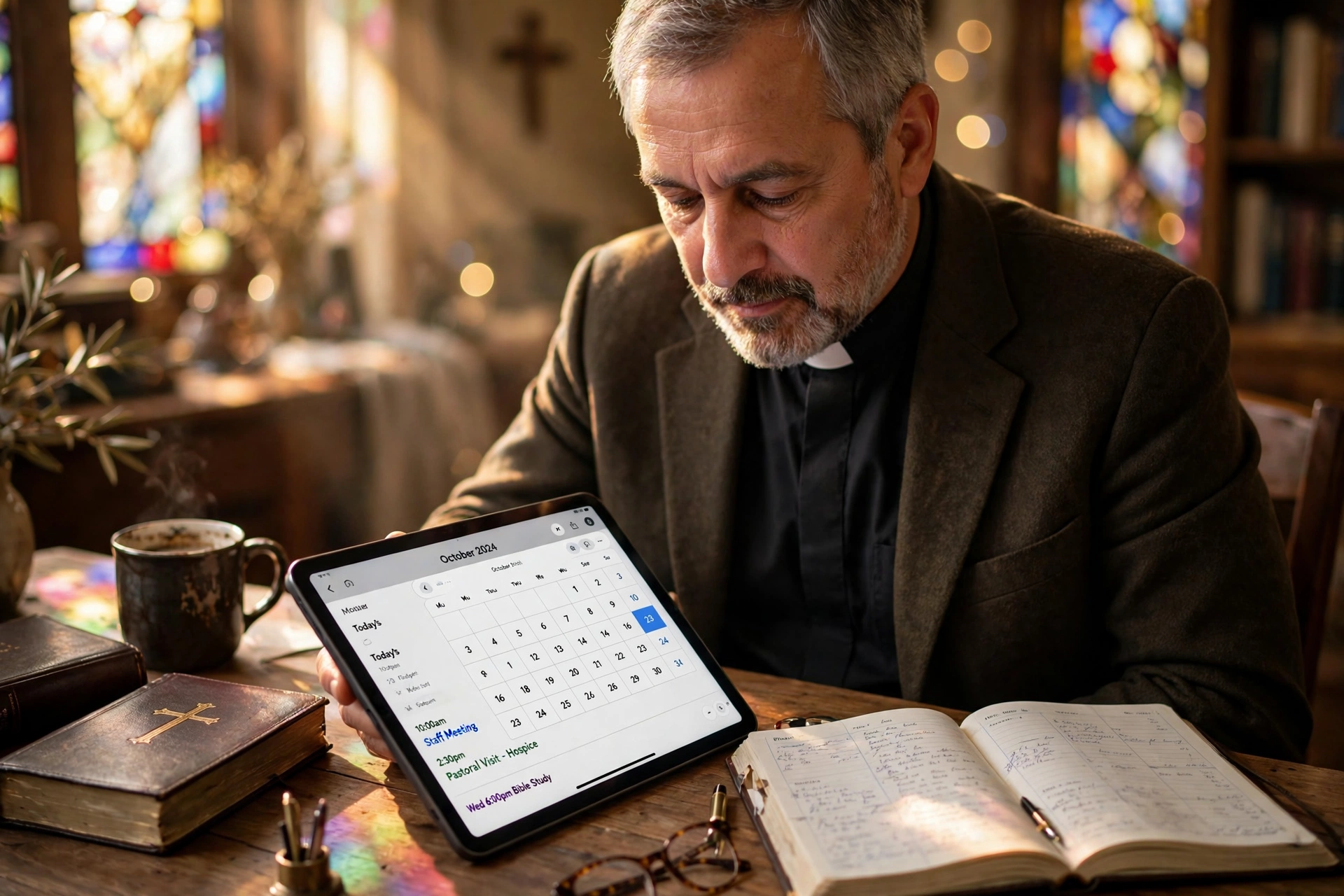
Which Church Calendar App Actually Solves Ministerial Burnout?
Managing a congregation's schedule often feels like a full-time job on top of a full-time calling. After analyzing the workflows of dozens of ministries, the pattern is clear: the "best" tool isn't the one with the most features, but the one that removes the friction between a pastor's availability and a member's need. For most churches in 2026, the ideal church calendar app is a dedicated scheduling system like Pastor Agenda, which prioritizes boundary setting and automated booking over simple date-tracking.

What Exactly is a Modern Church Calendar App?
When most people search for a scheduling tool, they imagine a digital version of a wall calendar. However, in a professional ministry context, a church calendar app is actually a sophisticated coordination engine designed to manage the intersection of public events, private pastoral care, and administrative deadlines.
📚
Definition
A church calendar app is a specialized software solution that synchronizes liturgical dates, congregational events, and individual appointment scheduling to prevent double-booking and ensure the sustainable distribution of a minister's time.
In my experience working with various church administrations, the biggest mistake I see is treating a ministry calendar as a static document. A static calendar tells people when something is happening, but a dynamic scheduling system manages how people access the leadership. The shift from "listing events" to "managing access" is what separates a basic calendar from a professional ministry tool.
According to research by the Barna Group, pastoral burnout is often exacerbated by a lack of perceived boundaries and the constant "on-call" nature of modern ministry. When a pastor uses a generic tool, they often find themselves manually texting back and forth with members to find a time for counseling, which adds cognitive load and emotional fatigue. A dedicated system solves this by providing a transparent window into availability, allowing the member to choose a slot that fits the pastor's pre-defined boundaries.
Now, here's where it gets interesting: the technical architecture of these apps must handle "conflicting layers." You have the Fixed Layer (Sunday services, holidays), the Flexible Layer (committee meetings, staff syncs), and the Private Layer (pastoral counseling, personal sabbatical). A high-quality church calendar app manages these layers without exposing the private details of the minister's life to the general public, maintaining a professional boundary that is essential for long-term mental health.
Why Does Your Choice of Scheduling Software Matter for Church Growth?
The administrative efficiency of a church is directly proportional to its capacity for growth. If a lead pastor spends five hours a week manually coordinating appointments via email or phone, that is five hours taken away from sermon preparation, strategic vision, or deep pastoral care. When we quantify this, the loss is staggering. Over a year, that inefficiency costs the ministry over 250 hours of high-level leadership time.
The implications of using a subpar system go beyond mere time loss; they impact the member experience. In 2026, congregants expect the same seamless digital experience from their church that they get from their healthcare provider or bank. A friction-heavy booking process, where a member must leave a voicemail and wait three days for a call back, creates a psychological barrier to seeking help.
Data from Christianity Today suggests that accessibility to leadership is one of the primary drivers of member retention in evangelical settings. If the "door" to the pastor is perceived as difficult to open due to scheduling chaos, members are less likely to seek the guidance they need during crises.
Furthermore, the lack of a centralized system leads to "information silos." When the youth pastor has one calendar, the worship leader has another, and the senior pastor uses a paper planner, the result is inevitable conflict. This operational friction often manifests as missed deadlines for sermon series or overlapping events in the church hall, which damages the professional image of the ministry. By implementing a unified system, the church moves from a reactive state ("We forgot the room was booked") to a proactive state ("We have successfully coordinated the quarterly outreach").
How to Implement a Scheduling System for Maximum Impact
Moving a church from a manual or fragmented system to a dedicated platform requires more than just installing software; it requires a change in culture. You cannot simply impose a digital tool on a staff that is used to "winging it." The implementation must be strategic.
First, define your "Availability Architecture." This is the most overlooked step. Instead of opening your entire calendar to the world, create specific "Pastoral Care Blocks." For example, Tuesday from 9 AM to 12 PM and Thursday from 2 PM to 5 PM. By designating these slots, you signal to the congregation that you are available, while protecting your study and family time.
Second, integrate the tool into your existing communication channels. A church calendar app is useless if people don't know how to find it. Place the booking link in your email signature, your social media bios, and the "Contact Us" section of your church website.
When you use Pastor Agenda, this process becomes streamlined. Because the platform is built specifically for the nuances of ministry, it understands that a "counseling session" requires different parameters than a "building committee meeting." You can set buffer times between appointments, ensuring that a heavy emotional session doesn't bleed into a business meeting without a 15-minute window for the pastor to reset and pray.
💡
Key Takeaway
The goal of a scheduling system is not to make the pastor more available, but to make the available time more effective and the unavailable time more sacred.
Step-by-step implementation workflow:
- Audit Current Friction: Identify where the most "scheduling leaks" occur (e.g. phone tag, forgotten appointments).
- Categorize Meeting Types: Define what is a "Quick Check-in," "Full Counseling Session," or "Administrative Sync."
- Set Boundary Parameters: Establish the hard limits of your working week to prevent burnout.
- Deploy the Link: Use Pastor Agenda to create a clean, professional booking page.
- Train the Congregation: Announce the new system during a service, explaining that this change allows the pastor to be more present and focused during their time with members.

Comparing Your Options: Traditional vs. Generic vs. Specialized
Choosing a tool often comes down to a trade-off between cost, ease of use, and specific functionality. Many churches make the mistake of choosing a free generic tool, only to find it lacks the privacy controls necessary for sensitive pastoral work.
| Feature | Traditional Manual Approach | Generic AI/Business Tools | Pastor Agenda Approach |
|---|---|---|---|
| Booking Speed | Slow (Phone/Email tag) | Fast (Automated) | Fast & Context-Aware |
| Boundary Control | Non-existent (Always on) | Basic (Open/Closed) | Advanced (Ministry-specific blocks) |
| Privacy | High (Manual control) | Low (Generic permissions) | High (Designed for confidentiality) |
| Setup Effort | None (but high daily cost) | Medium (Generic setup) | Low (Pre-configured for churches) |
| Member Experience | Frustrating/Dated | Impersonal/Corporate | Professional & Welcoming |
| Best For | Very small home churches | Corporate teams | Professional Ministries |
Most guides get this wrong by suggesting that a "free" Google Calendar is sufficient. While it works for dates, it fails as a scheduling tool. A calendar is a record of the past and present; a scheduling app is a tool for the future. Using a generic tool often leads to "notification fatigue" and a lack of integration with the specific needs of a clergy member, such as the need for "buffer zones" between intense emotional sessions.
Common Misconceptions About Digital Scheduling in Ministry
There is a persistent myth that moving to a digital church calendar app "dehumanizes" the pastoral relationship. Some argue that requiring a member to book a slot online removes the "spirit" of ministry.
Here is the reality: nothing is more dehumanizing than a pastor who is distracted, rushed, or exhausted because they are overwhelmed by administrative chaos. When a member books a slot through a professional system, they are not being "processed"; they are being given a guaranteed, focused window of time where the pastor is fully present.
Another common misconception is that these tools are only for "mega-churches." In fact, the smaller the church, the more the pastor wears multiple hats (preacher, administrator, counselor, janitor). In a small church, the pastor cannot afford to waste two hours a week on scheduling logistics. Efficiency is not a corporate luxury; it is a survival mechanism for the solo practitioner.
Finally, some believe that "AI-powered" scheduling is too complex for the average church office. The trend in 2026 is actually toward "invisible AI", tools that work in the background to optimize time without requiring a computer science degree to operate. The focus has shifted from "complex features" to "seamless outcomes."
Frequently Asked Questions
Will using a church calendar app make me seem less accessible to my members?
Actually, the opposite is true. When you provide a clear, digital way to book time, you eliminate the anxiety members feel about "bothering" the pastor. By stating, "I have dedicated these specific hours for you," you are communicating a high level of intentionality. Members prefer a guaranteed appointment at 2 PM on Tuesday over a vague promise that you will "try to call them back sometime this week." This transparency builds trust and ensures that those in crisis can secure help immediately without navigating a gatekeeper.
How does a professional scheduling tool handle the privacy of sensitive pastoral counseling?
A professional tool like Pastor Agenda separates the availability from the detail. While a member sees an open slot, the public never sees who is booking that slot or what the session is about. Unlike shared office calendars where a curious staff member might see "Counseling: [Name]," a dedicated ministry system ensures that the specifics of pastoral care remain confidential. This aligns with the ethical standards of clergy confidentiality, ensuring that the administrative ease of scheduling does not compromise the sanctity of the counseling room.
Can I sync a specialized church calendar app with my personal Google or Apple calendar?
Yes, and this is a non-negotiable requirement for any modern system. The goal is to have a "single source of truth." A high-quality system uses two-way synchronization. This means if you add a doctor's appointment to your personal phone calendar, that time is automatically blocked off in your Pastor Agenda booking page. This prevents the nightmare scenario of a member booking a session at the exact moment you are at a personal appointment, eliminating the need to manually update two different calendars.
Is it difficult to transition a congregation that isn't tech-savvy to a new system?
The transition is usually seamless if you frame it as a benefit to the member rather than a requirement of the office. Instead of saying "You must use this app," say "To make sure I can give you my undivided attention, I've set up this simple booking page." For those who are truly unable to use digital tools, the pastor can still manually enter their appointments into the system. This keeps the master schedule accurate while allowing the pastor to remain the "digital bridge" for the elderly or less tech-savvy members of the congregation.
How does a dedicated scheduling app reduce the risk of pastoral burnout?
Burnout often stems from "decision fatigue" and the erosion of boundaries. When a pastor spends their entire day responding to fragmented requests for time, they never enter a state of "deep work" or true rest. A church calendar app enforces a boundary. It allows the pastor to say "No" to an appointment without actually having to say the word "No" to a person. The system simply shows that the time is unavailable. This protects the pastor's Sabbath and study time, ensuring they are spiritually poured into before they pour into others.
Final Thoughts on Choosing the Best Church Calendar App
Choosing the right church calendar app is not about finding the most powerful software; it is about finding the tool that best protects your calling. The administrative burden of ministry can either be a wall that separates you from your people or a bridge that connects you more efficiently.
By moving away from manual coordination and generic tools, you reclaim hours of your week and, more importantly, your mental headspace. Whether you are leading a small plant or a multi-campus congregation, the ability to automate the "how" of scheduling allows you to focus on the "why" of your ministry.
If you are ready to stop the phone tag and start protecting your time, we invite you to explore PastorAgenda Blog. Our platform is specifically engineered to balance the demanding needs of a congregation with the essential boundaries of a healthy ministry.
Recommended Readings
To deepen your understanding of these topics, we recommend reading the following articles:
- Ensuring Absolute Privacy in Church Booking Systems
- Church Appointment Booking
- Online Appointment Booking for Modern Churches
- Automated Reminders and Communication for Congregations
Free Guide: The 7 Church Growth Hacks for 2026
Learn how modern ministries are using automated scheduling and AI pastoral assistants to save 12+ hours of admin work every week.



