
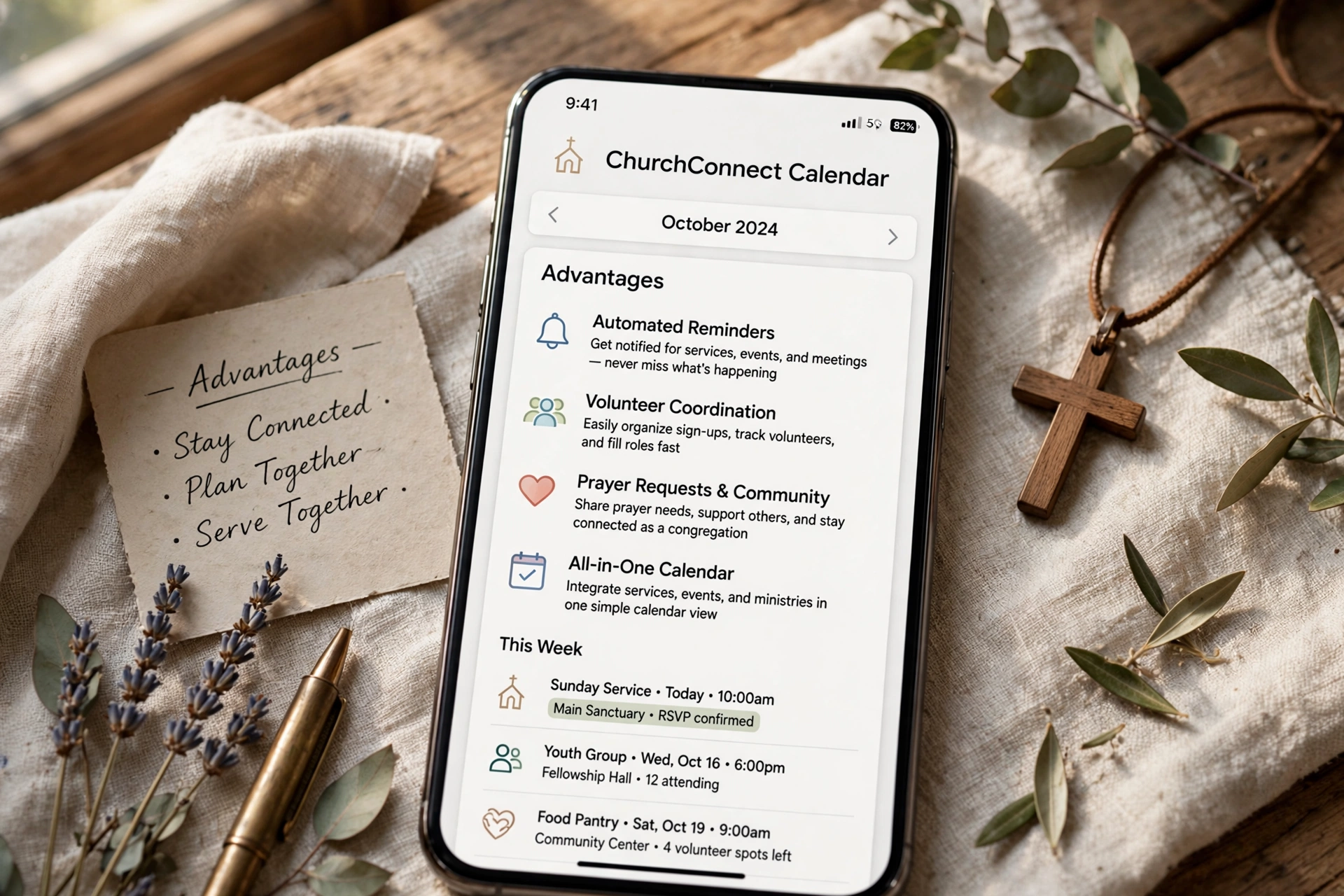
Why Your Ministry Needs a Digital Scheduling System
The friction of managing a church's schedule through fragmented emails and paper planners often leads to "ministry burnout," where the administrative burden outweighs the actual pastoral care. When a leader spends four hours a week coordinating room availability or resolving scheduling conflicts, they are losing critical time that should be spent in prayer or with the congregation. Transitioning to a dedicated church calendar app is not about adding more technology for the sake of novelty; it is about reclaiming the capacity for spiritual leadership by eliminating the cognitive load of manual coordination.
In my experience working with dozens of ministry leaders, the most common point of failure isn't a lack of vision, but a collapse of the "administrative backbone." I've seen seasoned pastors lose hours of sleep over a double-booked sanctuary or a missed counseling session simply because they relied on a shared Google Calendar that no one updated. The reason why a specialized system is necessary is that ministry scheduling is not a linear business process; it involves delicate boundaries between public worship and private pastoral care, requiring a level of nuance and privacy that generic tools simply cannot provide.
What Exactly is a Church Calendar App and How Does it Function?
A specialized scheduling tool for religious organizations is more than just a digital date-grid; it is a coordination hub that synchronizes the diverse needs of a faith community. Unlike a standard personal calendar, these systems are designed to handle multi-layered permissions, room management, and direct congregation access.
📚
Definition
A church calendar app is a specialized software solution designed to manage the temporal and spatial resources of a ministry, allowing for the synchronization of worship services, small group meetings, pastoral appointments, and facility rentals while maintaining strict privacy boundaries for sensitive pastoral care.
The core functionality centers on the ability to separate "public-facing" events from "internal" administrative tasks. For example, a wedding rehearsal is a public event that needs to be on the church's website, but a private counseling session for a grieving family must remain hidden from the general congregation. When these tools are implemented correctly, they create a "single source of truth" for the entire organization.
According to research from the Barna Group, leadership health in the church is heavily tied to the ability of the pastor to maintain a sustainable pace. When administration is streamlined through automation, leaders report higher levels of job satisfaction and lower rates of attrition. This is because a dedicated system removes the "invisible work" of constantly confirming times and dates via text message.

The technical architecture of these apps typically involves a cloud-based backend that pushes updates in real-time to all authorized users. This means that when the worship leader changes the rehearsal time from 6:00 PM to 7:00 PM, every volunteer receives an instant notification, preventing the dreaded "I didn't know it changed" excuse.
Why Does Digital Scheduling Actually Matter for Ministry Growth?
The shift from manual to digital scheduling has a direct impact on the scalability of a ministry. When a church relies on a manual process, they hit a "complexity ceiling." Once a congregation grows beyond a certain size, the number of intersecting events, youth group, choir practice, committee meetings, and outreach, becomes too great for one person to track mentally or on a physical whiteboard.
The consequences of not acting on this need are measurable. Mismanaged schedules lead to "volunteer friction," where the most dedicated members of the congregation become frustrated by poor communication and overlapping commitments. If a volunteer feels that their time is not being respected due to chaotic scheduling, their likelihood of burnout increases significantly.
Furthermore, there are significant implications for pastoral care. A pastor who is constantly interrupted by "Quick question, can you meet Tuesday at 4?" is living in a state of reactive leadership. By utilizing a church calendar app, the pastor shifts to proactive leadership. They set their available windows for counseling and allow the member to book within those parameters. This preserves the sanctity of the pastor's study time and family life.
As noted by Christianity Today, the modern pastor is often expected to be a CEO, a counselor, and a spiritual guide simultaneously. The only way to survive this multifaceted role in 2026 is to outsource the "CEO" tasks, like logistics and scheduling, to an efficient digital system.
The data shows that ministries using centralized scheduling systems see a marked increase in volunteer retention. When the "how" and "when" of serving are clear and automated, volunteers can focus on the "why" of their ministry. The psychological relief of knowing exactly where they need to be and what is expected of them reduces anxiety and increases engagement across the board.
How to Implement an Effective Scheduling Workflow
Implementing a digital system requires more than just installing software; it requires a shift in the church's culture. If you simply launch an app without a protocol, people will continue to text the pastor for appointments, rendering the tool useless.
The first step is the "Audit of Availability." The leadership team must define exactly which spaces (the sanctuary, the fellowship hall, the classrooms) are available for which activities. Once these parameters are set, they are programmed into the system. For instance, the sanctuary might be blocked off for "Quiet Prayer" from 8:00 AM to 10:00 AM daily, meaning no other events can be scheduled during that window.
Next, you must establish the "Booking Hierarchy." Who has the authority to override another event? In most healthy ministries, the Senior Pastor or the Executive Pastor holds the "Master Key," while department heads (Youth, Children, Worship) have limited autonomy to book their specific zones.
Now, here is where it gets interesting: you must integrate the public interface. Instead of the pastor manually entering dates into a website, the church calendar app should provide a live feed. When a member wants to see when the next potluck is, they check the app or the website, not the pastor's inbox.
💡
Key Takeaway
The success of a scheduling system depends not on the features of the software, but on the discipline of the users to stop using secondary communication channels for booking.
For those seeking a seamless transition, Pastor Agenda provides a streamlined experience specifically tailored to these needs. Instead of fighting with a generic business tool, Pastor Agenda understands that ministry has unique rhythms, such as the surge of activity during Advent or the specific privacy needs of pastoral counseling. By using a tool designed for the clergy, you avoid the steep learning curve associated with enterprise software.

The final step is the "Congregation Onboarding." Host a brief training session or send a simple video tutorial showing members how to book their appointments or view the church events. Once the congregation realizes that the app is the fastest way to get an answer, they will naturally migrate away from the outdated habit of calling the church office for every minor detail.
Choosing the Right Path: Traditional vs. Modern Scheduling
Many leaders struggle to decide if they need a specialized tool or if a free generic calendar is "enough." To help clarify this, we must look at the actual friction points involved in each method.
| Feature | Traditional/Manual Way | Generic AI/Free Apps | Modern Approach (Pastor Agenda) |
|---|---|---|---|
| Conflict Resolution | Manual check of paper/email; high error rate | Basic alerts; often ignored or missed | Automatic conflict detection and priority routing |
| Privacy Control | "Hope for the best" or separate notebooks | All-or-nothing permissions | Granular, role-based access (Pastoral vs. Public) |
| User Experience | High friction (calls/texts needed) | Medium friction (complex setup) | Low friction (one-click booking for members) |
| Time Recovery | Low (Hours spent on logistics) | Medium (Still requires manual oversight) | High (Automated workflows reclaim 5-10 hours/week) |
| Scalability | Fails after 100 members | Becomes cluttered and noisy | Scales seamlessly with congregation growth |
The "Generic AI/Free Apps" approach often fails because these tools are built for corporate sales teams, not for the nuances of a church. A sales tool wants you to maximize the number of meetings per hour; a pastoral tool wants you to protect your time for deep work and spiritual reflection.
The mistake I see constantly is the "Free Tool Trap." A leader spends three weeks trying to force a free corporate calendar to work for their church, only to find that they cannot hide private counseling sessions from the youth leader. By the time they realize the limitation, they have already spent dozens of hours in a futile attempt to customize a tool that wasn't built for them.
Common Misconceptions About Church Technology
There is a persistent myth that bringing more technology into the church "de-spiritualizes" the ministry. Most guides on church growth get this wrong by focusing on the "digital experience" rather than the "administrative liberation."
The first myth is that "Our church is too small to need a scheduling app." In reality, small churches often feel the pain of poor scheduling more acutely because the pastor is often the only administrator. When the pastor is overwhelmed by the logistics of a small church, they have less emotional energy for the people. Technology should be viewed as a servant to the ministry, not a replacement for it.
Another misconception is that "The congregation will find it too difficult to use." This is rarely true in 2026. Most members are already using smartphones for everything from banking to grocery shopping. When a tool is intuitive, like the interface provided by Pastor Agenda: the adoption rate is surprisingly high. The barrier isn't the technology; it's the lack of a clear invitation to use it.
Finally, some believe that "Scheduling is just a minor detail." It is not. Scheduling is the physical manifestation of a church's priorities. If your calendar is a chaotic mess, your ministry will feel chaotic. If your schedule is orderly and intentional, it signals to the congregation that the leadership is disciplined and that every member's time is valued.
Frequently Asked Questions
Does a church calendar app replace the need for a church secretary?
No, it does not replace the person; it replaces the tedious parts of their job. Instead of spending four hours a day playing "phone tag" to coordinate the use of the gym or the sanctuary, a secretary can spend that time on member outreach, hospitality, and deeper administrative support. A church calendar app automates the data entry and conflict detection, allowing the staff to focus on the human elements of ministry that a machine cannot handle.
How do we handle the privacy of sensitive pastoral counseling sessions?
Privacy is the most critical requirement for any ministry tool. A professional system allows you to create "Private" or "Hidden" event types. While the system knows the pastor is busy from 2:00 PM to 3:00 PM (blocking that time from others), the public or other staff members only see that the slot is "Unavailable." This ensures that the confidentiality of the counseling session is maintained while still preventing double-booking of the pastor's time.
Can we integrate the app with our existing church website?
Yes, most modern scheduling tools provide an embeddable widget or a public URL. This means you can place a "Book an Appointment" or "View Church Events" button directly on your homepage. Instead of the congregation having to email the church office and wait 48 hours for a response, they can see real-time availability and secure their spot instantly. This reduces the administrative load on the office and provides a better experience for the member.
What happens if someone forgets to cancel their appointment in the app?
This is a common pain point in manual systems, but digital tools solve this through automated reminders. You can configure the system to send an email or SMS reminder 24 hours and 2 hours before the appointment. This significantly reduces "no-show" rates. Additionally, you can set a "cancellation window," requiring members to cancel at least 12 hours in advance, which helps the pastor manage their day more effectively.
Is it difficult to migrate our current dates from a paper planner to an app?
The initial migration is the only "heavy lift" in the process, but it is a one-time investment. Most leaders find that spending one weekend inputting their core annual dates (holidays, conferences, special services) saves them hundreds of hours over the following year. Once the foundation is set, the system becomes self-sustaining. Tools like Pastor Agenda are designed to make this transition as painless as possible for non-technical users.
Final Thoughts on the Advantages of a Church Calendar App
The decision to implement a church calendar app is ultimately a decision about how you value the time of your leadership and your volunteers. When you remove the friction of manual scheduling, you aren't just "organizing dates"; you are creating a sanctuary of order that allows the Holy Spirit to work without the distraction of administrative chaos.
As we move through 2026, the expectation for instant, clear communication is higher than ever. Congregants expect to know when events are happening and how to access their leaders without jumping through hoops. By adopting a professional system, you signal that your ministry is healthy, organized, and ready to grow.
If you are tired of the constant "Where is the key?" and "Who booked the hall?" conversations, it is time to move toward a solution designed specifically for the unique needs of the clergy. We invite you to explore how PastorAgenda Blog can reclaim your time and restore your focus to what truly matters: the spiritual care of your flock.
Recommended Readings
To deepen your understanding of these topics, we recommend reading the following articles:
- Ensuring Absolute Privacy in Church Booking Systems
- Church Appointment Booking
- Online Appointment Booking for Modern Churches
- Automated Reminders and Communication for Congregations
Free Guide: The 7 Church Growth Hacks for 2026
Learn how modern ministries are using automated scheduling and AI pastoral assistants to save 12+ hours of admin work every week.



