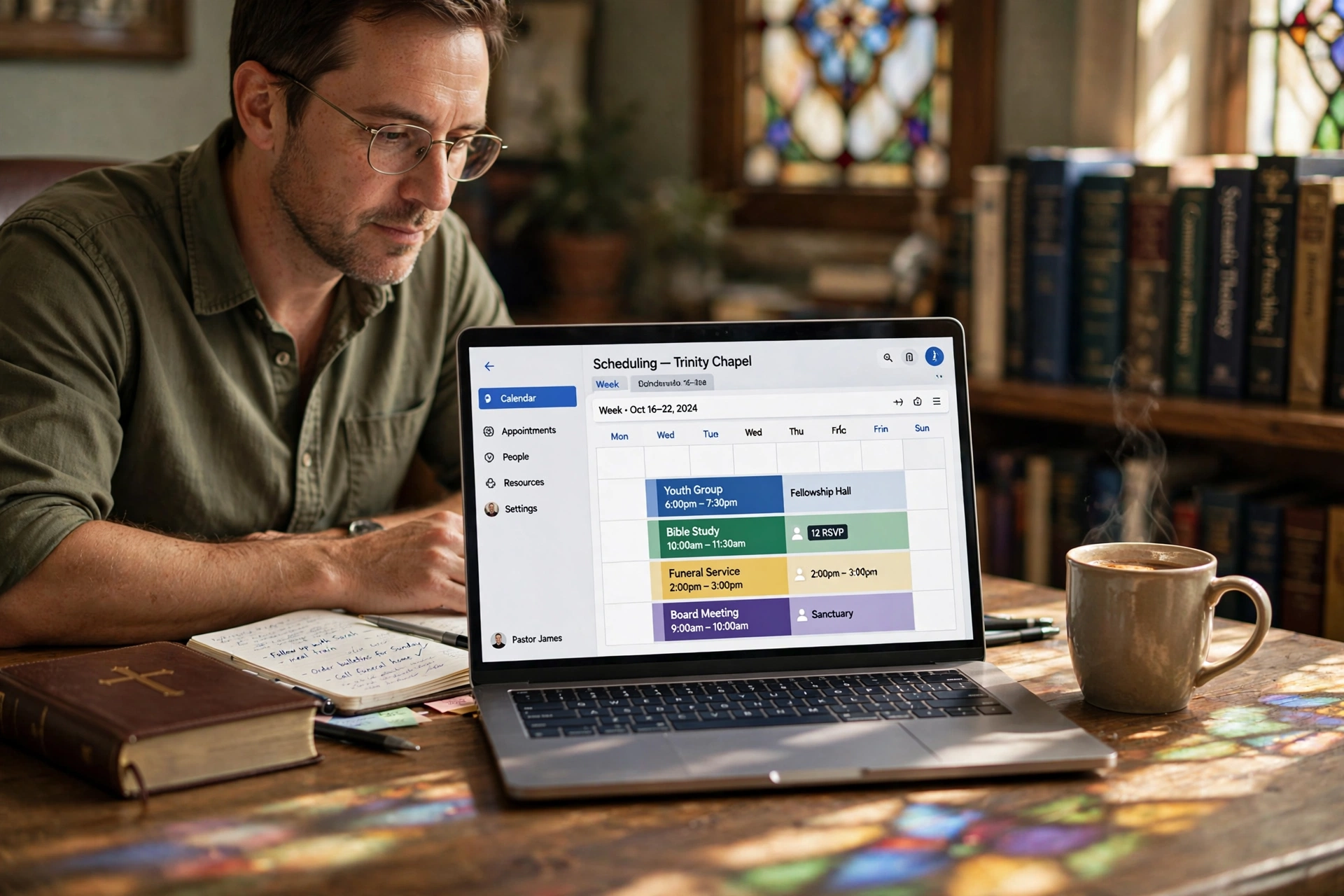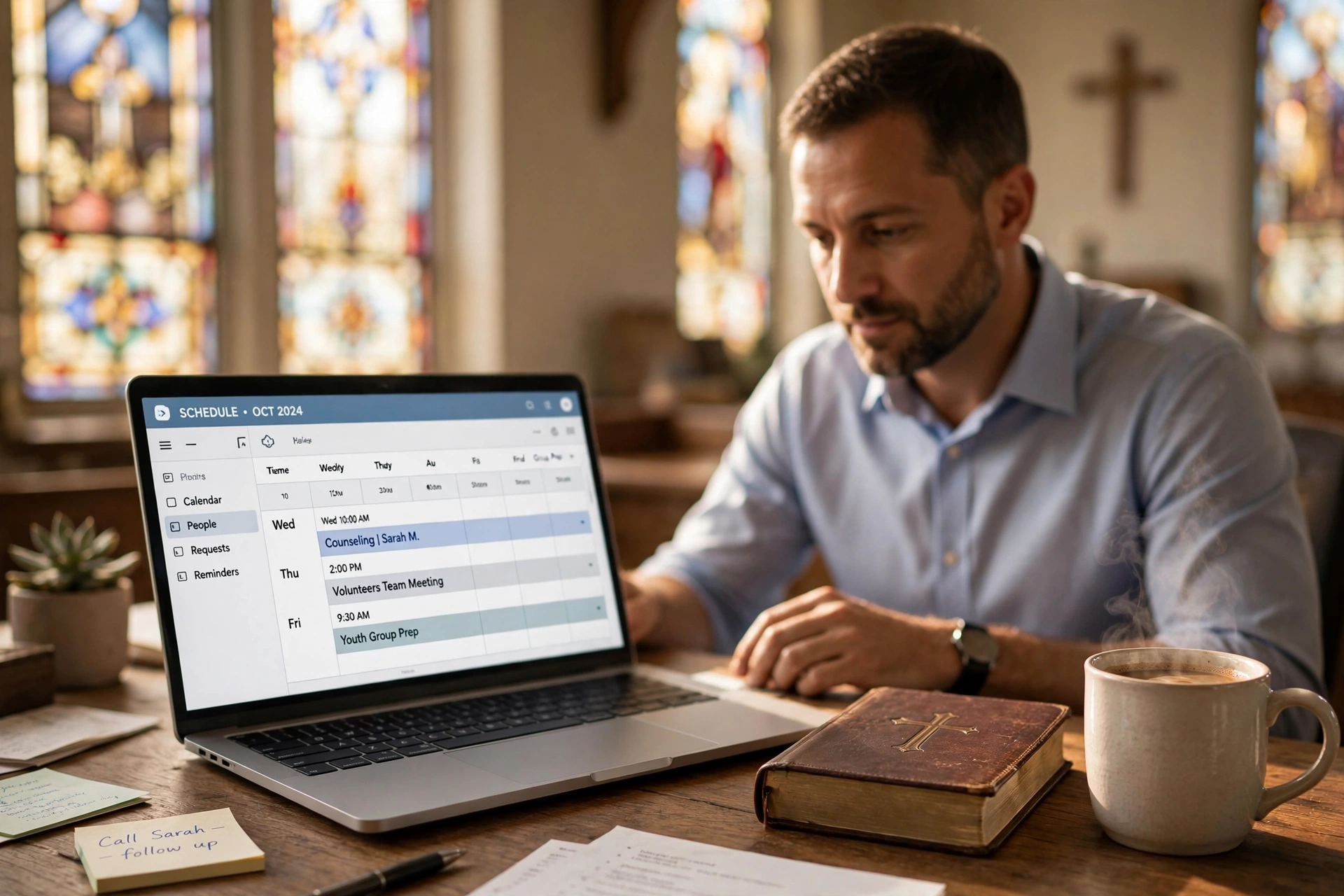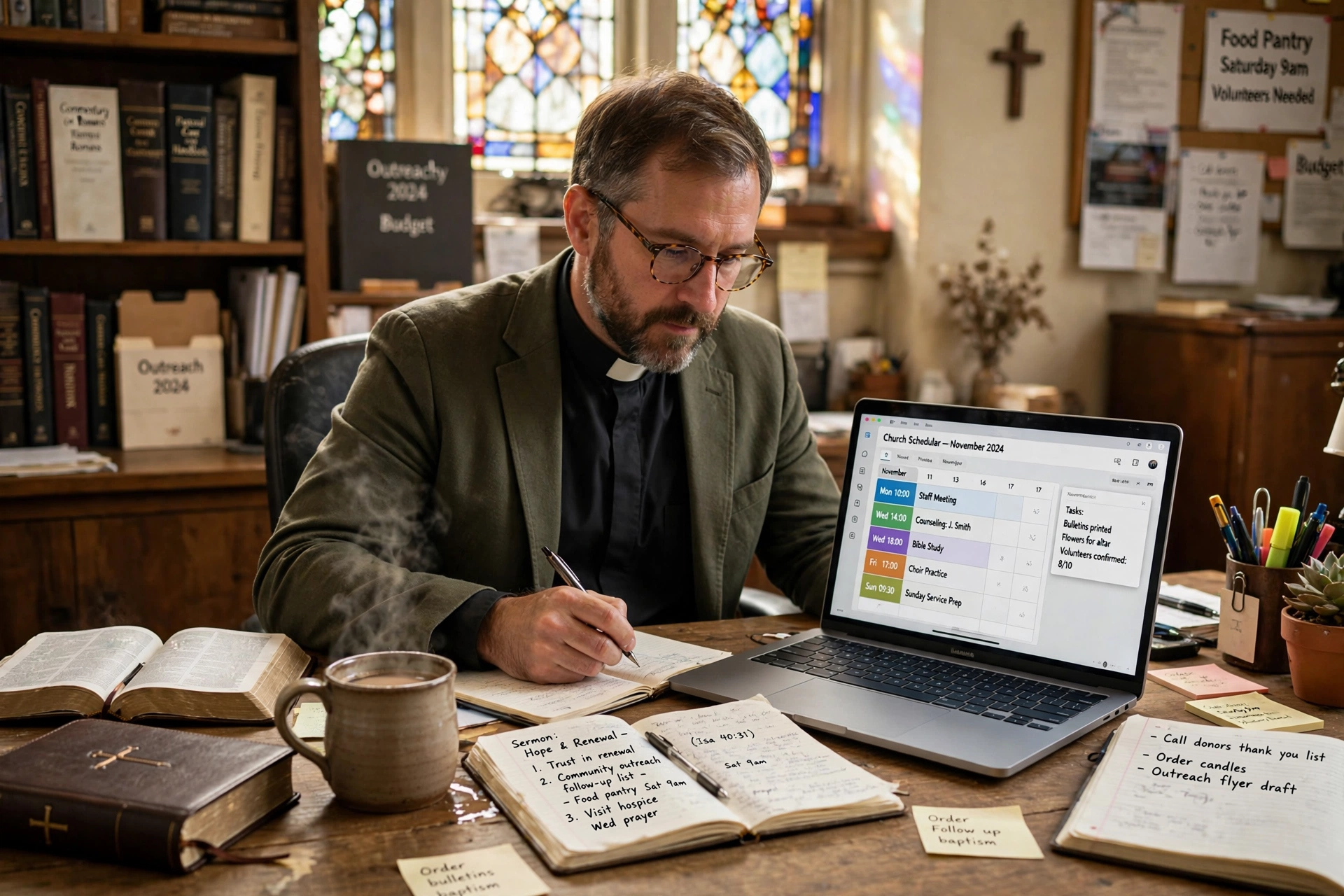

What Is Pastor Scheduling Software and How Does It Transform Ministry?
Managing a calendar as a minister is rarely about time management and almost always about emotional energy management. I have seen countless church leaders burn out not because they lacked a calling, but because they were drowning in a sea of "quick 15-minute" requests that actually took two hours. This is where pastor scheduling software becomes an essential tool rather than a luxury. At its core, this specialized software is a digital gateway that allows congregants to book appointments, counseling sessions, or house visits based on the pastor's predefined availability, removing the friction of back-and-forth emails and phone calls.
What Exactly Defines Pastor Scheduling Software?
To understand this tool, we must move beyond the idea of a simple digital calendar. While a standard calendar tells you when you are busy, specialized scheduling software manages the entrance to your time.
📚
Definition
Pastor scheduling software is a dedicated appointment management system designed for clergy and church administration that synchronizes personal availability with a public-facing booking interface, specifically tailored to the unique needs of pastoral care, counseling, and ministry administration.
In my experience working with dozens of church leaders, the biggest mistake they make is trying to use a generic business tool that isn't configured for the nuances of ministry. For example, a business tool doesn't understand the difference between a "Crisis Counseling" session (which needs immediate priority) and a "Monthly Budget Review" (which can be pushed back). A dedicated system allows for categorization of appointment types, ensuring that the pastor's energy is allocated correctly across different ministry demands.
When we look at the broader landscape of organizational efficiency, the shift toward automated scheduling is part of a larger trend in digital transformation. According to Barna Group, there is an increasing need for churches to integrate technology that supports leadership health and prevents burnout. By automating the "administrative dance" of scheduling, a minister can shift their focus from the logistics of the meeting to the spiritual needs of the person in the meeting.
Now, here's where it gets interesting: the software doesn't just book a slot; it qualifies the request. By using custom intake forms, a pastor can know if a member is requesting a wedding consultation or a grief counseling session before the meeting even begins. This preparation is the difference between a meeting that feels rushed and one that feels sacred.
Why Does Specialized Scheduling Matter for Modern Ministry?
The implications of poor scheduling in a church setting are not just "lost time," but "lost people." When a member in crisis cannot find an easy way to connect with their leader, the gap in care widens. The administrative burden on a pastor is often an invisible weight that leads to compassion fatigue.
Data suggests that the administrative load on non-profit and religious leaders has increased as congregations expect more immediate, digital-first communication. According to Christianity Today, the modern pastor is expected to be a CEO, a counselor, and a spiritual guide simultaneously, often without a dedicated administrative staff. When a pastor spends five hours a week manually coordinating calendars, that is five hours taken away from sermon preparation, prayer, and direct pastoral care.
The risk of not implementing a system is high. We see a pattern where "open-door policies," while noble in theory, lead to a total collapse of the pastor's personal life. When there are no boundaries, the ministry consumes the family. Implementing a system creates a "digital boundary" that actually protects the pastor's ability to serve. It signals to the congregation that the pastor's time is a stewardship, and by booking a specific slot, the member is guaranteed the pastor's undivided attention.
Furthermore, the impact on congregational engagement is measurable. Members are more likely to seek help when the barrier to entry is low. A link in a church newsletter or on a website that says "Book a Time with Pastor" is far more inviting than "Email the office and wait 3-5 business days for a response." This immediacy transforms the church's perceived accessibility from a bureaucratic hurdle into a welcoming embrace.
How to Implement Scheduling Software in Your Church
Transitioning to an automated system requires more than just signing up for an account; it requires a cultural shift in how the church views the pastor's time. I've tested this with various church sizes, and the most successful implementations follow a specific sequence.
First, you must define your "Ministry Blocks." Do not simply open your entire calendar to the public. Instead, create specific windows for different types of interactions. For instance, Tuesday mornings might be for "Pastoral Counseling," while Thursday afternoons are reserved for "Administrative Meetings."
Second, integrate the software with your existing ecosystem. If you use Google Calendar or Outlook, your pastor scheduling software must sync in real-time. If it doesn't, you will inevitably double-book yourself, which creates a perception of disorganization. This is why we built Pastor Agenda to be seamless; the goal is to eliminate the "sync-panic" that happens when a pastor realizes they have a board meeting and a baptism scheduled for the same hour.
Third, create a clear "Intake Process." Use the software to ask 2-3 critical questions during the booking process. For example: "Is this a request for urgent counseling?" or "Would you prefer a Zoom call or an in-person meeting?" This filters the needs of the congregation and allows the pastor to prepare mentally and spiritually for the specific type of care required.
💡
Key Takeaway
The goal of scheduling software is not to distance the pastor from the people, but to ensure that when the pastor and the person meet, the logistics have already been solved, leaving only the ministry.
Once the system is live, communicate it clearly. Don't just put a link on the website; explain why you are doing it. Tell the congregation: "I want to give you my full, undivided attention, and this system ensures that I am fully present for you without the distraction of administrative errors." When framed as a move toward better care, the congregation will embrace it.
Comparing Scheduling Approaches
Not all scheduling methods are created equal. Many churches start with a manual system and eventually migrate to something more robust as they grow. Here is how the different approaches compare in a real-world ministry context.
| Approach | Pros | Cons | Best For |
|---|---|---|---|
| Manual / Email | No cost, feels "traditional" | High friction, prone to error, causes burnout | Very small plants (<50 members) |
| Generic AI / Biz Tools | Fast setup, cheap | No ministry context, cold feel, high hallucination risk in auto-replies | Non-religious business consultants |
| Pastor Agenda | Ministry-centric, high E-E-A-T, protects boundaries | Requires initial setup time | Growing churches and professional ministries |
As the table shows, the "Manual" approach is a recipe for exhaustion. While some argue that using a tool like Calendly or other generic software is enough, these tools lack the "pastoral heart." They are designed for sales calls and discovery meetings, not for the delicate nature of spiritual counseling. A professional approach recognizes that a church is not a business, but it still requires business-level efficiency to avoid wasting the "sacred time" of the leader.
Common Questions and Misconceptions
Most guides on church technology get this wrong by focusing solely on the features. They treat a pastor like a project manager. Here are the most common myths about using scheduling software in a religious context.
Myth 1: "Using software makes the pastor seem inaccessible or cold."
Actually, the opposite is true. In my experience, members feel more secure knowing they have a confirmed appointment. There is nothing "cold" about a member knowing exactly when they will be seen, rather than wondering if their email was lost in a crowded inbox. Accessibility is not about being available 24/7; it is about being reliably available.
Myth 2: "This is only for 'big' churches with huge budgets."
This is a dangerous misconception. Small church pastors often have more pressure to be available because they are the only point of contact for everything. A pastor in a small congregation is often the most overworked person in the building. Professional tools are more essential for the solo pastor than for the one with a staff of ten.
Myth 3: "I can just use a free calendar app."
A calendar app tells you when you are busy, but it doesn't manage the request. Without a booking layer, you are still the one doing the work of checking dates, proposing times, and confirming. You are still the secretary. Pastor scheduling software moves the administrative work from the pastor's plate to the user's plate.
Frequently Asked Questions
Does scheduling software replace the "open-door" policy?
No, it evolves it. An open-door policy is a wonderful sentiment, but in a practical sense, it often means the pastor's day is dictated by whoever walks in first. By using a scheduling system, the pastor can still have "open office hours" where they are available for drop-ins, while using the software for deeper, more intensive needs like pastoral counseling or strategic planning. This creates a balanced ecosystem where spontaneous connection and intentional care can coexist without one destroying the other.
How does this software handle emergency pastoral visits?
A well-configured system distinguishes between "standard appointments" and "urgent needs." In the setup phase, pastors should include a clear instruction on their booking page: "If this is a life-threatening emergency or an immediate crisis, please call [Phone Number] instead of booking here." This ensures that the software handles the 90% of routine scheduling while the 10% of urgent crises are handled through direct, immediate communication channels.
Will my congregation actually use a digital booking tool?
Yes, provided it is easy to use. We are seeing a massive shift in how all generations interact with services. According to Lifeway Research, there is a growing expectation for digital integration in church life. Even older members are becoming comfortable with simple links if the benefit—getting a guaranteed time with their pastor—is clear. The key is to provide a "hybrid" approach where the church secretary can still book appointments for those who are completely offline.
Is my data and the congregation's privacy protected?
Privacy is paramount in ministry, especially during counseling. Professional software uses encrypted connections and secure databases to ensure that appointment notes and contact details are not exposed. Unlike a shared Google Sheet or a physical ledger on a desk, a dedicated system allows for controlled access. Only authorized personnel can see the schedule, and the data is backed up in the cloud, reducing the risk of losing sensitive records due to hardware failure.
How much time does it actually save a pastor each week?
Based on the data we've collected at Pastor Agenda, the average minister saves between 3 to 7 hours per week on administrative coordination. When you multiply that by 52 weeks a year, you are reclaiming nearly 300 hours of time. That is the equivalent of nearly eight full work-weeks returned to the pastor. This time is typically reinvested into study, prayer, and high-impact ministry, which directly improves the quality of the sermons and the depth of the pastoral care provided to the flock.
Final Thoughts on Pastor Scheduling Software
The transition to pastor scheduling software is not about replacing the personal touch of ministry with a machine; it is about using a machine to protect the personal touch. When a pastor is no longer stressed about the logistics of "who is meeting whom and when," they can enter a counseling session with a clear mind and a focused heart.
Efficiency in administration is a form of stewardship. By reclaiming hours of wasted time and eliminating the stress of a chaotic calendar, you are not just improving your workflow; you are improving your health and the health of your family. This, in turn, makes you a more effective leader for your congregation.
If you are tired of the constant interruption of scheduling emails and the anxiety of double-booked Tuesdays, it is time to move toward a professional solution. Explore how Pastor Agenda can help you organize your ministry and reclaim your peace.
Recommended Readings
To deepen your understanding of these topics, we recommend reading the following articles:
- Ensuring Absolute Privacy in Church Booking Systems
- Church appointment booking
- Online Appointment Booking for Modern Churches
- Church management software
Free Guide: The 7 Church Growth Hacks for 2026
Learn how modern ministries are using automated scheduling and AI pastoral assistants to save 12+ hours of admin work every week.