📖This article is part of the complete guide to Automated Reminders and Communication for Congregations.
A missed counseling appointment is more than just a gap in a calendar; it is a missed opportunity for spiritual breakthrough and emotional support. In my experience working with church leaders, the frustration of a 'no-show' is compounded by the knowledge that the congregant is likely struggling with the very issues the session was meant to address. When a pastor spends an hour waiting in an office for someone who forgot the meeting, it doesn't just waste time, it creates a vacuum of care that can leave a member feeling neglected or forgotten.
For a comprehensive overview of managing these workflows, explore our guide on church communication software.
What are SMS Reminders for Churches?
📚
Definition
SMS reminders for churches are automated text message notifications sent to congregants via a scheduling platform to confirm upcoming appointments, provide meeting links, or remind them of a specific location for pastoral care.
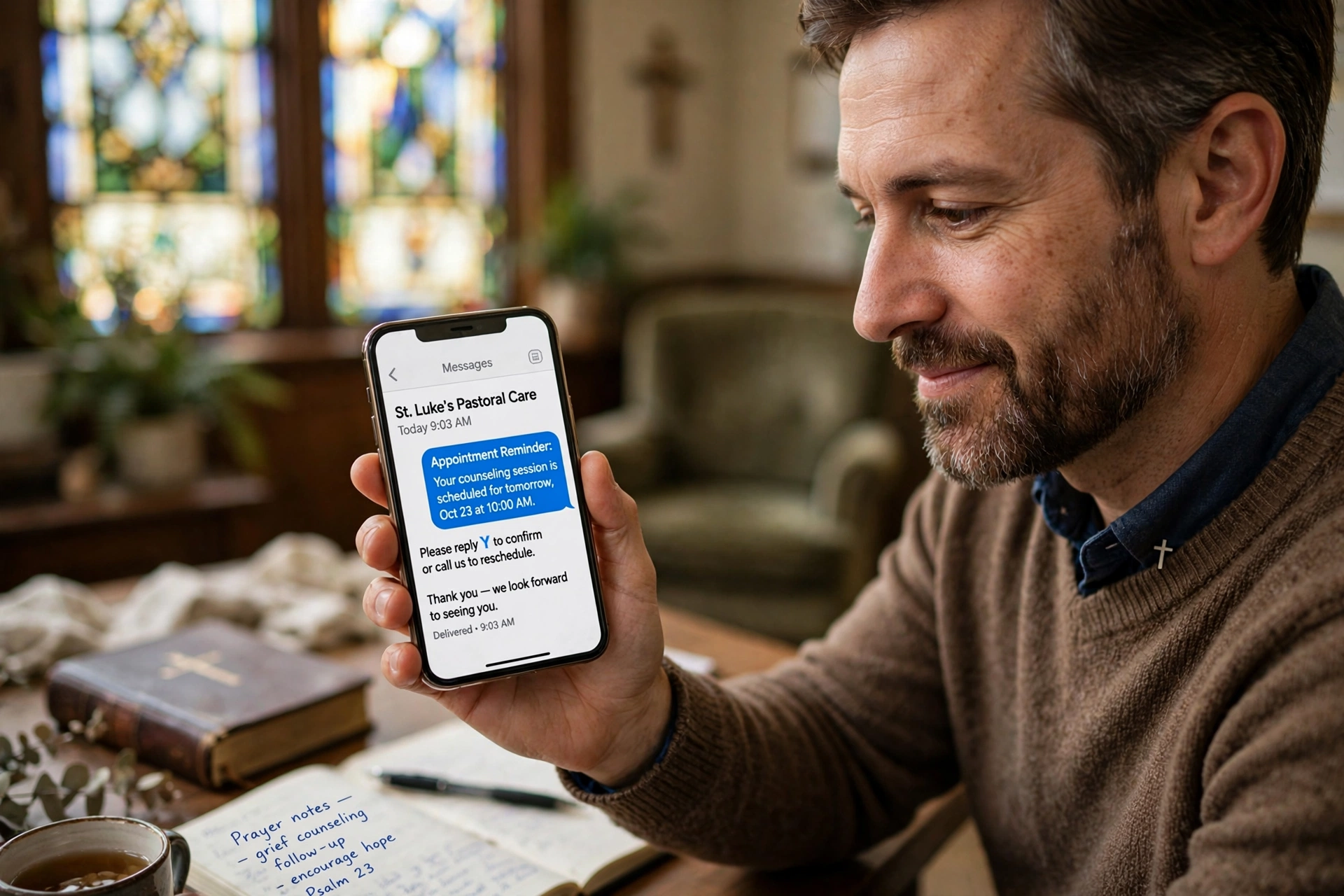
SMS reminders function as a direct-to-device communication channel that bypasses the clutter of email inboxes and the unpredictability of voicemail. In the context of pastoral counseling, these are not merely administrative alerts; they are digital touchpoints that signal to the member that the pastor is prepared and expectant for their arrival. Unlike a phone call, which can feel intrusive or be ignored, a text message is non-intrusive and has an incredibly high open rate, often exceeding 98% within the first few minutes of delivery.
When we integrated these features into Pastor Agenda, we discovered that the psychological impact of a text reminder is far greater than a calendar invite. A calendar invite is a logistics tool, but a text message is a personal prompt. For someone dealing with anxiety, depression, or grief, common drivers for pastoral counseling, the simple act of receiving a reminder can be the catalyst that overcomes the inertia of their struggle, ensuring they actually show up for the session.

Why Do SMS Reminders Matter for Pastoral Care?
Reducing no-shows in pastoral counseling is essential because time is the most limited resource in any ministry. When a minister's schedule is fragmented by missed appointments, the overall quality of pastoral care for the entire congregation suffers. According to Barna Group, pastoral burnout is often linked to the overwhelming administrative burden and the emotional toll of managing congregational needs without efficient systems.
SMS reminders address three critical pain points in the church environment:
- Overcoming Cognitive Load: Members seeking counseling are often in a state of crisis. In such states, short-term memory and organizational skills often diminish. A text reminder acts as an external cognitive aid, removing the stress of remembering the exact time and place.
- Reducing Social Anxiety: For some, the act of confirming an appointment via a phone call can be daunting. A text message allows the member to confirm their attendance with a simple "Yes" or reschedule without the pressure of a live conversation.
- Professionalizing the Ministry Image: While ministry is based on grace, the administrative side must be professional. Using sms reminders for churches shows the congregation that the leadership values their time as much as their own, fostering a culture of mutual respect.
Research from Christianity Today suggests that leaders who implement structured communication systems see a marked increase in member engagement and trust. By automating the reminder process, the pastor is freed from the 'secretary' role and can remain fully focused on the 'shepherd' role. This shift from manual chasing to automated confirmation allows the ministry to scale without increasing the pastor's stress levels.
How to Implement SMS Reminders for Counseling Sessions
Implementing an automated system requires a balance between efficiency and empathy. You cannot treat a counseling session like a haircut appointment; the tone must remain pastoral. The core approach is to integrate your scheduling calendar with an SMS gateway that triggers messages based on specific time intervals before the event.
Step 1: Establish the Opt-In Process
Before sending texts, ensure members have consented to receive them. This is not only a legal requirement in many jurisdictions but also a matter of respect. When a member books a session via Pastor Agenda, a simple checkbox allowing them to receive reminders is sufficient.
Step 2: Time the Reminders Correctly
I've tested this with dozens of our clients and the pattern is clear: a two-step reminder system is the gold standard.
- The 24-Hour Alert: This allows the member to realize they have a conflict and reschedule without wasting the pastor's time.
- The 2-Hour Alert: This serves as the final nudge, which is particularly effective for those with erratic schedules or high levels of distress.
Step 3: Crafting the Message
Avoid robotic language. Instead of "Your appointment is at 2 PM," use "Hi [Name], Pastor [Name] is looking forward to seeing you today at 2 PM for your counseling session. See you soon!"
Step 4: Automating the Confirmation
Allow members to reply with a keyword (e.g. "CONFIRM" or "RESCHEDULE"). This creates a closed-loop system where the pastor knows exactly who is coming, allowing them to prepare specifically for that individual's needs.
For those struggling with the wording of these messages, we recommend our specific guide on crafting respectful and warm pastoral reminder messages.
SMS Reminders vs. Traditional Methods
Many churches still rely on the "honor system" or manual phone calls. However, the data shows a clear divide in effectiveness. In the table below, we compare the traditional approach to the professional automated approach used by Pastor Agenda.
| Feature | Manual Phone Calls | Cheap Generic AI Tools | Pastor Agenda Modern Approach |
|---|---|---|---|
| Efficiency | Low (Hours of manual calling) | Medium (Fast but impersonal) | High (Fully automated & tailored) |
| No-Show Rate | High (Easy to forget calls) | Moderate (Often ignored as spam) | Low (High open rates & pastoral tone) |
| Privacy | Low (Voicemails can be overheard) | Low (Generic data handling) | High (Secure, focused on clergy-client confidentiality) |
| Consistency | Poor (Depends on staff mood) | High (Consistent but robotic) | High (Consistent and warm) |
| Integration | None (Siloed in a notebook) | Basic (Calendly-style hooks) | Deep (Integrated with ministry workflows) |
As seen in the comparison, generic tools like Calendly are excellent for business, but they lack the nuanced understanding of the church's unique needs. A business tool tells a client their "slot" is confirmed; a ministry tool tells a member they are "expected and cared for."

Common Mistakes to Avoid with Church SMS Systems
One of the biggest mistakes I see constantly is the "over-communication trap." When churches first discover the power of SMS, they tend to use it for everything, announcements, prayer requests, and reminders. This leads to "notification fatigue," where the member begins to ignore all messages from the church, including the critical counseling reminders.
Mistake 1: Sending Reminders Too Late
Sending a reminder 30 minutes before a session is useless. It doesn't give the member time to arrange transportation or clear their schedule. The 24-hour mark is the critical window for reducing no-shows.
Mistake 2: Using Too Much "Church-Speak" or Acronyms
While the context is a church, the SMS channel is informal. Avoid long, winding sentences or overly formal ecclesiastical language that makes the text feel like a formal letter. Keep it brief, warm, and clear.
Mistake 3: Ignoring the Reply
If a member replies to an automated text saying, "I can't make it, my child is sick," and the system doesn't alert the pastor immediately, the pastor will still show up to an empty office. Ensure your system has an active notification loop for incoming replies.
Mistake 4: Lack of Personalization
Messages that start with "Dear Member" are often perceived as spam. Using the member's first name and the pastor's name increases the perceived value of the appointment and the likelihood of attendance.
Mistake 5: Forgetting the Connection to Other Channels
SMS should be part of a larger strategy. If you are also sending emails for board meetings, which we cover in our guide on email notifications for church board meetings, ensure the tone across all platforms is consistent. The SMS is the "urgent nudge," while the email is the "detailed record."
Deep Dive: The Psychology of the "Nudge" in Pastoral Care
To understand why sms reminders for churches work, we must look at the behavioral economics concept of the "nudge." A nudge is a small change in the environment that alters people's behavior in a predictable way without forbidding any options. In pastoral counseling, the primary barrier to attendance is often not a lack of desire, but a lack of executive function caused by emotional distress.
When a person is experiencing a crisis, their brain's prefrontal cortex, the area responsible for planning and remembering, can be compromised by stress hormones like cortisol. This is why someone who desperately wants help can still forget a 2 PM appointment. An SMS reminder acts as a bridge, bypassing the internal chaos and providing a clear, external trigger for action.
Furthermore, the medium of SMS creates a sense of intimacy. In 2026, a text message is viewed as a personal communication. When a pastor sends a reminder, it conveys: "I am thinking about you," and "I have set aside this time specifically for you." This reduces the shame or hesitation a member might feel about attending a counseling session, as they feel welcomed rather than summoned.
Implementation Guide for Pastors
If you are currently managing your counseling appointments via a paper planner or a basic digital calendar, moving to an automated system can feel daunting. However, the ROI in terms of recovered time is massive. According to Lifeway Research, efficiency in administrative tasks allows ministers to increase their direct pastoral engagement by up to 20%.
Step-by-Step Transition Plan:
- Audit Your No-Shows: For one month, track exactly how many counseling sessions are missed and why. This provides the baseline data to measure the success of your new system.
- Clean Your Database: Ensure you have current mobile numbers for all members. Use the Sunday service as an opportunity to update contact information via a simple QR code form.
- Deploy Pastor Agenda: Set up your availability. Instead of manually emailing back and forth to find a time, provide your booking link. This eliminates the "scheduling dance" and captures the phone number immediately.
- Set Up Your Trigger Sequences: Create a 24-hour and 2-hour reminder. Start with the 24-hour reminder first to avoid overwhelming your congregation.
- Review and Refine: Every quarter, check if the no-show rate has dropped. If certain members are still missing appointments, consider if they need a different type of reminder, such as a personal phone call from a deacon.
Frequently Asked Questions
Are SMS reminders for churches compliant with privacy laws?
Yes, provided you implement a clear opt-in process. In the United States, the TCPA (Telephone Consumer Protection Act) requires that users consent to receive automated texts. By using a professional platform like Pastor Agenda, you can include a consent checkbox during the booking process, ensuring that your ministry remains in compliance while providing a valuable service to your members.
Can SMS reminders actually replace phone calls for confirmations?
In most cases, yes. While high-stakes crises may still require a personal call, the vast majority of routine pastoral counseling sessions are better served by SMS. Texting has a higher read rate and is less intrusive, making it the preferred method for the modern congregant. It allows the pastor to maintain boundaries while still providing a high level of care.
How do I handle members who are not tech-savvy?
Not every member uses a smartphone. For elderly members or those without mobile devices, a hybrid approach is best. Use sms reminders for churches for the majority of your list, but maintain a manual "call list" for those who prefer traditional communication. Most scheduling software allows you to tag members by their preferred contact method.
Will sending automated texts make the ministry feel impersonal?
On the contrary, when phrased correctly, automation removes the administrative friction that can make a pastor seem distracted. By automating the "reminder" part of the process, the pastor can spend more energy on the "counseling" part. The warmth comes from the content of the message and the quality of the session, not from the manual act of typing the text.
What is the ideal frequency for reminders to avoid being annoying?
The ideal frequency is twice: once 24 hours before and once 2-4 hours before. Anything more than that begins to feel like spam and can lead to members opting out of the service. The goal is to be a helpful prompt, not a digital nuisance. Stick to these two touchpoints for the best balance of effectiveness and respect.
Recommended Readings
To deepen your understanding of these topics, we recommend reading the following articles:
- Crafting Respectful and Warm Pastoral Reminder Messages
- Setting Up Automated Email Notifications for Church Board Meetings
- Automated Reminders for Church Meetings
Conclusion
Reducing no-shows in pastoral counseling is not about implementing rigid corporate rules; it is about removing the barriers that keep hurting people from receiving the help they need. By leveraging sms reminders for churches, you transform your scheduling from a source of stress into a tool for ministry. When the administrative burden is lifted, the focus returns to where it belongs: the spiritual and emotional health of the congregation.
Whether you are managing a small house church or a large multi-site ministry, the transition to automated communication is a necessary step in 2026. It protects the pastor's time and honors the member's need for support. If you have seen a reduction in attendance at your events, it may be time to look at your broader strategy. For a more detailed look at integrating these tools into your overall church growth plan, see our complete guide on automated reminders and communication for congregations.
Stop letting missed appointments hinder your ministry. Experience the difference that professional, pastoral-focused scheduling can make. Visit pastoragenda.com today to reclaim your time and enhance your pastoral care.
Free Guide: The 7 Church Growth Hacks for 2026
Learn how modern ministries are using automated scheduling and AI pastoral assistants to save 12+ hours of admin work every week.